Algeria
 Egypt
 Libya
 Morocco
 Sudan
 Tunisia
 Burkina Faso
 Cabo Verde
 Côte d'Ivoire
 Ghana
 Guinea
 Guinea-Bissau
 Liberia
 Mali
 Mauritania
 Niger
 Nigeria
 Senegal
 Sierra Leone
 The Gambia
 Togo
 Cameroon
 Central African Republic
 Chad
 DR Congo
 Equatorial Guinea
 Gabon
 Republic of the Congo
 São Tomé and Príncipe
 Burundi
 Comoros
 Djibouti
 Eritrea
 Ethiopia
 Kenya
 Madagascar
 Malawi
 Mauritius
 Mozambique
 Rwanda
 Seychelles
 Somalia
 South Sudan
 Tanzania
 Uganda
 Angola
 Botswana
 Eswatini
 Lesotho
 Namibia
 South Africa
 Zambia
 Zimbabwe
A world debut that says something about Beninese sport
In Pamplona, Benin is not just seeking a placing. The country is entering a circle where consistency, technique and the ability to last at the highest level matter most. For a discipline still little seen in public life in Benin, this first appearance at the World Aerobic Gymnastics Championships marks an important transition: from a sport in development to a stage where every detail counts.
The event takes place from 11 to 13 September 2026 at the Navarra Arena in Pamplona, Spain, as part of the 19th Senior World Championships in aerobic gymnastics. The competition brings together more than 300 gymnasts from 38 delegations, according to the Navarra Arena’s organisers and official information from World Gymnastics.
Benin arrives with a team already tested at continental level
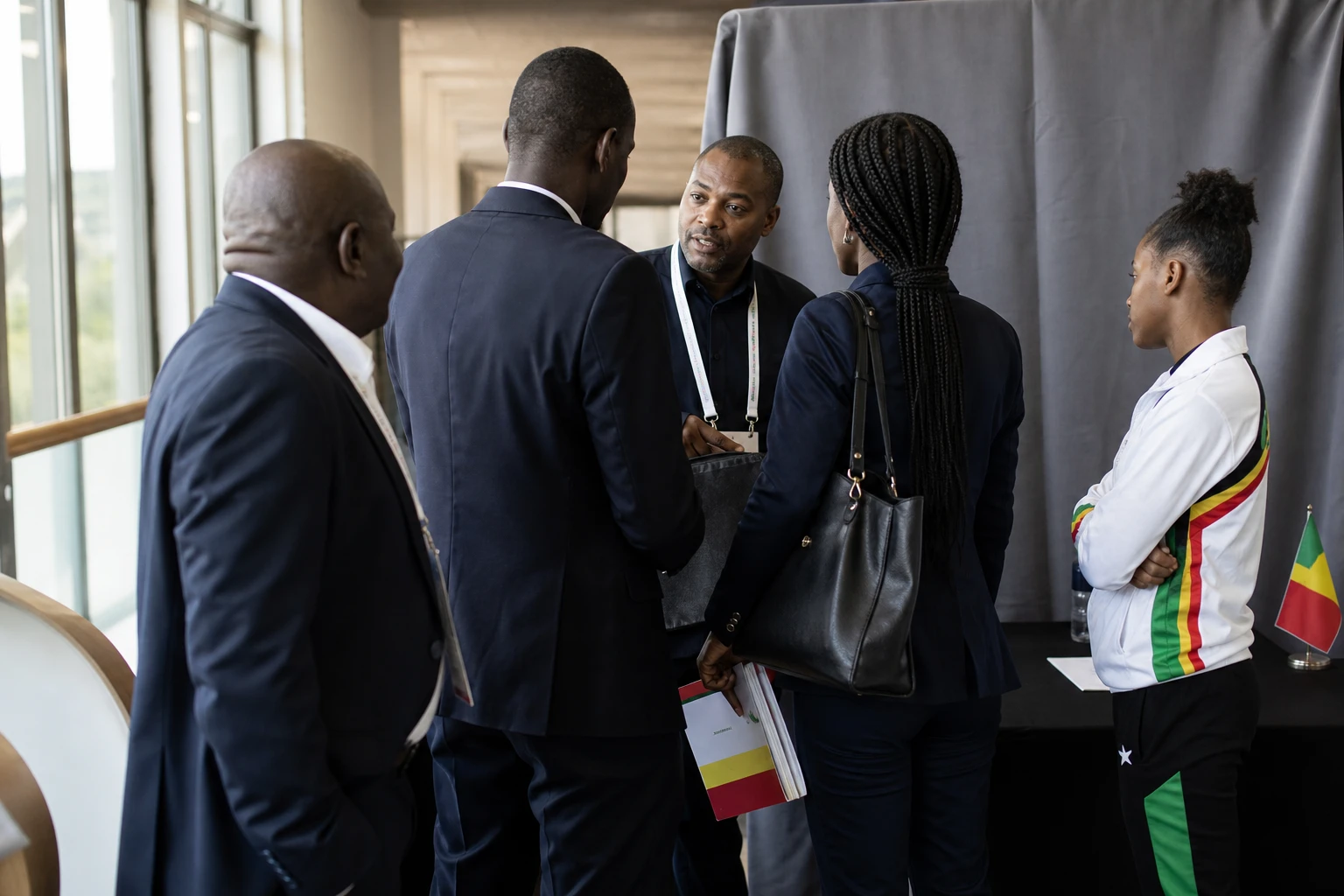
The Beninese delegation left Cotonou on 7 September, according to information corroborated by several Beninese media outlets and the provisional lists published by World Gymnastics. On the official start list, the code BEN appears among the entries in the women’s individual event, with Raissa Gbessinon.
The country is also represented in several aerobic gymnastics formats, a discipline in which gymnasts perform highly codified routines combining strength, flexibility, coordination and rhythm. The official start list confirms Benin’s presence in the events registered by the world governing body.
The names that have featured in Beninese gymnastics for several seasons are not newcomers. Rodrigue Thachégnon Ahissou and Fernand Dieudonné Kitty are among the figures already exposed to African contests and international competitions. Beninese media and sporting bodies note that Kitty was born in Cotonou and that Ahissou has already achieved continental results in aerobic gymnastics.
The facts: a Beninese team entered in several events
According to information provided by the Beninese Gymnastics Federation and reported by the local sports press, Benin is represented in Pamplona by Degnon Raïssa Isabelle Gbessinon in the women’s individual event, by Thachégnon Rodrigue Ahissou in the mixed pair with her, and then in the trio with Armel Junior Gbaguidi and Fernand Dieudonné Kitty. Fernand Dieudonné Kitty is also entered in the men’s individual event. Benin is also listed in the group event with Rodrigue Ahissou, Armel Junior Gbaguidi, Fernand Dieudonné Kitty, Raïssa Isabelle Gbessinon and Précieux Mathias Ahouanmenou.
This appearance comes as the Pamplona World Championships have already published their official entry lists and schedules. World Gymnastics published the provisional registrations in April 2026, followed by the schedule for the senior events in September. The competition is therefore taking place within a well-established framework, with international arrangements finalised several months in advance.
For Benin, the stakes go beyond simply taking part. The country arrives with genuine African experience built over several seasons. In 2024, in Alexandria and then Cairo, Beninese gymnasts achieved notable results at the African Championships, with a medal haul described as one of the country’s strongest in the discipline. The Beninese National Olympic and Sports Committee notably reported 10 medals in Cairo in September 2024.
What this debut means for Beninese sport
The significance of this world debut lies first in the system’s coming of age. When a country enters gymnasts in several formats — individual, pair, trio and group — it shows that it is no longer content with a symbolic presence. It is building a pool of talent. It is also a signal to technical staff: repeated international competitions help refine routines, improve precision and familiarise athletes with the demands of the world stage.
For the athletes, the benefit is immediate. International elite competition exposes weaknesses without sugar-coating them: range of movement, stability of figures, stress management, keeping to the tempo and execution scores. For officials, the value is more strategic. A first appearance at a world championship serves as a showcase, but it also tests the effectiveness of local training, the ability to fund preparation and the continuity of training camps. In a country where competitive sport remains largely concentrated in a few more visible disciplines, aerobic gymnastics is gaining recognition.
This momentum also has a social dimension. It is a reminder that Beninese sport is not limited to football or to the disciplines that dominate television screens. In Porto-Novo and Cotonou, the challenge is to create credible sporting pathways in individual disciplines, which often receive less media coverage but can deliver performance, discipline and careers. Benin has already demonstrated this in aerobic gymnastics at African level; Pamplona must now serve as a benchmark, not a mere interlude.
A significance that extends beyond Benin’s borders
In West Africa, this appearance also matters for ECOWAS, even though the event is sporting. It shows that a country in the region can emerge in technical disciplines often dominated by nations with a long gymnastics tradition. As federations across the continent seek to diversify sporting activities, each Beninese entry at this level broadens West Africa’s sporting map.
The signal is continental too. Benin’s performances in aerobic gymnastics, already visible at African events and a handful of international competitions, illustrate the growing capabilities of small federations that progress in cycles, often with limited resources but producing real results. What comes next will depend on how Benin turns this first world appearance into continuity: schedules, training camps, African competitions and the development of young athletes. That is what will determine the value of a first appearance.