Algeria
 Egypt
 Libya
 Morocco
 Sudan
 Tunisia
 Burkina Faso
 Cabo Verde
 Côte d'Ivoire
 Ghana
 Guinea
 Guinea-Bissau
 Liberia
 Mali
 Mauritania
 Niger
 Nigeria
 Senegal
 Sierra Leone
 The Gambia
 Togo
 Cameroon
 Central African Republic
 Chad
 DR Congo
 Equatorial Guinea
 Gabon
 Republic of the Congo
 São Tomé and Príncipe
 Burundi
 Comoros
 Djibouti
 Eritrea
 Ethiopia
 Kenya
 Madagascar
 Malawi
 Mauritius
 Mozambique
 Rwanda
 Seychelles
 Somalia
 South Sudan
 Tanzania
 Uganda
 Angola
 Botswana
 Eswatini
 Lesotho
 Namibia
 South Africa
 Zambia
 Zimbabwe
In Cotonou, 1 August is about more than a parade
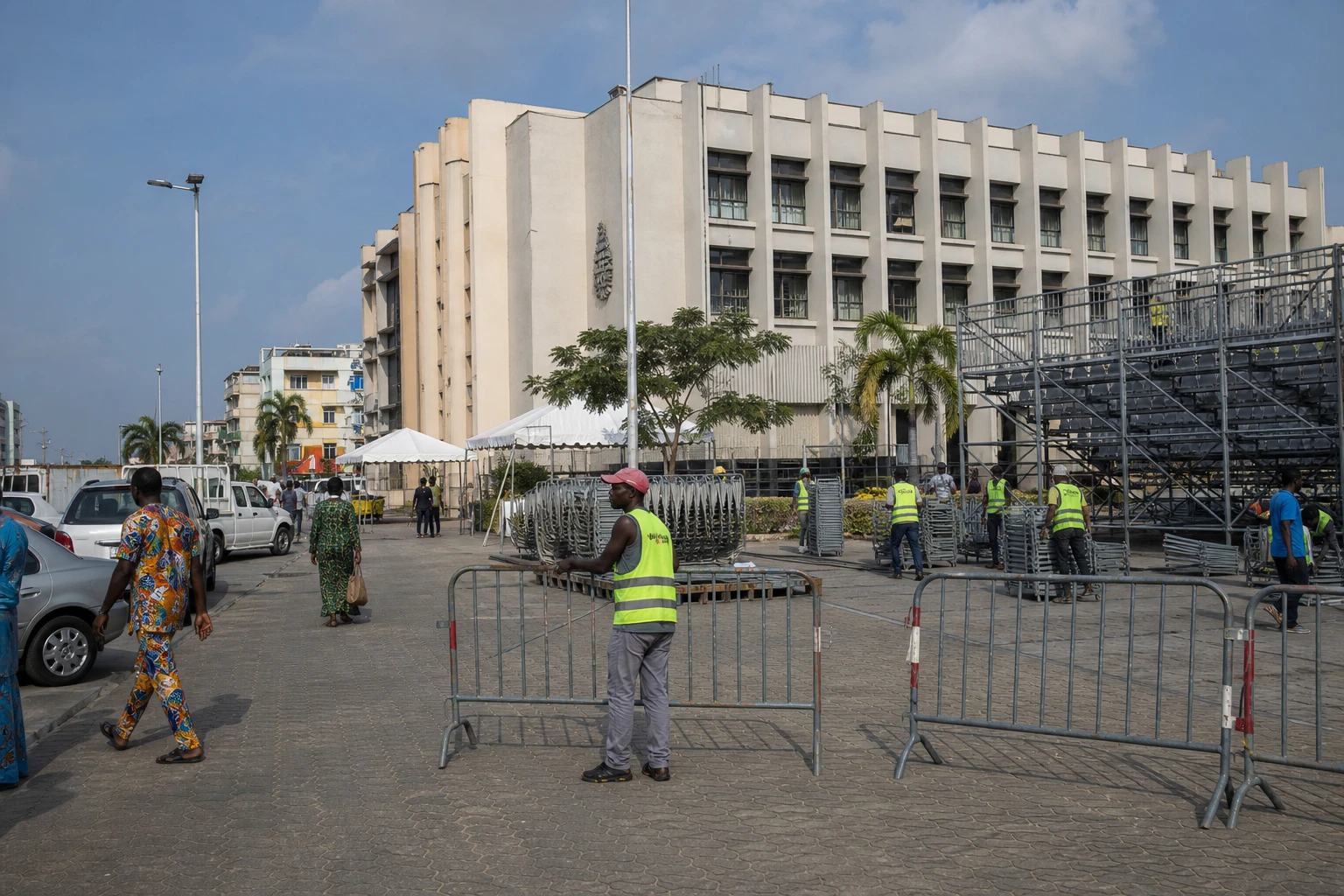
On Boulevard de la Marina in Cotonou, Benin’s national day is never just about the ranks of marchers. It is also reflected in the traffic, stands, barriers, rehearsals and organisation of an urban space that becomes, for a few hours, a showcase for the Beninese state. This year again, the 66th anniversary of independence began well before 1 August, with logistical work starting on 26 June 2026 near the Esplanade de l’Amazone.
The choice is no accident. The boulevard borders several highly symbolic sites in the economic capital, while Porto-Novo remains Benin’s political capital. Yet Cotonou hosts the major civic ceremonies because it carries most of the country’s traffic, services and national visibility. On 1 August, this urban geography becomes a stage for the country.
A plan designed for security, but also to keep the city functioning
The heart of the plan is the installation of stands on Boulevard de la Marina, beside the Esplanade de l’Amazone. The official statement says work began on Friday 26 June 2026 and was expected to disrupt traffic temporarily on this route alone, without affecting Cotonou’s other roads. It also provides for a diversion near the esplanade and temporary use of the section for two-way traffic. Heavy goods vehicles were to avoid the area and take other routes.
The Republican Police then began managing traffic from 1 July, with restrictions announced until 2 August. In the final days before the celebration, traffic was limited from 6am to 3pm between several key points in the city, from Route des Pêches to Avenue Clozel, via Boulevard de la Marina. On the day of the ceremony, access to the relevant perimeter was to be prohibited from midnight to 5pm. In other words, national day here imposes very tangible urban discipline, with the order of the parade relying as much on logistics as on security.
This approach is consistent with the preparations visible on the ground. On 21 July, the Minister of the Interior and Public Security, Djibril Mama Cissé, visited the eastern corniche to observe rehearsals by the Republican Police and Benin Customs. He inspected the progress made by the units due to represent their institutions in the 1 August parade.
The central fact: a civic ceremony involving several branches of the state
According to information published on the eve of the celebration, the independence parade involves 30 platoons, several thousand men and women from the defence and security forces, 47 vehicles and four vessels from the National Navy. This scale explains the advance preparations. It requires rehearsals and close coordination between the forces, municipal services and the operator responsible for event logistics.
Beyond the figures, the message is political in an institutional sense. 1 August remains a moment when the state makes itself visible, not through abstract speech but through the bearing of its units, the precision of their march and the synchronisation of their actions. During his visit on 21 July, the Minister of the Interior stressed the troops’ cohesion, pace and bearing — visible signs of preparations regarded as a matter of public prestige.
This year’s event also has particular significance. Benin’s public-service media note that it is the first national day presided over by Romuald Wadagni since his inauguration on 24 May 2026. In this context, 1 August marks not only a defining date in the country’s history. It is also the new president’s first major civic occasion, in a country where institutional continuity is often expressed through such collective rituals.
What this says about Benin, and what the region is watching
In a West African country that is part of ECOWAS, the 1 August parade goes beyond commemoration. It reflects how a state stages its authority, internal cohesion and the place of its defence forces in public life. In Benin, this scene remains largely urban and concentrated in Cotonou, but it speaks to the whole country by bringing together a shared national memory.
For residents, the impact is mixed. On the one hand, traffic restrictions make daily journeys more difficult, particularly for users of the Port of Cotonou, coastal districts and routes towards the city centre. On the other, entry remains free, and the ceremony continues to attract a large crowd willing to take detours, walk to the site and work around the time restrictions to watch the parade in person. National day therefore remains an occasion for strong public participation, even as the city has to reorganise around it.
At continental level, the image is worth watching. Benin shows how an independence ritual can become a tool for institutional consolidation while remaining an open civic event. In a region where political transitions are sometimes turbulent, the ability to organise a major national occasion with visible procedures, public rehearsals and logistics announced in advance matters as much as the parade itself. Attention now turns to the new government’s next steps, the place given to national symbols and how Cotonou will continue to balance celebration, security and urban mobility in the years ahead.