Algeria
 Egypt
 Libya
 Morocco
 Sudan
 Tunisia
 Burkina Faso
 Cabo Verde
 Côte d'Ivoire
 Ghana
 Guinea
 Guinea-Bissau
 Liberia
 Mali
 Mauritania
 Niger
 Nigeria
 Senegal
 Sierra Leone
 The Gambia
 Togo
 Cameroon
 Central African Republic
 Chad
 DR Congo
 Equatorial Guinea
 Gabon
 Republic of the Congo
 São Tomé and Príncipe
 Burundi
 Comoros
 Djibouti
 Eritrea
 Ethiopia
 Kenya
 Madagascar
 Malawi
 Mauritius
 Mozambique
 Rwanda
 Seychelles
 Somalia
 South Sudan
 Tanzania
 Uganda
 Angola
 Botswana
 Eswatini
 Lesotho
 Namibia
 South Africa
 Zambia
 Zimbabwe
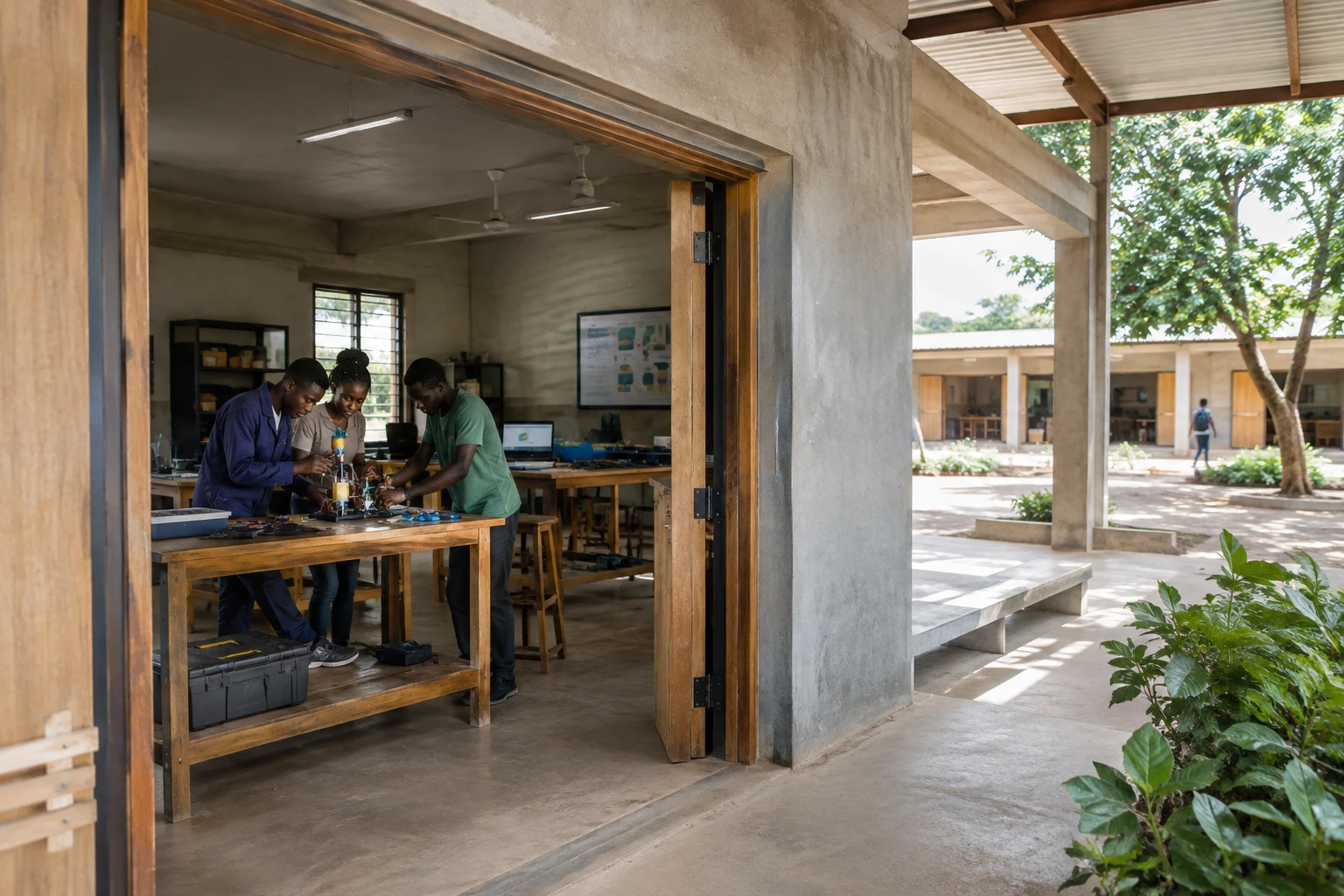
Can an equipped workshop bring innovation closer to young people and small businesses in Benin, beyond the major urban centres? That is the challenge behind the Innobox project, for which the government plans an initial trial in Parakou and Porto-Novo.
Two pilot sites before possible expansion
The Council of Ministers on Wednesday 4 November 2026 authorised the creation of two pilot units, according to information released about the project. This date and the details of the announcement could not be cross-checked against an accessible official report. The project envisages modular buildings fitted out for making, testing and developing technological solutions.
The choice of Parakou and Porto-Novo gives this first phase a different reach from a scheme concentrated in the Littoral. Parakou is a major hub in the north of the country; Porto-Novo, Benin’s political capital, is in the south-east. The government intends to draw lessons from the operation and activities of the two sites before considering an expansion to municipalities.
The Innobox workshops would be open to the public, with priority given to young people. Learning is intended to be hands-on: designing an automatic irrigation system, a flood alert, a voice-controlled lamp or an autonomous robot. In each case, the aim is to turn technical skills into a prototype that meets a local need.
The programme also plans to collect corpora in national languages to contribute to the development of artificial intelligence. These linguistic data can help in designing digital tools suited to local practices. Their collection and use will, however, need to be governed by clear rules on consent, data protection and the sharing of benefits.
Bridging the gap between project founders and resources
The distribution of support organisations is a documented challenge. A mapping published by TechnoServe and available on the website of the Agency for the Development of Small and Medium-sized Enterprises lists 276 organisations, 46% of them in the Littoral department. The document cited in the project refers to at least 278 organisations at the end of 2022: the scope or counting methods may differ, and these figures should not be conflated.
This concentration means that entrepreneurs in other departments may have fewer nearby services for testing an idea, obtaining advice or accessing equipment. Public workshops could help narrow this gap, particularly for young people who cannot travel regularly to the best-resourced support hubs.
But access to a machine is not enough. The mapping also highlights shortcomings in the availability and suitability of equipment, follow-up after it has been provided, and maintenance once funding projects come to an end. For the Innobox workshops to deliver lasting results, it will therefore be necessary to specify who trains users, repairs the tools, pays for consumables and manages access slots.
The ADPME’s 2025-2029 strategic plan, for the public body responsible for supporting small and medium-sized enterprises, also highlights the still-weak links between businesses, higher education and research. The workshops could create opportunities for collaboration. That would, however, require concrete partnerships with universities, craftspeople, local authorities and businesses, rather than simply making premises available.
Viability will matter as much as equipment
Tenders listed in September and October 2026 concern the Innobox business model and support for implementing the programme. These steps indicate that the question of sustainability has already been identified. They do not, on their own, confirm the opening timetable or final budget for the two sites.
Success will be measured less by the number of machines installed than by their regular use and the projects able to progress beyond prototyping. A useful scheme must allow teams to improve an initial version, find complementary skills and, if the solution works, move towards viable production or a viable service.
The effects will not be the same for everyone. Young people in training may gain practical experience; small businesses may be able to test tools without bearing their cost alone; residents may contribute to defining local solutions. By contrast, restricted opening hours, high fees or opaque selection could reserve access for those already well connected.
A skills challenge beyond the two municipalities
The project is part of a broader movement: West African states are seeking to develop digital skills and foster businesses capable of meeting the needs of their markets. ECOWAS, the regional economic community of fifteen West African states, provides a framework for co-operation, but results will depend first and foremost on the quality of national policies and links between education, research and the economy.
For Benin, the next step will be to make the lessons from the two sites visible: user profiles, projects undertaken, equipment availability and continuity of funding. These factors will show whether the model can be adapted to the realities of other municipalities. The ambition of a national network will take shape only if the workshops remain accessible, maintained and connected to institutions that can support ideas through to implementation.