Algeria
 Egypt
 Libya
 Morocco
 Sudan
 Tunisia
 Benin
 Burkina Faso
 Cabo Verde
 Côte d'Ivoire
 Ghana
 Guinea
 Guinea-Bissau
 Liberia
 Mali
 Mauritania
 Niger
 Nigeria
 Senegal
 Sierra Leone
 The Gambia
 Togo
 Central African Republic
 Chad
 DR Congo
 Equatorial Guinea
 Gabon
 Republic of the Congo
 São Tomé and Príncipe
 Burundi
 Comoros
 Djibouti
 Eritrea
 Ethiopia
 Kenya
 Madagascar
 Malawi
 Mauritius
 Mozambique
 Rwanda
 Seychelles
 Somalia
 South Sudan
 Tanzania
 Uganda
 Angola
 Botswana
 Eswatini
 Lesotho
 Namibia
 South Africa
 Zambia
 Zimbabwe
A transfer that goes beyond the transfer window
When a player born in Douala joins one of Europe’s most scrutinised clubs, the story is not just an English one. It also says something about Cameroonian football: its training centres, its export pathways, and the value of a midfielder developed away from the spotlight before being honed at the highest level in Europe. Carlos Baleba, 22, belongs to the rare category of footballers whose moves carry both sporting ambitions and symbolic weight.
The deal is part of a broader sequence of events. Manchester United officially announced the arrival of the Cameroonian from Brighton & Hove Albion on Tuesday, 25 August 2026. British media initially reported a package worth up to £70 million, or about $95 million, including a fixed fee and bonuses. The English club later confirmed that he had signed a contract running until June 2031, with an option for a further year.
From a Douala neighbourhood to Old Trafford
Baleba did not get here by chance. Sources at LOSC, Brighton and the Manchester club point to the same path: Futur Soccer in Douala, then the École de Football des Brasseries du Cameroun, followed by spells at Lille and Brighton. His journey demonstrates the strength of a Cameroonian ecosystem that is often underestimated, in which private academies play a decisive role in nurturing talent.
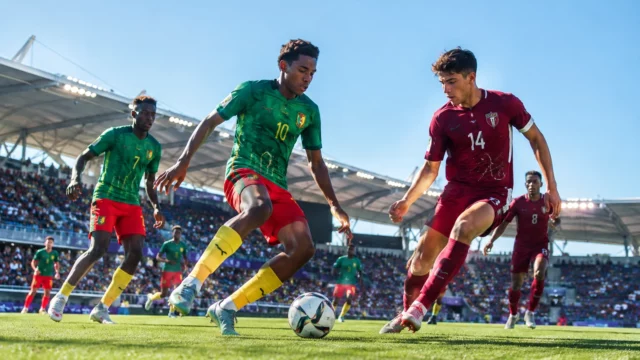
Cameroon is not just sending individual players to Europe. It is also exporting a midfield culture: physicality, running capacity, reading of the game and mobility. Brighton recently said that Baleba had played 31 Premier League matches in the 2025-2026 season, with high statistics for tackles, interceptions and second-ball recoveries. Manchester United presents the same profile as a player already accustomed to the intensity of English football, but with room to improve.
The Yaoundé club that oversees national football policy is central to this picture. FECAFOOT, whose headquarters are in Yaoundé, sees players trained locally leave for Europe, while the national team seeks to build a competitive squad for its upcoming fixtures. Baleba first wore the Indomitable Lions shirt in June 2024, in Cameroon’s 4-1 win over Cape Verde in qualifying for the 2026 World Cup.
What this move means for Cameroon
On the pitch, Manchester United are buying a player who can win the ball back, carry it forward and press. That is precisely what advanced data reports highlight in Baleba: strong activity when possession is lost, as well as the ability to carry the ball and win duels in central areas. For Brighton, the sale confirms a now well-established English model: recruit early, develop players, then sell them for a very high fee. For United, the deal addresses a more immediate need. The Manchester club’s midfield has been disrupted by injuries and successive reshuffles, and the club has sought to stabilise the centre of the pitch before the start of the season.
For the Cameroonian, the stakes are twofold. He is reaching a new level in terms of salary and sport. But he also faces new pressure: that of high-profile transfers, where success is measured not only by the number of matches played, but by the ability to set the tempo, withstand comparisons and meet immediate expectations. At Manchester United, every pass, every interception and every mistake becomes a talking point. This is all the more true for a young African player signed for a high fee, because outside observers are too quick to reduce his career to his price tag.
For Cameroon’s football economy, the signal is broader. The value generated by a player from a Douala academy shows that the development chain is in place: local training, a spell at a stepping-stone club in Europe, then a move to a continental giant. This chain benefits the country’s image, but it also raises a more concrete question: how can talent be better retained, supported and monetised before players leave? Centres such as the EFBC have demonstrated their ability to produce top-level players. The question is whether the league and national structures can eventually capture a greater share of that value.
A significance that goes beyond one player
The transfer resonates beyond Cameroon. Across Central Africa, academies, development clubs and national teams are watching these career paths closely. A player’s journey from Douala to Manchester is not an isolated exception; it illustrates a structural trend in contemporary African football, where training often takes place on the continent while financial value is still realised in Europe. This long-standing imbalance fuels both sporting pride and debate about the autonomy of training pathways.
The Cameroon national team is also looking further ahead. The Indomitable Lions remain in contention for the 2026 World Cup, with decisive qualifying matches in a fiercely contested group. In this context, seeing a potential key player establish himself at a club competing at the top of European football could affect his standing internationally. For Yaoundé, it is good news for sport. For the continent, it is a reminder: African talent is plentiful, but building structures to capture its value remains one of the major challenges facing modern football.
In the short term, Cameroon will therefore be following two paths in parallel: Baleba’s at Old Trafford, and that of a generation of Cameroonian players continuing to put the country on the map in Europe’s major leagues, while reminding everyone that the foundations of this success are built first in Douala, Yaoundé and the country’s training centres.