Algeria
 Egypt
 Libya
 Morocco
 Sudan
 Tunisia
 Benin
 Burkina Faso
 Cabo Verde
 Côte d'Ivoire
 Ghana
 Guinea
 Guinea-Bissau
 Liberia
 Mali
 Mauritania
 Niger
 Nigeria
 Senegal
 Sierra Leone
 The Gambia
 Togo
 Cameroon
 Central African Republic
 Chad
 DR Congo
 Equatorial Guinea
 Gabon
 Republic of the Congo
 São Tomé and Príncipe
 Burundi
 Comoros
 Djibouti
 Eritrea
 Ethiopia
 Kenya
 Madagascar
 Malawi
 Mauritius
 Mozambique
 Rwanda
 Seychelles
 Somalia
 South Sudan
 Tanzania
 Uganda
 Botswana
 Eswatini
 Lesotho
 Namibia
 South Africa
 Zambia
 Zimbabwe
A long coastline, an economy under pressure
In Angola, the sea is more than a border. It generates part of the government’s revenue, accounts for a decisive share of exports and underpins many of the country’s ambitions to diversify. Against this backdrop, strengthening surveillance of its waters is less a symbolic gesture than a very practical economic calculation: protecting offshore zones, trade routes and fishing activities without tying up costly human resources at sea.
The country has an Atlantic coastline of about 1,650 kilometres and a maritime surveillance network that has expanded in recent years. In January 2024, Luanda inaugurated the National Maritime Coordination and Surveillance Centre, designed to work with other surveillance points along the coast, notably in Soyo, Lobito and Namibe. This forms part of Angola’s strategy to secure its blue economy, as the country remains heavily dependent on offshore oil activity.
Six unmanned helicopters delivered to Luanda
On 2 September, six HT-100 Naval unmanned helicopters were officially delivered to the Angolan Navy following trials and checks. The batch also includes electro-optical and infrared sensors, as well as maritime control stations. The manufacturer describes the aircraft as a long-endurance naval platform capable of operating for up to six hours and travelling up to 600 kilometres in its maritime configuration.
Beyond the technical specifications, the operational value is clear. The drones are intended to expand the Angolan Navy’s intelligence, surveillance and reconnaissance capabilities, while reducing the need to use crewed helicopters or patrol boats for some long-duration missions. The logic is simple: see further, stay longer over a sensitive area and respond more quickly in the event of an alert.
The system must also perform in rough seas. The HT-100 Naval is designed for radar-guided autonomous landing, an important feature for a navy seeking to secure platforms, shipping lanes and support points exposed to the conditions of the South Atlantic. In a coastal economy, technology is never abstract: it determines whether assets are actually available when needed.
Protecting revenue from the sea
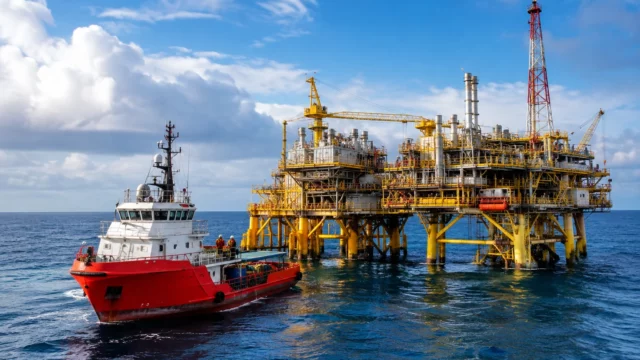
Angola’s maritime domain is home to interests that extend well beyond defence. The International Monetary Fund says oil accounts for about 94% of the country’s exports and 60% of government revenue. In such a system, maritime surveillance serves first to protect a strategic source of income, but also to limit the risks of sabotage, cargo theft, unauthorised incursions or incidents around offshore facilities.
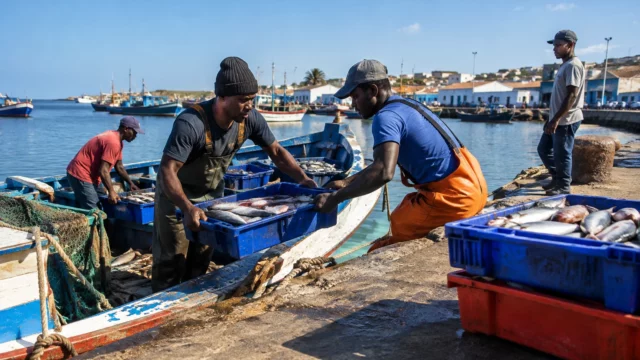
The fisheries sector is also crucial. The authorities say it contributes 3% of national GDP and directly employs more than 150,000 people. For 2025, they projected fisheries production of 723,419 tonnes, with a target of meeting 96% of domestic consumption. These figures give an idea of the risks: a surveillance gap affects more than the military coastline; it can threaten the livelihoods of thousands of families and the supply of the local market.
Ports are similarly dependent on the smooth flow of maritime traffic. The Port of Luanda said it handled 17.79 million tonnes of cargo in 2025, while the Port of Lobito reported 1.5 million tonnes in 2024 and an increase in activity in the first half of 2025. In Luanda, vessel traffic rose by 23% year on year, according to data published by the port authority, with a large share made up of oil-related support vessels. Securing the waters therefore also means safeguarding the logistics chain linking the capital, secondary ports and the hinterland.
A broader naval modernisation programme
The delivery of the six drones is just one part of a wider naval programme, announced at about $1.2 billion. Angola has also begun construction of three BR71 Mk II-class corvettes. The first, the NRA Ekuikui II, was launched in Cherbourg on 4 March 2026. The vessels complement the drones: one observes and raises the alarm, while the other provides an armed and sustained presence.
This expansion builds on an institutional foundation already in place. The maritime surveillance centre inaugurated in Luanda in 2024 is tasked with coordinating the protection of maritime resources and the security of communications. It is also expected to work with the national search-and-rescue system, aligned with the International Maritime Organization’s instruments for 2025-2029. In other words, Angola is not simply buying equipment; it is trying to build a chain of command, detection and response.
The signal for Southern Africa is clear. In a region where maritime trade, offshore hydrocarbons and port corridors are becoming increasingly important, maritime security is a tool of competitiveness as well as sovereignty. Angola, a member of SADC, is moving into an area that several coastal states are watching closely: how to strengthen protection without excessively increasing operating costs, and how to make maritime surveillance serve the real economy, from Luanda to provincial ports.