Algeria
 Egypt
 Libya
 Morocco
 Sudan
 Tunisia
 Benin
 Burkina Faso
 Cabo Verde
 Côte d'Ivoire
 Ghana
 Guinea
 Guinea-Bissau
 Liberia
 Mali
 Mauritania
 Niger
 Nigeria
 Senegal
 Sierra Leone
 The Gambia
 Togo
 Cameroon
 Central African Republic
 Chad
 DR Congo
 Equatorial Guinea
 Gabon
 Republic of the Congo
 São Tomé and Príncipe
 Burundi
 Comoros
 Djibouti
 Eritrea
 Ethiopia
 Kenya
 Madagascar
 Malawi
 Mauritius
 Mozambique
 Rwanda
 Seychelles
 Somalia
 South Sudan
 Tanzania
 Uganda
 Angola
 Botswana
 Eswatini
 Lesotho
 Namibia
 South Africa
 Zambia
 Zimbabwe
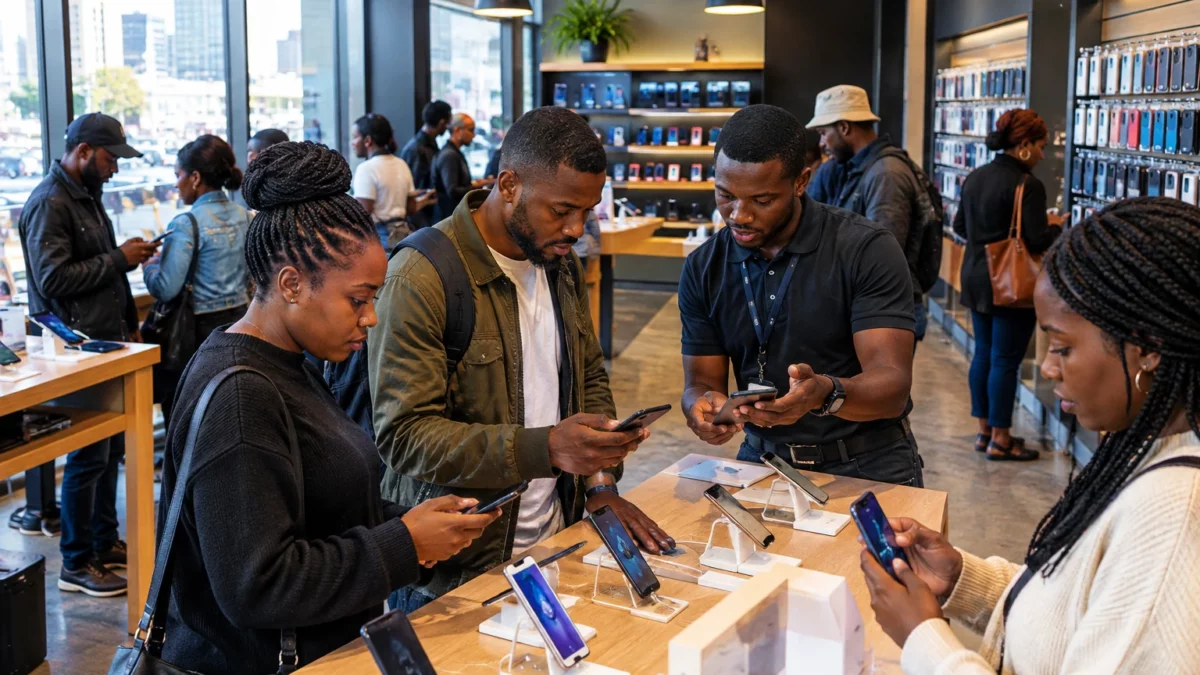
A mobile mast can serve a village without its residents being able to connect. In Africa, this gap between network availability and actual use remains one of the main challenges of digital transformation.
The GSMA’s Digital Africa Index 2026 highlights this dual reality: several countries are strengthening their digital policies, but a large share of the population remains distant from online services. The index covers 54 countries and compares, among other things, the development of digital use and the policies governing the sector.
Ten countries in the leading group, with different trajectories
The report, published on 18 November 2026 in Cape Town, identifies ten countries that score above 50 out of 100 for both digital development and their policy and regulatory environment. Egypt, Ghana, Nigeria, Rwanda, Senegal, Seychelles and Tunisia have joined Kenya, Mauritius and South Africa. In 2024, only three African countries met both criteria, according to the results presented by the GSMA.
These indicators do not constitute an overall ranking of digital quality of life. The DNSI measures the integration of technologies into society and the economy, particularly among consumers, businesses and public administrations. The DPRI examines sector policies and rules. A high score in both areas therefore signals joint progress, but does not mean that all residents already benefit from affordable access.
South Africa and Kenya have the highest digital development scores, at 69 and 65 points respectively. In terms of regulation, Egypt and Ghana have made the strongest gains since 2024: each has added more than ten points to its DPRI score. The GSMA links these developments to measures relating in particular to cybersecurity, radio spectrum management, consumer protection and digital inclusion.
The cost of a phone weighs on access
Regulation is not limited to operators’ licences. Taxes on devices can also determine who is able to connect. In South Africa, a 9% excise tax on smartphones sold for less than 2,500 rand was abolished in April 2025. The GSMA says monthly sales of entry-level models rose from about 250,000 units in March 2025 to nearly 460,000 in February 2026, an increase of around 80%.
This national trend does not, on its own, prove that the tax reform explains the entire increase in sales. It does, however, illustrate a practical lever: reducing purchase costs can make it easier to acquire a device, especially for households unable to pay for a phone upfront. The GSMA recommends reviewing levies that make affordable devices more expensive and expanding financing options.
The continental picture remains mixed. Of the 54 countries studied, nine reportedly levy neither a sector-specific tax nor import duty on mobile phones, compared with ten in 2024, according to the report. Tax policies vary from country to country, as do incomes, markets and purchasing power. A measure that works in one country therefore cannot automatically be applied across the continent.
Coverage alone is not enough to drive use
At the end of 2025, mobile broadband networks covered 92% of Africa’s population, but only 28% of residents used mobile internet on their own device. The GSMA estimates the usage gap at 64%: this is the share of the population covered by a mobile broadband network but not using mobile internet. These figures, published in the index, have also been reported by African specialist media.
The cost of smartphones and data matters, but does not explain everything. Digital skills, the availability of relevant content and trust in services also influence adoption. Barriers do not manifest in the same way everywhere: rural areas may suffer from poorer connection quality, while low-income urban households may live within network coverage but be unable to afford the regular cost of data.
For small businesses, mobile access can make payments, communication with customers and order management easier. But these uses require a functioning device, a reliable connection and suitable services. Network expansion is therefore a necessary condition, not a guarantee of participation in the digital economy.
Online public services still face the test of everyday use
The report also stresses that putting an administrative service online does not necessarily make it accessible. An unstable connection, an interface in a language users do not know well, or a process that still requires a visit to a counter can bring an application to a halt. The GSMA groups the barriers under access, the usefulness of services, trust and public accountability, inclusion, and coordination between public administrations.
It urges governments to measure applications actually completed and user satisfaction, rather than simply counting the services available online. Services in local languages, better data protection and secure interoperability between identity, payment and information-sharing systems are also among the proposed measures.
The issue concerns the design of platforms as much as their governance. Linking public records can simplify an application, but requires safeguards for security, users’ rights and the responsibilities of public administrations. Trust cannot be decreed by putting a form online.
A national issue that calls for regional cooperation
The ten countries highlighted do not form a homogeneous group. Their priorities differ, as do their institutions and markets. Yet their results can inform discussions among African governments and regulators on device costs, spectrum rules and digital public services.
Across the continent, the challenge is to turn investment in networks into access that is genuinely useful, without confusing coverage with inclusion. The next stage will depend on implementation: changes to taxes, the quality and price of connections, services accessible in users’ languages and effective data protection. The impact of the regulatory progress identified by the GSMA will be measured by these tangible results.