Algeria
 Egypt
 Libya
 Morocco
 Sudan
 Tunisia
 Benin
 Burkina Faso
 Cabo Verde
 Ghana
 Guinea
 Guinea-Bissau
 Liberia
 Mali
 Mauritania
 Niger
 Nigeria
 Senegal
 Sierra Leone
 The Gambia
 Togo
 Cameroon
 Central African Republic
 Chad
 DR Congo
 Equatorial Guinea
 Gabon
 Republic of the Congo
 São Tomé and Príncipe
 Burundi
 Comoros
 Djibouti
 Eritrea
 Ethiopia
 Kenya
 Madagascar
 Malawi
 Mauritius
 Mozambique
 Rwanda
 Seychelles
 Somalia
 South Sudan
 Tanzania
 Uganda
 Angola
 Botswana
 Eswatini
 Lesotho
 Namibia
 South Africa
 Zambia
 Zimbabwe
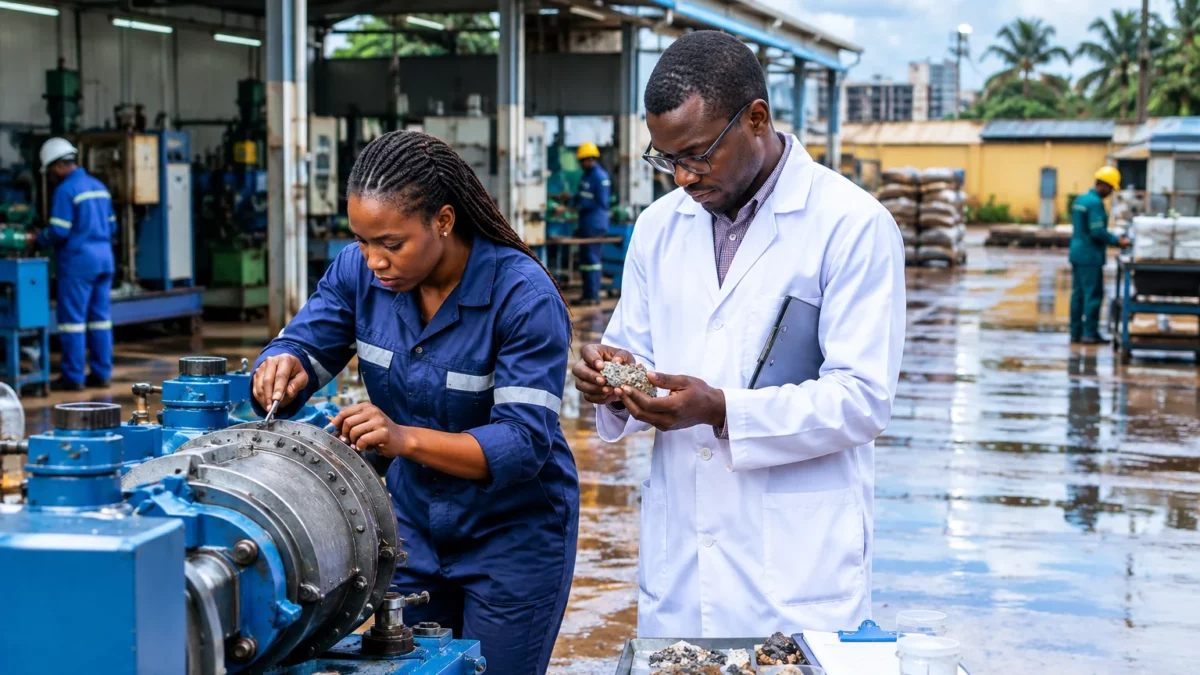
Can an Ivorian laboratory help a company struggling to mechanise production or process a local raw material? In Côte d’Ivoire, a new initiative aims to bring these two worlds closer together. Its goal goes beyond research: it is also about developing solutions that can be used by the country’s industries and value chains.
From business needs to a research programme
On 24 November 2026, in Abidjan, officials presented ten priority pilot projects under a 36-month action plan. The Ivorian News Agency (AIP) reports that the initiative is based on a study conducted by the ministries responsible for industry and research, with support from German cooperation. The study figures available here are attributed to that report; no second independent publication has been found to confirm them.
The survey reportedly identified 95 needs among businesses, professional organisations, support institutions and research bodies in five cities. It is said to have involved around 40 businesses, 16 organisations or institutions and 19 research bodies. Of the needs identified, 68 related to research and development and innovation. These were grouped into 38 collaborative projects: 25 planned for the short term, within 18 months, and 13 over a period of 18 to 36 months.
The areas cited include mechanisation, quality, digital technology, energy, the development of new products and the use of local raw materials. However, the published information does not detail the content of the ten selected priorities, their budgets or the final selection process. Their announcement therefore marks a programming milestone, not proof that the projects are funded or already under way.
The journey from laboratory to workshop still needs organising
This initiative addresses a familiar challenge: researchers and businesses do not always work at the same pace or towards the same goals. A company is often looking for a productivity gain or a quick solution to a specific problem. A laboratory, by contrast, needs to develop and validate its work, sometimes over a longer period. Bringing the two together therefore requires common rules, clearly defined responsibilities and resources to test solutions in real-world conditions.
In June 2025, the Fund for Science, Technology and Innovation (FONSTI) had already highlighted the protection and use of scientific results. Together with the Ivorian Intellectual Property Office and the Ivorian Society for the Use of Research Data, it organised training for researchers on patents, technology transfer and mechanisms for protecting innovations. This work offers a practical example of the skills needed to turn a discovery into a product, process or service.
Contracts are just as important. Who pays for testing? Who owns the rights to an innovation developed jointly? Who can manufacture or market it? Late answers to these questions can undermine a partnership, even when the company and research team share the same goal. It will therefore be important to see whether the pilot plan provides legal support and intellectual property rules from the start of the projects.
A broader trend, but separate initiatives
The project announced in November is part of a broader interest in collaborative research in Côte d’Ivoire. In September 2026, the Connect Initiative, led by CIRAD and IRD, brought together ten consortia of researchers and socio-economic stakeholders in Abidjan. These teams are working on issues such as making use of agricultural waste, preserving fresh produce, water and biosecurity in fish farming. This initiative is separate from the industrial plan presented in November: the two announcements should not be confused, but they show that several actors are seeking to develop projects around problems identified by value chains.
For businesses, the value of the initiative will be measured by how useful the solutions are and how much they cost to adopt. A technology may improve quality or reduce losses without being accessible to small processing units. Large companies generally have more resources to experiment; small and medium-sized enterprises, cooperatives and informal economy operators may need suitable equipment, training or shared access to facilities. Taking these disparities into account will be crucial if the benefits are not to remain concentrated in a few organisations.
For researchers, working with industry can open up opportunities for experimentation and give their work economic relevance. But it requires time, equipment and predictable funding. Results will also need to be assessed on more than the number of projects launched: productivity gains, improved quality, increased local processing, jobs created or benefits for suppliers and producers. The presentation report does not yet specify which indicators will be used to monitor the ten priorities.
A competitiveness challenge for Côte d’Ivoire and the region
Côte d’Ivoire, whose political capital is Yamoussoukro, is seeking to strengthen local processing and the competitiveness of its value chains. In the Economic Community of West African States (ECOWAS), businesses operate in regional markets where the ability to produce, process and guarantee quality can influence their growth. Solutions developed through Ivorian research could therefore be of interest beyond the domestic market, provided they are reliable, affordable and suited to the needs of other countries.
The significance of the announcement will now depend on very concrete decisions: publication of the ten selected projects, available budgets, responsible partners and an implementation timetable. It will also be important to know how results will be shared between laboratories and businesses, and what role will be given to smaller organisations. The 36-month plan sets a timeframe; its success will be judged by its ability to turn the identified priorities into solutions that Ivorian businesses actually adopt.