Algeria
 Egypt
 Libya
 Morocco
 Sudan
 Tunisia
 Benin
 Burkina Faso
 Cabo Verde
 Côte d'Ivoire
 Ghana
 Guinea
 Guinea-Bissau
 Liberia
 Mali
 Mauritania
 Niger
 Nigeria
 Senegal
 Sierra Leone
 The Gambia
 Togo
 Cameroon
 Chad
 DR Congo
 Equatorial Guinea
 Gabon
 Republic of the Congo
 São Tomé and Príncipe
 Burundi
 Comoros
 Djibouti
 Eritrea
 Ethiopia
 Kenya
 Madagascar
 Malawi
 Mauritius
 Mozambique
 Rwanda
 Seychelles
 Somalia
 South Sudan
 Tanzania
 Uganda
 Angola
 Botswana
 Eswatini
 Lesotho
 Namibia
 South Africa
 Zambia
 Zimbabwe
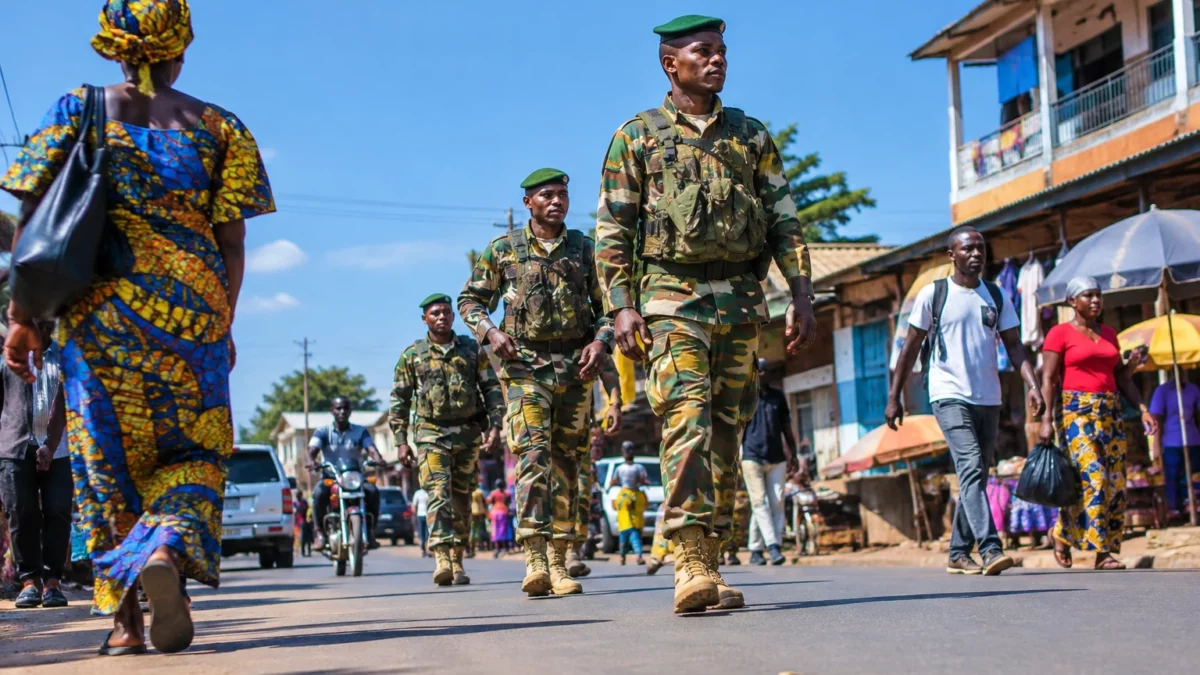
Strengthening a national army is not measured only by the equipment it buys. For Central Africans, the question is also whether the forces will be able to protect people far from Bangui, with sustainable resources and effective public oversight.
A five-year programme to be funded
On 23 November 2026, the Central African National Assembly adopted the military programming law covering the period 2026–2030. The text provides for an allocation of 662.09 billion CFA francs, or about $1.1 billion, according to Radio Lengo Songo, a Central African media outlet that reported the amount and the vote.
This sum is a multi-year forecast, not proof that the funds are already available. Implementation will depend on the appropriations actually included in annual budgets, state revenues and funding mobilised. Publicly available information does not yet detail the spending timetable item by item or how it will be distributed among regions.
The programme is intended to fund personnel training, improve equipment and develop defence infrastructure. The Ministry of Defence presents this plan as a means of strengthening the operational capacity of the Central African Armed Forces (FACA) and building a professional army.
A programming law sets objectives and a course of action over several years. It does not, by itself, guarantee that planned spending will be carried out. To measure progress, it will therefore be necessary to track the budgets approved each year, recruitment and training completed, and the actual availability of equipment.
A security transition does not mean an end to international support
The Central African Republic is emerging from several years of armed conflict and severe instability. The situation has improved on some fronts, but border areas remain exposed to violence and the movement of armed groups. Conditions are particularly precarious in the north-east, south-east and parts of the north-west, according to information presented by the head of MINUSCA to the Security Council on 20 October 2026.
The conflict in neighbouring Sudan is adding pressure on localities in the east and north-east. Risks affect residents of border areas, as well as transport routes, mining sites and corridors used by herders. In these areas, security depends as much on the presence of forces as on their ability to respond, protect civilians and work with local authorities.
The UN mission in the Central African Republic, MINUSCA, supports civilian protection and stabilisation, among other things. The Security Council renewed its mandate on 12 November 2026 until 15 November 2027. It set a ceiling of 12,000 for its authorised military personnel. This change accompanies a gradual transfer of responsibilities to the Central African state; it does not mean the mission is leaving immediately.
This distinction matters. National authorities must gradually take on more tasks, while the United Nations maintains its presence in a context where state capacity varies across regions. The transfer cannot therefore rely on an administrative timetable alone: it also depends on security on the ground and the resources available.
Turning appropriations into tangible security
In Bangui, where the main institutions are concentrated, the effects of military reinforcement may be more visible. Needs are different in rural and remote areas: mobile units, communications equipment, maintenance of roads and equipment, and coordination with civilian services. The programme will have to address these varied realities without reducing defence to the purchase of matériel.
Training and discipline within the forces will also affect the outcome. A better-equipped army does not automatically guarantee better protection for residents. Trust also depends on personnel conduct, clear lines of responsibility between the army and internal security forces, and mechanisms to prevent abuses and handle complaints.
Funding is just as central. An allocation announced for five years will have to be reconciled with other public spending and converted into appropriations that are actually spent. Transparency around contracts, procurement, deliveries and maintenance would help verify that resources are producing usable capabilities, rather than equipment that is difficult to maintain.
The law also comes after the completion, in April 2026, of the electoral cycle that began in 2025 and included legislative, regional and municipal elections. This political milestone does not resolve security challenges, but it is a reminder that state consolidation involves several institutions. Defence is part of a broader system that also includes local administration, justice and public services.
A challenge for Central Africa
Regional stability in the Central African Republic matters in particular because of its borders with Sudan, Chad, Cameroon, the two Congos and South Sudan. Conflict-driven displacement and the cross-border movement of armed groups do not stop at national boundaries. Cooperation with neighbouring countries and Central African regional frameworks therefore remains important, alongside the role of the African Union and the United Nations.
The programme’s significance will be judged less by its announced amount than by its implementation. Future budgets will have to show which objectives are funded and what results are achieved. MINUSCA’s presence until November 2027 provides a horizon for the transition, but the handover will depend on sustainable national capabilities and security that also benefits people far from the capital.