Algeria
 Egypt
 Libya
 Morocco
 Sudan
 Tunisia
 Benin
 Burkina Faso
 Cabo Verde
 Côte d'Ivoire
 Guinea
 Guinea-Bissau
 Liberia
 Mali
 Mauritania
 Niger
 Nigeria
 Senegal
 Sierra Leone
 The Gambia
 Togo
 Cameroon
 Central African Republic
 Chad
 DR Congo
 Equatorial Guinea
 Gabon
 Republic of the Congo
 São Tomé and Príncipe
 Burundi
 Comoros
 Djibouti
 Eritrea
 Ethiopia
 Kenya
 Madagascar
 Malawi
 Mauritius
 Mozambique
 Rwanda
 Seychelles
 Somalia
 South Sudan
 Tanzania
 Uganda
 Angola
 Botswana
 Eswatini
 Lesotho
 Namibia
 South Africa
 Zambia
 Zimbabwe
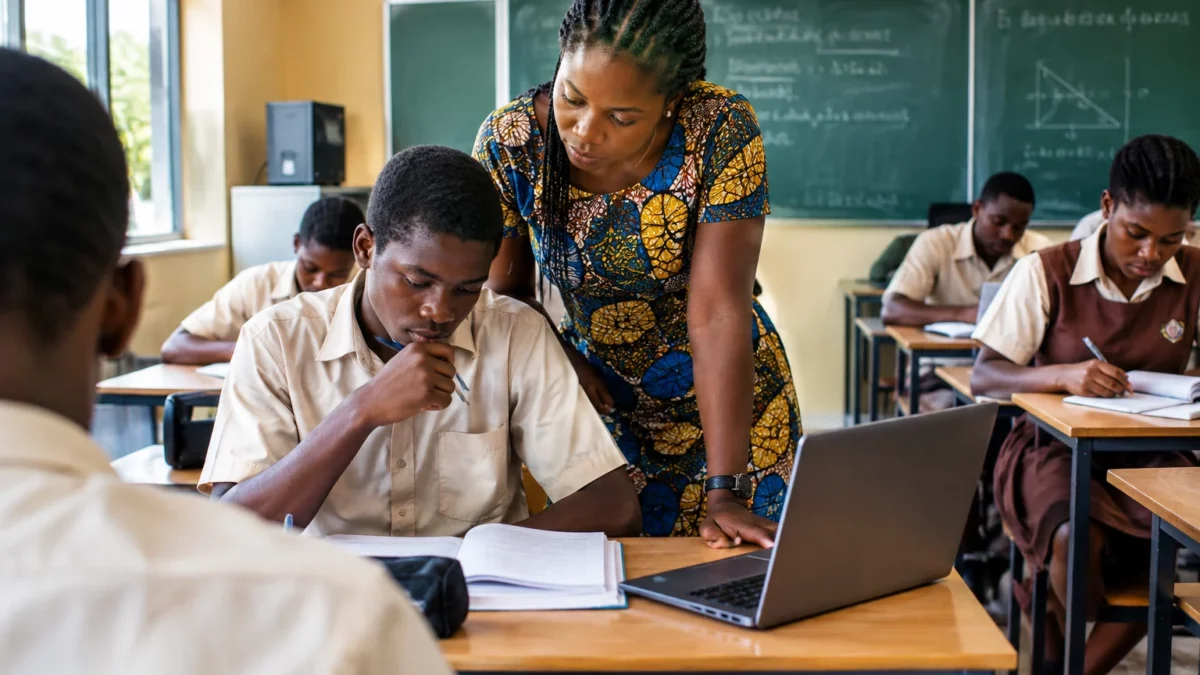
Introducing artificial intelligence in schools is not simply a matter of adding a subject to the curriculum. In Ghana, the challenge is also to define who can use these tools, under what conditions and with what protections for pupils.
A roadmap still to be drawn up
In Accra, National Education Week and the Evidence Summit brought together public officials, teachers, researchers and civil society organisations on 23 and 24 November 2026. Discussions are focused on the use of AI in education and are intended to contribute to a national roadmap for 2027–2030, as well as guidelines on ethics and data privacy. These documents are being prepared: the framework papers do not yet set out adopted rules or definitive conclusions. The programme for the summit on AI in education in Ghana details the expected role of research and technical discussions.
Education Minister Haruna Iddrisu advocates technology that supports teachers’ work without replacing them. He also warns that excessive reliance on it could weaken pupils’ critical thinking, creativity and problem-solving skills. This approach puts intellectual independence at the heart of the debate, beyond simply familiarising pupils with digital tools. The Ghanaian Ministry of Information’s report confirms these priorities and says the curriculum review is still awaiting Cabinet approval.
Revised curricula, but implementation still to be clarified
The proposed curriculum covers children from kindergarten to Primary Six. It plans to incorporate artificial intelligence, robotics, coding and electronics. This is a proposed reform, not teaching that is already widespread in schools. The distinction matters: political approval, teaching guidelines and an implementation timetable have yet to be established.
The review is part of a broader undertaking. In July, the National Council for Curriculum and Assessment submitted a revised curriculum to the ministry, following work carried out between March and July 2026. The Ghana News Agency reports that the committee addressed concerns including literacy, numeracy and curriculum overload raised by teachers. It recommended gradual, adequately funded training, as well as a monitoring system. The Ghana News Agency’s report on the revised curriculum notes that the proposal must still go through the institutional process before implementation.
This context raises a practical question: how can technological learning be added without reducing the time devoted to core subjects? AI can help prepare lessons, adapt teaching materials or design exercises. But its usefulness depends on pupils’ ability to understand content, check answers and learn without delegating all their thinking to a machine.
Teachers are key to change
An initiative in Kumasi offers a glimpse of training needs. On 8 May 2026, nearly 200 science and mathematics teachers from 35 senior high schools took part in a two-day workshop on the educational and ethical uses of AI. Activities covered lesson preparation, assessments and adapting resources for pupils, among other topics. Kwame Nkrumah University of Science and Technology describes the workshop in Kumasi. A one-off initiative, however, is not enough to establish the needs of all schools in the country.
UNESCO’s framework can serve as a reference point without dictating Ghana’s choices. Published in 2024, it defines 15 teacher competencies across five areas: a human-centred approach, ethics, understanding and using AI, pedagogy and professional development. It sets out three levels of progression, from acquiring basic knowledge to developing more advanced uses. UNESCO’s AI competency framework for teachers also stresses that training cannot deliver results without access to tools, data protection and time for professional development.
The effects will not be the same everywhere. Schools in Accra or Kumasi may have more regular access to the internet and equipment than schools far from major centres. Teachers in public schools will need resources and support suited to their working conditions. For families, children’s data protection and inequalities in access to devices will also be decisive.
A national issue extending beyond the classroom
The issue is linked to the national AI strategy and Ghana’s broader debate on the skills its economy needs. It is also part of a wider discussion in West Africa: how can digital tools be integrated without access to equipment, languages or training widening disparities between learners? ECOWAS, the Economic Community of West African States, provides a regional framework for cooperation, but school rules and their funding are primarily the responsibility of national authorities.
For Ghana, the next step will therefore be less about announcing a technology than publishing actionable decisions: the responsibilities of schools, privacy rules, staff training, the resources required and criteria for measuring learning. Discussions on 23 and 24 November are informing preparatory work, but do not amount to the adoption of a policy. The move from proposal to classroom will depend on government decisions and the ability to support schools beyond Accra and the major urban centres.