Algeria
 Egypt
 Libya
 Morocco
 Sudan
 Tunisia
 Benin
 Burkina Faso
 Cabo Verde
 Côte d'Ivoire
 Ghana
 Guinea
 Guinea-Bissau
 Mali
 Mauritania
 Niger
 Nigeria
 Senegal
 Sierra Leone
 The Gambia
 Togo
 Cameroon
 Central African Republic
 Chad
 DR Congo
 Equatorial Guinea
 Gabon
 Republic of the Congo
 São Tomé and Príncipe
 Burundi
 Comoros
 Djibouti
 Eritrea
 Ethiopia
 Kenya
 Madagascar
 Malawi
 Mauritius
 Mozambique
 Rwanda
 Seychelles
 Somalia
 South Sudan
 Tanzania
 Uganda
 Angola
 Botswana
 Eswatini
 Lesotho
 Namibia
 South Africa
 Zambia
 Zimbabwe
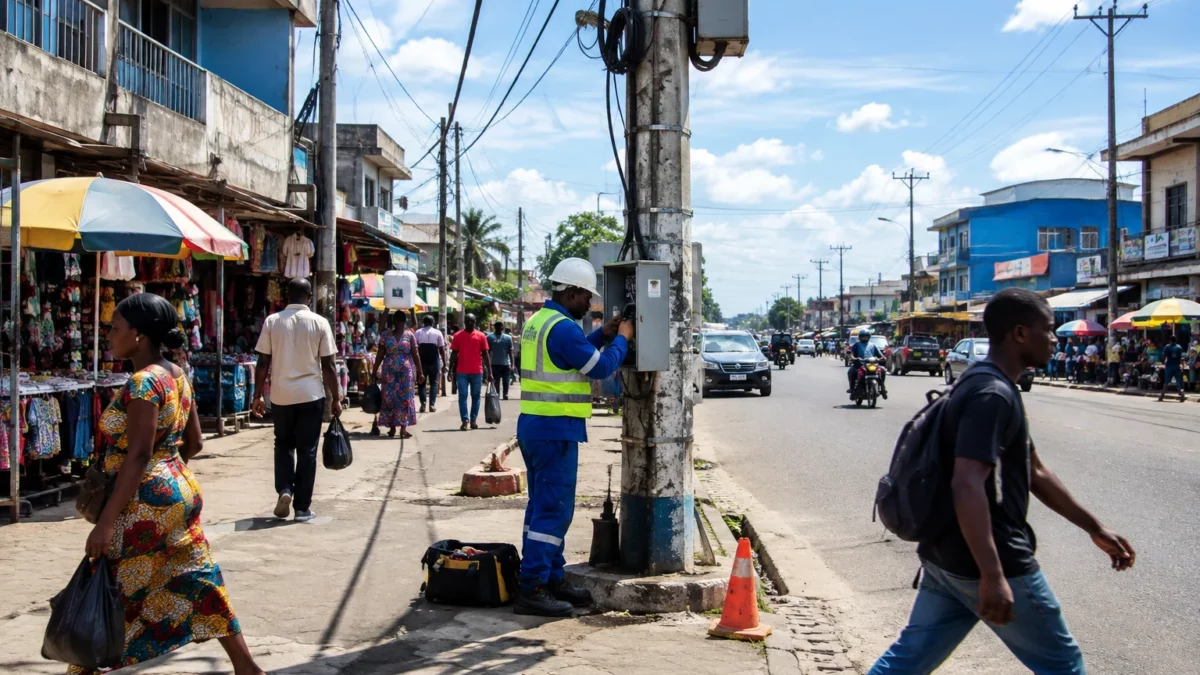
In Monrovia and Liberia’s rural areas, access to electricity remains a practical concern for households, public services and businesses. A major agreement with mining company Bea Mountain promises to strengthen power generation and roads. But its financing, based on future mining revenues, is already raising questions in Parliament and civil society.
A power shortfall the country wants to address
Liberia is starting from a low base. According to the National Energy Compact published with support from the World Bank, about 32.7% of the population had access to electricity in the data used for the document. The gap between urban and rural areas is pronounced: the Liberia Electricity Corporation’s grid mainly serves urban centres, while off-grid solutions — notably solar — play a role in remote areas.
The country must also contend with generation that is vulnerable to seasonal changes and rising demand. Electricity exchanges with neighbouring countries, via the Côte d’Ivoire–Liberia–Sierra Leone–Guinea interconnection, help supply the grid. This regional link is part of the efforts of the West African Power Pool, which aims to facilitate electricity trading between states.
In its energy compact linked to Mission 300, the government has set a target of reaching 75% access by 2030 and making 100,000 new connections a year. Mission 300 is an initiative by the World Bank and the African Development Bank to expand access to electricity in sub-Saharan Africa. Achieving this target will require developing both the national grid and decentralised solutions.
Agreement signed, but still subject to parliamentary scrutiny
On 25 November 2026, President Joseph Boakai signed a Master Infrastructure Development Agreement (MIDA) with Bea Mountain Mining Corporation. It provides for several energy and road projects. Public announcements put its total value at about $5.7 billion, a figure to distinguish from the $5.6 billion cited in some presentations of the project.
The programme is expected to add 270 megawatts of capacity, according to the authorities. It includes a 100 MW hydroelectric plant on the Via River, two facilities on the Saint Paul River with a combined capacity of 110 MW, and a 60 MW biomass plant. Three reservoirs, with a stated capacity of 10 billion cubic metres, are also planned to support generation when water flows decline.
The transport component includes a 146-kilometre road called the Liberia Development Road, $1 billion for other roads and $230 million to strengthen the electricity grid. The Ministry of Information describes the programme as an investment phased over five years. The president’s signature does not, however, constitute ratification: the text must still be examined by the Legislature before it enters into force.
Repayment mechanism at the heart of criticism
The government says the arrangement is intended to avoid financing the programme directly through a new sovereign loan. It provides for additional revenues that Bea Mountain is expected to generate for the state to be allocated to the project, notably as a result of higher gold prices. The company must also make a $500 million bridging finance facility available.
This explanation has not dispelled questions about the final cost to public finances. Samuel B. Reeves Jr., president of the Liberia Council of Churches, has urged lawmakers not to ratify the text in its current form. He says essential documents, including payment schedules, technical specifications and construction contracts, are not available in the dossier he reviewed.
Criticism also concerns how the company could recoup its expenditure. According to Reeves’s analysis, as reported by Liberian media outlet FrontPage Africa, some public revenues — including taxes, royalties and dividends — could be offset against the programme’s costs. This interpretation is contested in public debate and must be verified against the full text and its annexes. Nevertheless, it highlights a central question for lawmakers: what share of mining revenues will actually reach the Treasury, and at what pace?
The government defends the project as a way to mobilise investment without increasing public debt. Those opposed to immediate ratification do not necessarily dispute the need for roads and electricity. Rather, they are calling for spending caps, delivery guarantees, independent cost oversight and clear commitments to the communities concerned. Parliament will therefore have to assess both the expected benefits and the long-term contractual risks.
Measuring the benefits beyond major construction projects
An increase in generation does not automatically mean more electricity for households. Power will also need to be transmitted, new customers connected and facilities maintained. Rural residents, often far from the grid, will benefit from the new power plants only if lines, mini-grids or standalone systems are developed in parallel. For small businesses and health services, reliability and the price of electricity will matter as much as installed capacity.
The timetable and consistency with other Liberian energy projects also remain to be clarified. The authorities will need to show how the MIDA fits with projects already planned, including hydropower development on the Saint Paul River, and how the environmental and social impacts of the dams, reservoirs and roads will be assessed.
The issue therefore goes beyond the relationship between Monrovia and a mining company. It raises a regional question: how can natural resources be converted into useful infrastructure without compromising public revenues or the rights of local communities? The next decisive step will be Parliament’s examination of the text and its annexes. Publishing detailed costs, repayment terms and guarantees of access to electricity will make it possible to judge whether the promise of new capacity can also translate into a more accessible service for Liberians.