Algeria
 Egypt
 Libya
 Morocco
 Sudan
 Tunisia
 Benin
 Burkina Faso
 Cabo Verde
 Côte d'Ivoire
 Ghana
 Guinea
 Guinea-Bissau
 Liberia
 Mali
 Mauritania
 Niger
 Nigeria
 Senegal
 Sierra Leone
 The Gambia
 Togo
 Cameroon
 Central African Republic
 Chad
 DR Congo
 Equatorial Guinea
 Gabon
 Republic of the Congo
 São Tomé and Príncipe
 Burundi
 Comoros
 Djibouti
 Eritrea
 Ethiopia
 Kenya
 Madagascar
 Malawi
 Mauritius
 Mozambique
 Rwanda
 Seychelles
 Somalia
 South Sudan
 Tanzania
 Uganda
 Angola
 Botswana
 Eswatini
 Lesotho
 Namibia
 South Africa
 Zambia
 Zimbabwe
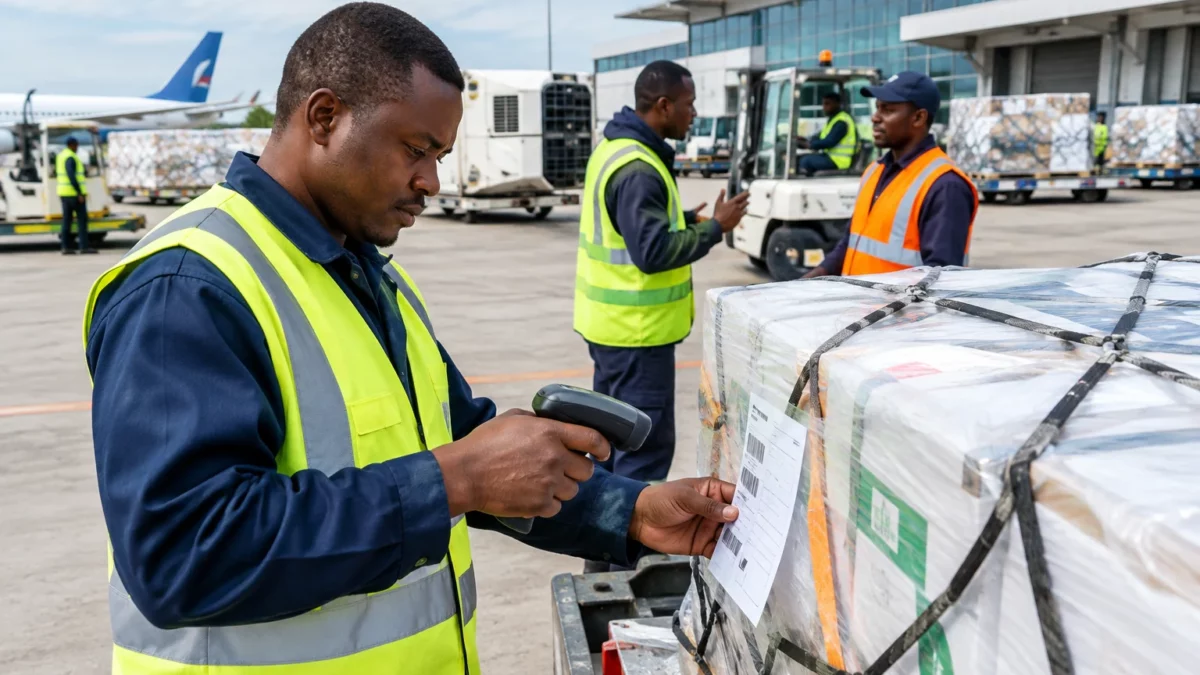
For a flower exporter in northern Tanzania, a few hours lost between the warehouse, carrier and customs can matter as much as an aircraft’s capacity. Air freight becomes more predictable when stakeholders exchange the same information at the right time. But connecting software is not enough: procedures and infrastructure must keep pace.
Connected systems, from booking to the warehouse
Initiatives under way in Morocco, Ethiopia and Tanzania show different stages of this shift. They do not yet form an integrated continental network. But they illustrate a shared challenge: making data useful to airlines, freight forwarders — professionals who organise shipments — and ground teams.
In Addis Ababa, Ethiopian Cargo announced a partnership with CargoAi on 17 September 2026. The airline plans to make its rates and capacity available in real time to more than 30,000 freight forwarders, through the platform or transport management software. The integration is intended to make it easier to view available services and book them. The figure and timeline come from the airline’s announcement, which presents the system as a way to broaden its distribution. Ethiopian Airlines outlines the CargoAi integration.
In Casablanca, Royal Air Maroc Cargo has deployed tools from CHAMP Cargosystems. Mobile applications give agents up-to-date information on shipments in the warehouse. Application programming interfaces, or APIs, connect software and provide access to functions including booking and pricing. CHAMP announced their deployment in January 2025. The supplier says the airline wants to automate some repetitive tasks; no quantified productivity gains have been disclosed. CHAMP outlines the tools deployed at Royal Air Maroc Cargo.
In Tanzania, a more tangible link is being added to the digital one. At Kilimanjaro International Airport, Swissport opened a cold-storage facility in 2026 equipped with a weighing system connected to its management platform, mobile scanners and automated tracking. The facility, announced as capable of handling up to 13,000 tonnes a year, is aimed in particular at perishable goods and temperature-sensitive cargo. This figure describes planned capacity, not the volume actually handled. The operator says the tools improve visibility and speed up handling, but has published no measure of the time saved. Swissport describes its cold-storage facility at Kilimanjaro.
Customs remains a decisive step
Faster booking does not guarantee faster delivery if documents do not move between the company, handler and authorities. Digitisation must therefore also cover formalities; otherwise, it speeds up one stage while leaving the others untouched.
In Kenya, the iCMS customs management system provides a concrete example. TradeMark Africa reports that the average air freight clearance time fell from two days to two or three hours. The organisation attributes this result to the system run by the Kenya Revenue Authority and says it had been observed since December 2021. This is a result reported by TradeMark Africa, not a new measurement made in 2024 or 2026. TradeMark Africa presents the results associated with iCMS.
In Mozambique, Kalé Logistics and Mozambique Airport Handling Service announced an air cargo community system in January 2025, designed to connect industry stakeholders and incorporate customs and financial functions. The project was due to start at eight airports operated by MAHS, with the possibility of extending to a further 12. These figures describe the announced scope, not coverage already achieved. In July 2026, Kalé was also selected to develop a community system at the Port of Maputo. This second initiative concerns maritime transport: it does not prove that the air and port platforms are already interconnected. Kalé sets out the project launched with MAHS and announces its mandate for the Port of Maputo.
A common standard, but no automatic fix
Since 1 January 2026, the International Air Transport Association (IATA) has recognised ONE Record as its preferred standard for cargo data sharing. The system organises shipment information around a common model and secure interfaces. It aims to facilitate exchanges between airlines, freight forwarders and handlers. IATA stresses, however, that effective adoption also depends on authorities accepting this data for regulatory declarations. IATA’s fact sheet explains the ONE Record standard.
This condition is central for African operators. An airline can put its rates online while a warehouse tracks parcels by scanner; if customs still requires documents in another format, the gains stop at the administrative border. Companies must also connect their systems without exposing commercial or personal data. For small freight-forwarding companies and exporters, the cost of equipment, training and upgrades can weigh more heavily than it does for large carriers.
The effects are therefore unevenly distributed. Airlines and large freight forwarders can gain visibility and attract clients. Warehouse agents can reduce repetitive data entry. Exporters of perishable goods, particularly in agricultural regions connected to Kilimanjaro Airport, stand to benefit from better co-ordination between storage, booking and transport. But these tools do not replace freight capacity, the cold chain or the permits required for export.
The task extends beyond each airport
The examples point to different priorities in each country: commercial distribution in Ethiopia, warehouse operations in Morocco, the cold chain in Tanzania, customs clearance in Kenya and co-ordination between stakeholders in Mozambique. Bringing them together under a single label of “African modernisation” would obscure these differences in infrastructure and regulation.
The next step will depend on genuine system compatibility and the recognition of digital documents by authorities. At regional level, consistent procedures can help goods continue their journey beyond their country of departure, particularly when air transport is part of a chain involving road, port and warehouse. ONE Record provides a common language for the air cargo industry, but does not by itself create common customs rules.
Air freight competitiveness will therefore depend less on the number of platforms announced than on their ability to transmit reliable information all the way to delivery. The results reported in Kenya show the potential of streamlined formalities; projects in Mozambique and tools deployed elsewhere show how much work remains. In the next roll-outs, the question is whether data will move as easily between companies and authorities as it does between private software systems.