Algeria
 Egypt
 Libya
 Morocco
 Sudan
 Tunisia
 Benin
 Burkina Faso
 Cabo Verde
 Côte d'Ivoire
 Ghana
 Guinea
 Guinea-Bissau
 Liberia
 Mali
 Mauritania
 Niger
 Nigeria
 Senegal
 Sierra Leone
 The Gambia
 Togo
 Cameroon
 Central African Republic
 Chad
 DR Congo
 Equatorial Guinea
 Gabon
 Republic of the Congo
 São Tomé and Príncipe
 Burundi
 Comoros
 Djibouti
 Eritrea
 Ethiopia
 Kenya
 Madagascar
 Malawi
 Mauritius
 Mozambique
 Rwanda
 Seychelles
 Somalia
 South Sudan
 Tanzania
 Uganda
 Angola
 Botswana
 Eswatini
 Lesotho
 Namibia
 South Africa
 Zambia
 Zimbabwe
An artificial intelligence tool may answer confidently in English, but make mistakes in an African language or overlook the realities of a local public service. For governments, the challenge is therefore not just to access these technologies: they must also be able to test them and influence the rules governing them.
The issue took on a diplomatic dimension on 23 November 2026 in Bridgetown, the capital of Barbados. The UN Secretary-General, António Guterres, and Barbados Prime Minister Mia Mottley called on states to open discussions on a multilateral framework for managing the risks associated with artificial intelligence (AI), with independent oversight. The call does not yet constitute an adopted international agreement. Guterres’s speech at the Bridgetown summit sets out the scope of the initiative.
Global rules, but no one-size-fits-all model
AI systems cross borders, while their effects are felt in very different contexts. A model can help analyse medical images or forecast the weather. It can also reproduce bias, expose personal data or produce unreliable results. National standards are therefore not always enough to address risks that cross borders.
In Bridgetown, Guterres called for comparable assessments, greater co-operation and the sharing of information about serious incidents. He also stressed that each country must be able to verify how tools behave in its own context. His formulation sums up the political stakes: the countries concerned should not simply adapt to decisions made elsewhere, but take part in shaping them.
The Secretary-General also proposed a Global Fund for AI Capacity Building. The goal outlined is to mobilise about $3 billion. This is a funding target, not an amount already raised or available to governments. The distinction matters for countries that must plan investments without any guarantee of immediate resources.
Testing tools in local languages and contexts
A note published on 22 November by the UN’s Independent International Scientific Panel on AI says that access to a model does not guarantee that it will be useful or safe. Systems must be assessed using data and for uses suited to the countries where they are deployed. The panel believes local testing can give authorities evidence with which to negotiate corrections, adapt a tool or reject an unsuitable solution. The panel’s note on national AI capacity places particular emphasis on assessment.
This capacity matters on a continent where several hundred languages coexist and public administrations have widely differing resources. A tool’s performance in French or English does not show that it will respond correctly in Yoruba, Swahili or Fon. Errors can affect access to information, agricultural support or health services, with tangible consequences for users.
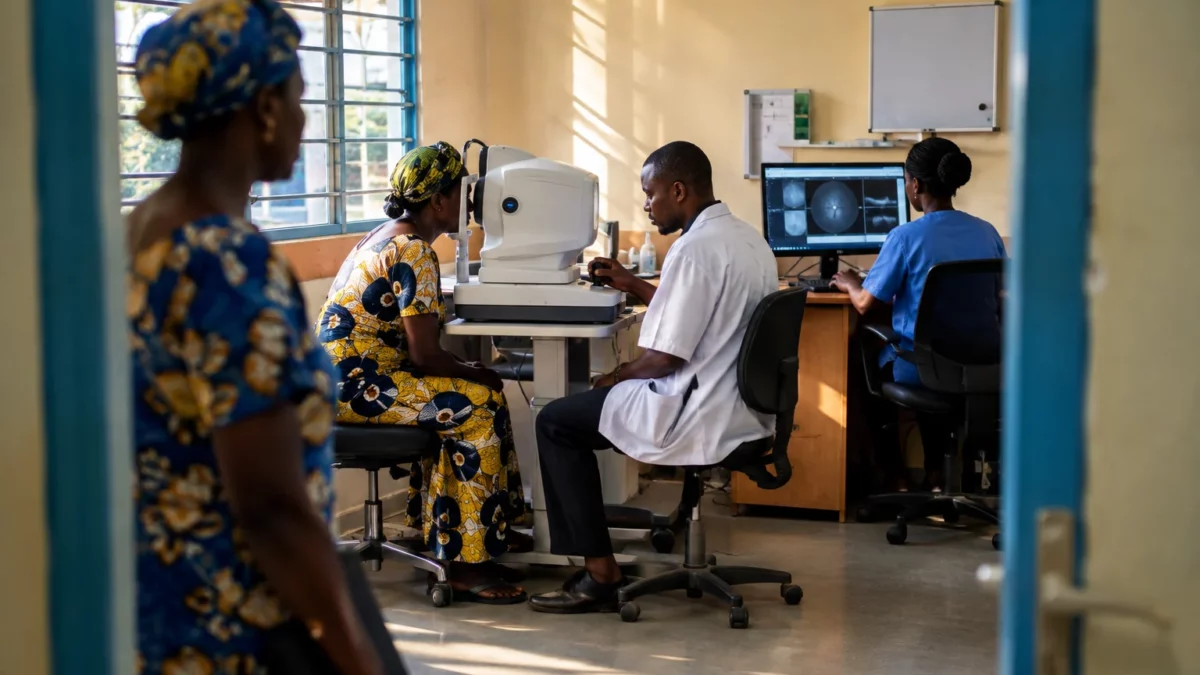
The panel also cites an example of diabetic eye screening in Tanzania: people who quickly received an AI-assisted result and advice were almost twice as likely to attend a follow-up appointment. This finding relates to a specific case and does not demonstrate that every deployment produces the same effect. It nevertheless shows that a tool’s value depends on how it is integrated into a care pathway, not just on the technology itself.
For authorities, local testing is thus becoming an instrument of negotiation and oversight. It requires specialists, relevant data, infrastructure and institutions able to act. Without these resources, regulators can hardly verify a supplier’s promises or monitor a system’s effects after its launch.
The African Union seeks to turn strategy into influence
The African Union (AU) has already established a continental framework. Its AI strategy, endorsed in July 2024, calls for harmonising member states’ approaches and strengthening African and international co-operation. It provides a common basis, but does not replace national policies or on-the-ground oversight capacity. The African Union’s continental strategy on artificial intelligence links these aims to the continent’s development priorities.
In September 2026, the AU Commission brought African ambassadors together in Geneva to co-ordinate the continent’s positions in digital negotiations. The meeting recommended closer links between diplomats and technical specialists and studying the creation of a network of African diplomats specialising in technology. The meeting marks a step towards co-ordination, not the establishment of a continental apparatus already equipped with all the necessary resources. The African Union’s report on the Geneva consultation details these proposals.
There are also obstacles at national level. A study by the Organisation for Economic Co-operation and Development, based on dialogue with officials from 12 African countries, identifies challenges involving infrastructure, funding, administrative co-ordination and regulatory expertise. It also notes that several national strategies remain difficult to translate into concrete measures. These findings do not describe every country in the same way, but point to constraints that are widely shared. The OECD study on AI governance in Africa outlines these challenges and national initiatives.
The next challenge: moving from presence to the ability to act
The Bridgetown discussion opens a new phase, but does not yet set binding common rules. Guterres’s proposal must now be considered by states. For African countries, the challenge will be to defend shared priorities while taking account of their differences: budgetary capacity, languages, infrastructure and uses of AI vary considerably from one country to another.
The pan-African impact will therefore depend as much on diplomacy as on practical investment. Teams able to assess models, corpora of local languages and co-operation among regulators can give greater weight to positions advanced in international forums. Without these tools, participation in discussions risks remaining largely formal. With them, governments will be better able to determine which systems are suited to their citizens and public services.