Algeria
 Egypt
 Libya
 Morocco
 Sudan
 Tunisia
 Benin
 Burkina Faso
 Cabo Verde
 Côte d'Ivoire
 Ghana
 Guinea
 Guinea-Bissau
 Liberia
 Mali
 Mauritania
 Niger
 Nigeria
 Senegal
 Sierra Leone
 The Gambia
 Togo
 Cameroon
 Central African Republic
 Chad
 DR Congo
 Equatorial Guinea
 Gabon
 Republic of the Congo
 São Tomé and Príncipe
 Burundi
 Comoros
 Djibouti
 Eritrea
 Ethiopia
 Kenya
 Madagascar
 Malawi
 Mauritius
 Mozambique
 Rwanda
 Seychelles
 Somalia
 South Sudan
 Uganda
 Angola
 Botswana
 Eswatini
 Lesotho
 Namibia
 South Africa
 Zambia
 Zimbabwe
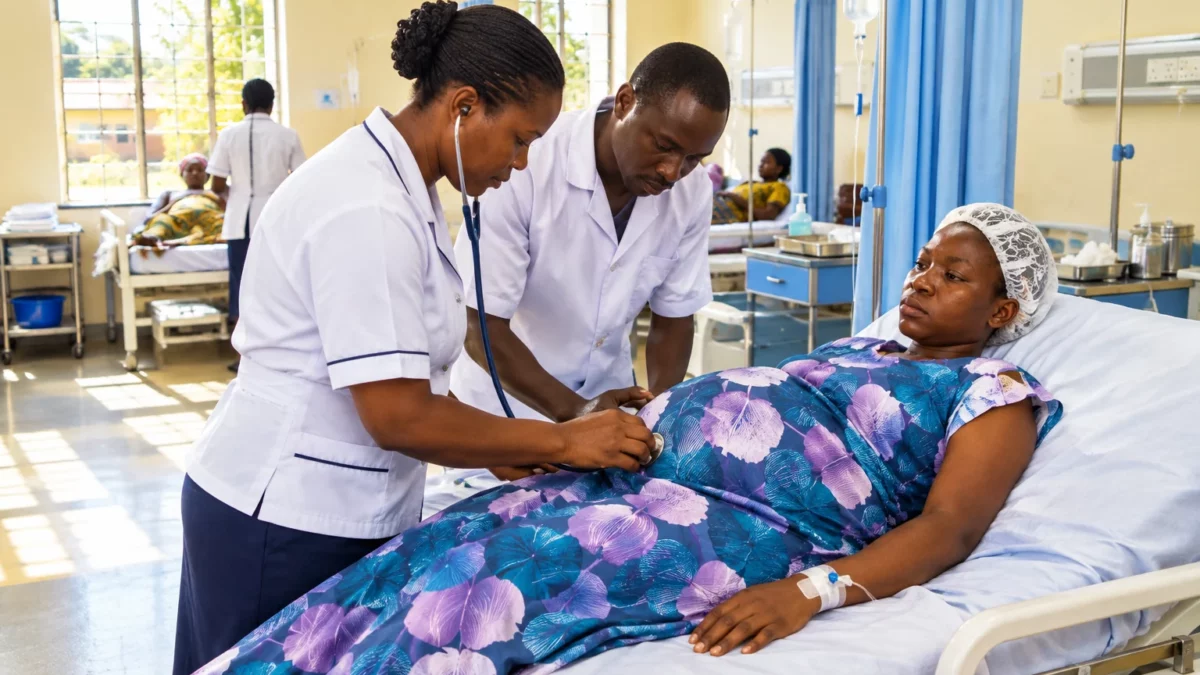
For a pregnant woman, the distance to a health centre is measured not only in kilometres. It is also counted in minutes before seeking care, time spent travelling and the medical team’s ability to intervene. Tanzania wants to build its experience around these practical obstacles into a new African roadmap for maternal and child health.
From continental commitments to local realities
The African Union roadmap for sexual, reproductive, maternal, newborn, child and adolescent health covers the period 2026-2030. It puts three goals at its centre: no birth without skilled personnel in an appropriate facility, no preventable maternal or neonatal death, and no unvaccinated child. Africa CDC, the African Union’s public health agency, presents the framework as a way to turn political commitments into concrete interventions.
The document was highlighted in Addis Ababa, Ethiopia, at the CPHIA 2026 conference. Tanzanian President Samia Suluhu Hassan, the African Union’s champion for maternal and child health, advocated an approach combining political leadership, sustainable financing and stronger health services. African Union chairperson Évariste Ndayishimiye of Burundi and Ethiopian Prime Minister Abiy Ahmed also took part in the launch.
The scale of the emergency is considerable, but continental figures need to be read precisely. Africa CDC’s roadmap cites about 180,000 maternal deaths in Africa in 2023. This total underlines the scale of the challenge, but by itself does not reflect disparities between countries, regions or social groups. Access to care depends in particular on roads, transport, staff availability and the quality of equipment.
Three delays that can compound one another
A public health framework distinguishes three delays that can turn a treatable complication into a life-threatening emergency: the time taken to decide to seek care, the journey to a facility, and the wait for treatment on arrival. This is not about placing responsibility on women or their families. These delays also reflect how services are organised, the information available and the resources in each area.
The first step is to make antenatal care and assisted delivery accessible and acceptable. In Tanzania, the proportion of births in health facilities rose from 51% in 2010 to 81% in 2022, according to figures cited in the dossier. The progress is clear, but almost one birth in five still took place outside a health facility in 2022. Rural and remote areas face particular difficulties when journeys are long or costly.
The second delay, transport, prompted the roll-out of m-mama. The scheme brings together health authorities, private partners and a network of local transport providers. It connects people facing an obstetric emergency with transport to an appropriate centre. The Vodafone Foundation reports more than 150,000 emergency journeys and more than 6,300 lives saved at an earlier milestone. These figures come from the programme’s partner and are not, on their own, an independent assessment of its impact.
On arrival, the capacity to provide care matters
Faster transport is not enough if a facility lacks staff or equipment. Postpartum haemorrhage requires an immediate response. An emergency caesarean section requires a trained team, including an anaesthesia professional. Premature newborns also need specialised care. The availability of these skills varies between facilities and according to their distance from major centres.
Tanzania has increased the number of facilities listed as able to provide emergency obstetric and newborn care, according to figures cited by Africa CDC. The roadmap also focuses on training: Samia Suluhu Hassan announced 60 scholarships for specialists in midwifery, anaesthesia, obstetrics and gynaecology, and neonatal care. The country also plans short courses and supervised placements for nurses, midwives and other health workers.
National indicators point to significant improvement, but comparisons require caution. Tanzania’s 2022 Demographic and Health Survey estimates the maternal mortality ratio at 104 deaths per 100,000 live births for the seven-year period before the survey. The published confidence interval ranges from 59 to 149. The previous survey, in 2015-2016, gave an estimate of 556. These estimates are based on surveys and carry a margin of uncertainty: they show a trend, but do not allow the claim that the actual rate is now around 75 unless the newly announced data are published and examined.
Funding promises and tracking disparities
Implementation will depend on national budgets. Africa CDC says only 28 of the African Union’s 55 member states have a dedicated budget line for sexual and reproductive health. A shared roadmap can set priorities, but it cannot replace regular public spending or the teams working in clinics. Nor does it guarantee that resources will reach the regions that need them most.
For Tanzanian authorities, the challenge is therefore to consolidate progress while reducing disparities between the capital, Dodoma, the cities and rural areas. For families, the quality of the system is measured in very practical terms: knowing whom to call, being able to reach a facility in time and finding a team there capable of acting. For health workers, this requires adequate staffing, functioning equipment and clear referral pathways between local centres and hospitals.
Tanzania is placing this effort within a broader regional dynamic. As a member of the East African Community, it shares challenges with its neighbours around training, access to care and the availability of medicines. The African Union framework can facilitate the exchange of practices, particularly on emergency referral systems. But each country will have to adapt the goals to its own circumstances and report on the results achieved.
The test of the 2026-2030 roadmap will therefore not be just the number of decisions announced in Addis Ababa. It will be the regularity of funding, the deployment of skills and the ability to track disparities between areas. In Tanzania, as elsewhere in the region, reducing preventable deaths will require all three links to work together: seeking care in time, arriving in time and receiving appropriate treatment.
Africa CDC’s 2026-2030 roadmap for maternal and child health · Tanzania Demographic and Health Survey, 2022 · Data published by the Vodafone Foundation on m-mama