Algeria
 Egypt
 Libya
 Morocco
 Sudan
 Tunisia
 Benin
 Burkina Faso
 Cabo Verde
 Côte d'Ivoire
 Ghana
 Guinea
 Guinea-Bissau
 Liberia
 Mali
 Mauritania
 Niger
 Nigeria
 Senegal
 Sierra Leone
 The Gambia
 Togo
 Cameroon
 Central African Republic
 DR Congo
 Equatorial Guinea
 Gabon
 Republic of the Congo
 São Tomé and Príncipe
 Burundi
 Comoros
 Djibouti
 Eritrea
 Ethiopia
 Kenya
 Madagascar
 Malawi
 Mauritius
 Mozambique
 Rwanda
 Seychelles
 Somalia
 South Sudan
 Tanzania
 Uganda
 Angola
 Botswana
 Eswatini
 Lesotho
 Namibia
 South Africa
 Zambia
 Zimbabwe
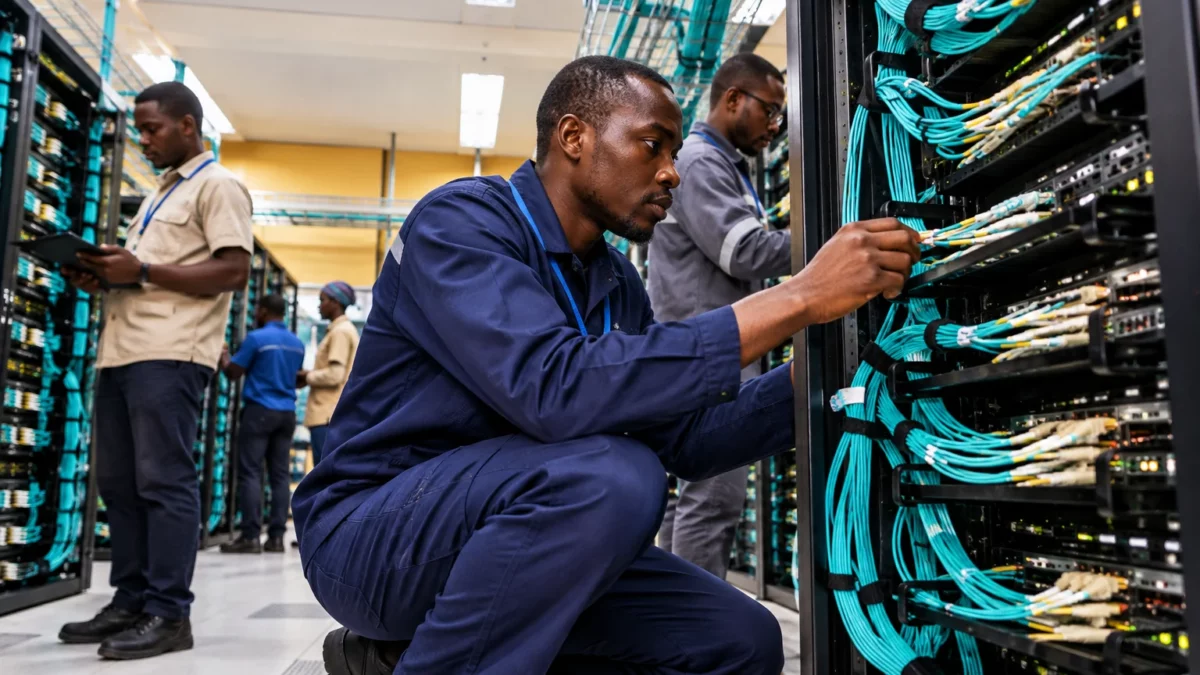
For a company in N’Djamena or a student connecting from a provincial town, an outage on an external corridor can slow or even interrupt access to online services. Chad is therefore seeking to increase the number of its fibre-optic routes. Several options were discussed in Doha, but they still need to be turned into funded, operational projects.
International access concentrated on a few routes
Landlocked in Central Africa, Chad relies on terrestrial links through neighbouring countries to reach submarine cables and global networks. This dependence makes service continuity vulnerable to technical incidents and to crises affecting transit countries.
In August 2024, the Internet Society reported a three-hour outage in Chad, following two fibre cuts on Camtel infrastructure in Cameroon. The organisation also noted that the link through Sudan had been out of service since 27 May 2024, amid the war. It pointed to a high concentration of international transit, with insufficient redundancy. The Internet Society’s analysis of the resilience of Chad’s network illustrates the risk: an incident on one route can affect many users.
The issue extends beyond large companies and government departments. Operators have to buy international capacity to carry data. If routes are scarce or expensive, there is limited scope to improve prices and quality. The effects are also felt in the regions, where network expansion and broadband availability are already significant challenges.
Potential connections discussed in Doha
At the International Telecommunication Union (ITU) Plenipotentiary Conference, held in Doha in November 2026, Chad’s Minister of Telecommunications, Haliki Choua Mahamat, held several discussions with regional partners.
On 13 November, Chad and Nigeria signed a letter of interest addressed to the World Bank, seeking support for a study of a cross-border fibre-optic link. The document is neither approval of funding nor the launch of construction work. It opens an assessment phase covering, among other things, routes, interconnection options and financing arrangements. Qatari media outlet The Peninsula reports that the proposed project would build on digital initiatives already under way in both countries.
Discussions with Algeria focused on the Trans-Saharan Fibre-Optic Backbone, which could give Chad access to Algerian submarine cables via Niger. Chad’s ministry has also raised a proposal for a corridor through Tibesti and Libya. Haliki Choua Mahamat is said to have requested a feasibility study to examine this option. Talks with the Libyan authorities concerned a direct interconnection between the two countries. Routes, funding and operating arrangements remain to be clarified.
These options add to projects already under way. The African Development Bank documents the Trans-Saharan Backbone, supported by the European Union and the governments concerned. The World Bank, meanwhile, approved a $92.2 million grant in September 2024 for the Chad Digital Transformation Project. It aims, among other things, to extend broadband in rural, peri-urban and urban areas. These funding commitments and objectives do not, however, mean that every international link discussed in Doha has already been built or funded.
Fibre alone will not guarantee cheaper internet
Adding corridors can reduce dependence on a single route and give connectivity providers more options. But the presence of several fibre links does not automatically guarantee lower prices for households or small businesses. Attention will also need to be paid to the cost of accessing this infrastructure, competition in the wholesale market and equipment maintenance.
The benefits will also depend on how new capacity is distributed within the country. An additional international link can improve the resilience of the national network, but it does not replace the investment needed to connect secondary cities and rural areas. The World Bank says its digital project is specifically intended to extend connectivity beyond major urban centres. The project description for Chad also includes digital public services and skills development.
The challenge is therefore both technical and economic: building alternative routes, maintaining them, allowing several operators to access them and connecting remote areas. For users, the practical test will be whether these changes improve service stability and affordability, rather than simply how many kilometres of fibre are laid.
An issue that extends beyond Chad’s borders
The discussions bring together countries with complementary access routes: Nigeria to the west, Algeria to the north and Libya to the north-east. They highlight the importance of cross-border agreements for landlocked countries, whose connectivity depends on networks crossing several jurisdictions. Beyond diplomacy, each corridor will require coordination on technical standards, interconnections and outage management.
The next step will be to move from letters of interest and studies to investment decisions, and then to services that are actually available. For Chad, diversification will not be measured solely by the presence of new routes on a map. It will be demonstrated by the network’s ability to withstand outages and by whether people in N’Djamena and the regions have real access to more reliable and affordable internet.