Algeria
 Egypt
 Libya
 Morocco
 Sudan
 Tunisia
 Benin
 Burkina Faso
 Cabo Verde
 Côte d'Ivoire
 Ghana
 Guinea
 Guinea-Bissau
 Liberia
 Mali
 Mauritania
 Niger
 Nigeria
 Senegal
 Sierra Leone
 The Gambia
 Togo
 Cameroon
 Central African Republic
 Chad
 DR Congo
 Equatorial Guinea
 Gabon
 Republic of the Congo
 São Tomé and Príncipe
 Burundi
 Comoros
 Djibouti
 Eritrea
 Ethiopia
 Kenya
 Madagascar
 Malawi
 Mauritius
 Mozambique
 Rwanda
 Seychelles
 Somalia
 South Sudan
 Tanzania
 Uganda
 Angola
 Botswana
 Eswatini
 Lesotho
 Namibia
 South Africa
 Zambia
 Zimbabwe
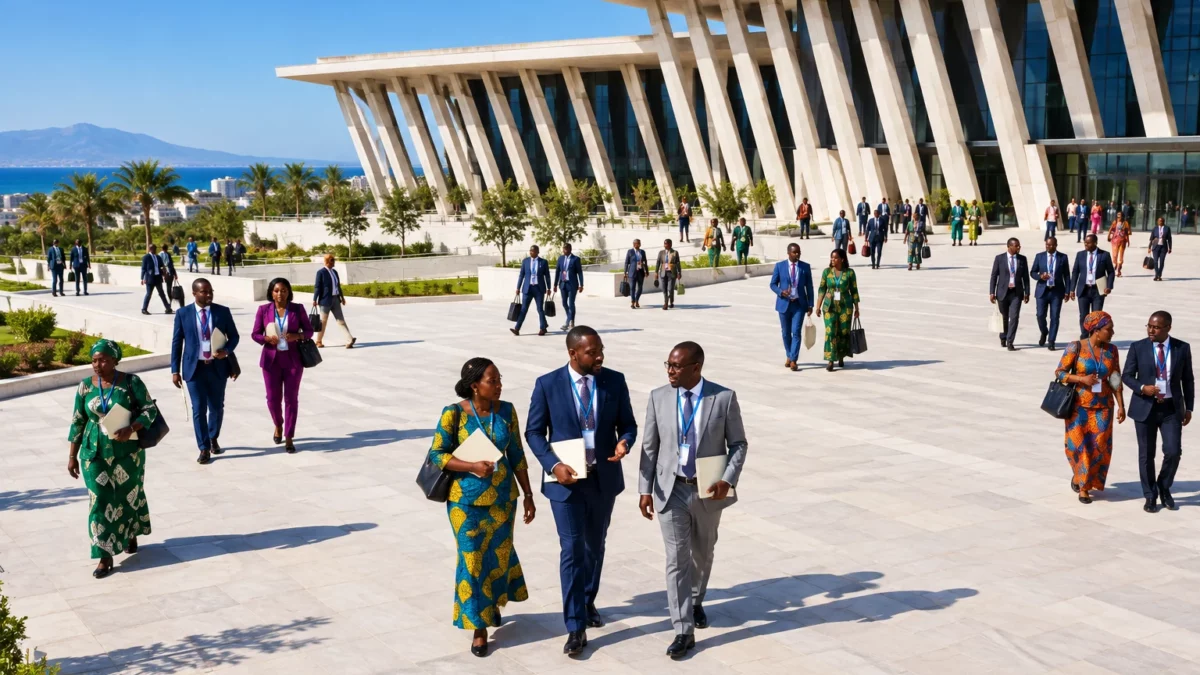
African countries face a dual challenge in climate negotiations: securing the means to protect their people and economies, while having a greater say in the rules governing the energy transition. COP31 in Antalya failed to produce a general political agreement. But the talks were not entirely fruitless, and the divisions laid bare at the close offer a glimpse of the balance of power to come.
A summit without a general agreement, but not without decisions
COP31 was held in Antalya, Türkiye, from 9 to 20 November 2026. The negotiations ran over by two days, however, concluding on 22 November without consensus on an overarching political text. United Nations Secretary-General António Guterres expressed his “deep disappointment”. He stressed that the absence of an agreement changes neither the scientific findings nor the urgency of cutting emissions and strengthening protection for exposed populations. The UN’s closing assessment of COP31 and statements by the climate convention presidency confirm that no general consensus was reached.
This deadlock does not mean that every issue remained stalled. The executive secretary of the United Nations Framework Convention on Climate Change said decisions had been taken on some matters, including a just transition. The distinction matters: the conference did not produce a general agreement, but work on specific issues moved forward. The climate convention’s closing remarks set out the situation in detail.
The political breaking point centred in particular on the place of fossil fuels in the overarching text. Some delegations wanted an explicit reference to their role in global warming and the need to organise their phase-out. Others opposed wording of this kind. In the absence of consensus, governments did not adopt a shared general decision on this direction.
Finance remains central for African countries
The debate directly concerns African states, but their circumstances are not identical. Needs vary according to exposure to droughts, floods, coastal erosion and pressure on water and agriculture. Priorities also differ depending on energy systems and available resources. The issue in negotiations is therefore not limited to setting emissions targets: it also concerns how to finance adaptation and national transitions without excessively increasing debt.
Before the summit, Senegal’s Minister of the Environment and Ecological Transition, Aliou Gori Diouf, announced that Dakar would advocate diversifying climate finance and taking concrete action. The Senegalese Press Agency reported that adaptation would be among Senegal’s priorities. This position reflects a broader concern: announced funding must be accessible, predictable and suited to projects, whether they involve coastal cities, rural areas or energy infrastructure. The Senegalese Press Agency on Senegal’s priorities sets out this position.
Loans are a sensitive issue. Repayable finance can support investment, but it can also weigh on public budgets when projects generate little income or climate shocks hit revenues. Governments are therefore calling for a range of instruments, including concessional resources and grants, as well as easier access to existing funds. These choices have different effects: administrations seek to finance national programmes, while local authorities and communities need resources for local responses, which are often more immediate.
An organised African presence, and influence to be converted into leverage
African countries did not arrive in Antalya as a bloc without proposals. The African Pavilion, led in particular by the Economic Commission for Africa, Afreximbank and the African Development Bank, highlighted climate finance, adaptation, resilient food systems, green industrialisation and technology. This platform gives visibility to shared priorities. It does not, however, remove the divergent interests of hydrocarbon-producing countries, energy-importing states and economies where access to electricity remains a major need. The Economic Commission for Africa sets out African priorities at COP31.
Diplomatic work then consists of defending shared principles without erasing these differences. An energy transition compatible with development needs requires investment in grids, renewable energy and infrastructure. It also involves national decisions on resource exploitation, employment and public revenue. An international text can set a direction; it cannot replace political choices or the capacity to implement them in each country.
The COP remains a forum where almost all states can negotiate under common rules. In practice, consensus also gives each party the power to block progress. The Antalya episode illustrates this limit: disagreements over fossil fuels and finance prevented the adoption of a general framework, despite progress on some issues. For African countries, the challenge is to turn their collective presence into negotiating alliances capable of defending finance, adaptation and differentiated energy pathways.
What comes next will depend on implementation
The absence of a general agreement weakens the COPs’ ability to send a shared political signal. It does not end climate negotiations: decisions adopted on specific issues, national commitments and financing mechanisms will continue to be examined. The next step will be to see whether countries translate existing compromises into budgets, projects and applicable rules, rather than carrying the same disputes from one summit to the next.
For African governments, Antalya’s significance for the continent lies as much in what was not agreed as in the priorities they advanced. The question is not simply whether the COPs still serve a purpose. It is whether negotiations can deliver accessible finance and sufficiently precise decisions to address national realities, without imposing a uniform pathway on different economies.