Algeria
 Egypt
 Libya
 Morocco
 Sudan
 Tunisia
 Benin
 Burkina Faso
 Cabo Verde
 Côte d'Ivoire
 Ghana
 Guinea
 Guinea-Bissau
 Liberia
 Mali
 Mauritania
 Niger
 Nigeria
 Senegal
 Sierra Leone
 The Gambia
 Togo
 Cameroon
 Central African Republic
 Chad
 DR Congo
 Equatorial Guinea
 Republic of the Congo
 São Tomé and Príncipe
 Burundi
 Comoros
 Djibouti
 Eritrea
 Ethiopia
 Kenya
 Madagascar
 Malawi
 Mauritius
 Mozambique
 Rwanda
 Seychelles
 Somalia
 South Sudan
 Tanzania
 Uganda
 Angola
 Botswana
 Eswatini
 Lesotho
 Namibia
 South Africa
 Zambia
 Zimbabwe
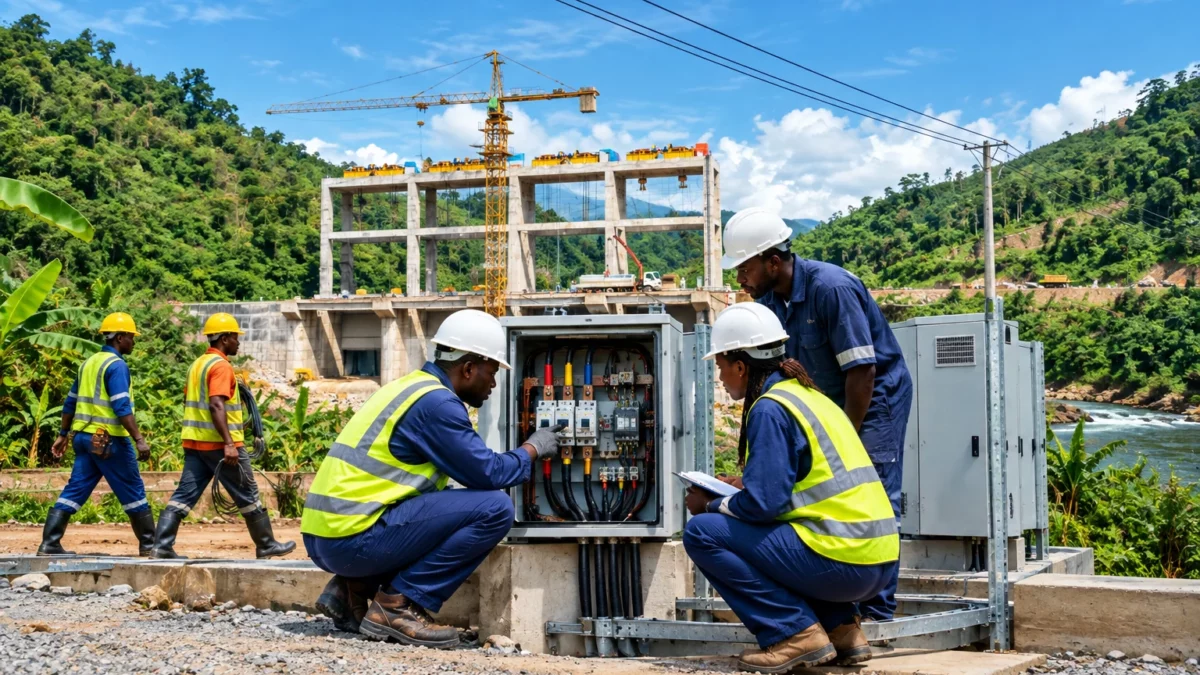
In Libreville, the arrival of new electricity capacity does not yet mean an end to power cuts. The Kinguélé Aval dam is nearing commissioning, while connecting it to the grid has already required works and caused temporary disruptions. The challenge now is to turn this infrastructure into electricity available to households and businesses.
A grid under pressure in Greater Libreville
In Gabon, electricity demand is rising with urban and industrial activity, particularly in wood processing. But producing more is not enough: energy must also be transmitted and existing power plants maintained. The power cuts affecting Greater Libreville are a reminder of the gap between demand and the capacity actually available.
Figures published in November illustrate this fragility. During the connection works for Kinguélé Aval, taking the 225-kilovolt line linking Kinguélé to Bisségué out of service temporarily reduced the combined output of the Tchimbélé and Kinguélé dams. The Gabonese daily L’Union reports that it fell from 94 to 55 megawatts during the intervention.
The operation took place from 8 to 15 November 2026. It was intended to connect the new power plant to Libreville’s interconnected grid. The cuts observed during this period were therefore the result of announced works, not a general failure at the dam. The connection is reported to be complete, but the full planned capacity is still being injected gradually.
Kinguélé Aval: additional capacity, but a gradual rollout
Located on the Mbéi River, downstream of the Kinguélé and Tchimbélé facilities, the project is set to add 35 megawatts of installed capacity. Its promoters and the authorities are targeting annual output of around 200 to 205 gigawatt-hours. The plant is expected to be commissioned in stages, with the first injections expected in December 2026, according to Gabon Power Company and several Gabonese media outlets.
On 31 October, after visiting the site, Gabon Power Company said construction was more than 95% complete and tests were under way. The company said commissioning was expected in December, with capacity ramping up gradually before the end of the year. On 20 November, the Gabonese media outlet Gabonreview reported that the connection was complete and the first injections were expected the following month.
The project is being developed under a public-private partnership involving Gabon Power Company and Méridiam, with Asonha Énergie as the project company and Sinohydro as the construction contractor. The African Development Bank had described Kinguélé Aval as a new hydropower plant intended to strengthen Gabon’s electricity supply. During a site visit in August 2025, the Gabonese presidency cited capacity of 35 megawatts and estimated annual output of 205 gigawatt-hours.
A partial response to a structural shortfall
The expected 35 megawatts represent a significant addition, but do not on their own guarantee a stable supply. Installed capacity describes what a power plant can produce under certain conditions; it does not mean that this amount will be available every hour. Hydropower output depends, among other things, on water levels, while the quality of the grid and the condition of other facilities affect the electricity actually delivered.
The Gabonese government also relies on floating power plants operated by Turkish company Karpowership, whose contracted capacity reaches 150 megawatts. This supplementary generation can meet part of demand quickly, but it is no substitute for sustained investment or maintenance of lines and equipment. A French economic document published in 2026 also reported tensions over payments and an announced suspension of this generation in March. The episode highlights the vulnerability of a system dependent on contracts and costly thermal power.
For households, power cuts affect lighting, food preservation and the operation of domestic appliances. Shops, workshops and small businesses have to absorb the interruptions or pay for backup solutions. Major generation infrastructure can improve national supply, but its benefits will also depend on the grid’s ability to deliver electricity to neighbourhoods and business districts.
A Gabonese project with regional implications
The project is part of the energy trajectory of a country seeking to support its industrial and urban development. It follows a period in which the authorities have made access to water and electricity a priority, while users await tangible and consistent improvements. The announced commissioning is therefore a test of coordination between generators, the grid operator, investors and public authorities.
Regionally, Gabon is a member of the Economic and Monetary Community of Central Africa (CEMAC), which brings together six Central African countries for economic and monetary co-operation. Electricity security remains important for competitiveness and economic diversification across the region. However, Kinguélé Aval will first supply the Gabonese grid: its regional significance lies mainly in the experience it offers in public-private financing, hydropower and connecting new capacity.
The next step to watch is the effective injection of the 35 megawatts and their contribution to grid stability during periods of peak demand. The announced timetable provides for commissioning to be phased in by the end of 2026. Only after capacity has ramped up will users be able to assess whether the new facility really reduces the frequency of power cuts in Libreville and its surrounding areas.