Algeria
 Egypt
 Libya
 Morocco
 Sudan
 Tunisia
 Benin
 Burkina Faso
 Cabo Verde
 Côte d'Ivoire
 Ghana
 Guinea
 Guinea-Bissau
 Liberia
 Mauritania
 Niger
 Nigeria
 Senegal
 Sierra Leone
 The Gambia
 Togo
 Cameroon
 Central African Republic
 Chad
 DR Congo
 Equatorial Guinea
 Gabon
 Republic of the Congo
 São Tomé and Príncipe
 Burundi
 Comoros
 Djibouti
 Eritrea
 Ethiopia
 Kenya
 Madagascar
 Malawi
 Mauritius
 Mozambique
 Rwanda
 Seychelles
 Somalia
 South Sudan
 Tanzania
 Uganda
 Angola
 Botswana
 Eswatini
 Lesotho
 Namibia
 South Africa
 Zambia
 Zimbabwe
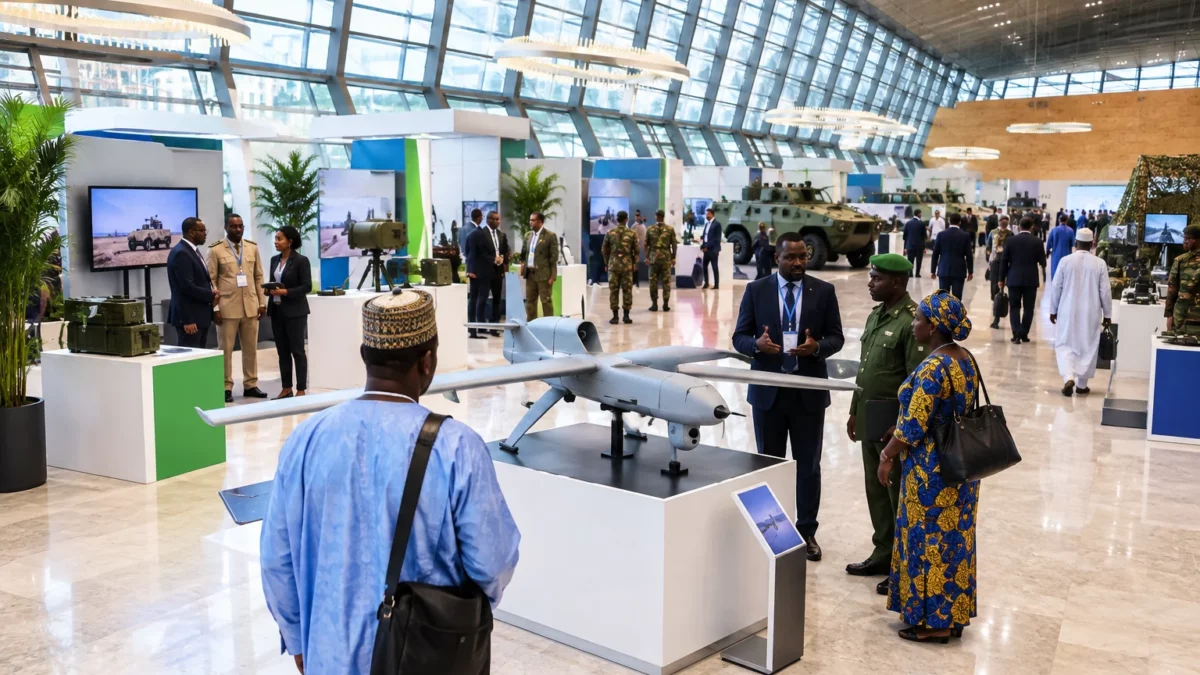
In Bamako, a defence exhibition poses a question that goes beyond display stands and demonstrations: how can military capabilities be strengthened without replacing one dependency with another? For Mali, the issue is concrete. It concerns the security of the country, but also training, equipment maintenance and the share of expertise that can be developed at home.
A showcase amid regional tensions
The second Bamako International Defence and Security Exhibition, BAMEX, was held from 9 to 13 November 2026. The event comes after a year marked by serious attacks in Mali. On 25 and 26 April, coordinated assaults attributed to Jama’at Nusrat al-Islam wal-Muslimin (JNIM) and the Azawad Liberation Front (FLA) struck several localities. Defence Minister Sadio Camara was killed in Kati, according to the Malian authorities and independent reports. These events exposed the difficulties that Malian forces continue to face.
The country’s institutional trajectory also matters. Mali, Burkina Faso and Niger left the Economic Community of West African States (ECOWAS), the regional integration organisation, on 29 January 2025. Since then, they have strengthened their co-operation within the Alliance of Sahel States (AES), which brings the three countries together. This shift is changing the frameworks for political and security dialogue in West Africa, without eliminating cross-border challenges.
Many delegations, few public announcements
The exhibition brought together official delegations from 19 countries and around 30 exhibiting companies, according to the Malian Armed Forces. The authorities organised the exhibition at the Bamako Exhibition Centre. Equipment demonstrations also took place at the Tanabougou firing range, in the Koulikoro region. Prime Minister Abdoulaye Maïga presided over the opening.
The equipment on display included drones, counter-drone systems, armoured vehicles, surveillance and tactical communications. Turkish companies, including Baykar, ASELSAN and ROKETSAN, were among the exhibitors. The Chinese group Norinco also had a stand. Their presence signals commercial and diplomatic interest; it does not, in itself, prove that contracts have been concluded or new systems delivered.
The visit by the commander of the United States Africa Command (AFRICOM), General Dagvin Anderson, gave the event an additional diplomatic dimension. He met the head of the Transition, Assimi Goïta, on 10 November. AFRICOM says the discussions covered shared security priorities and possible forms of co-operation. No announcement of a new defence agreement accompanied the meeting.
Diversifying suppliers, managing dependencies
Russia retains a major role in Mali’s military relations, while Turkey and China are seeking to expand their presence as suppliers. Bamako is also broadening its contacts, as illustrated by the meeting with the US delegation. This is therefore less a simple choice between partners than an attempt to diversify support, in a context in which relations with several Western governments have become strained.
Data from the Stockholm International Peace Research Institute (SIPRI), which tracks transfers of major arms, provide a useful reference point. Between 2021 and 2025, Mali accounted for 8% of sub-Saharan Africa’s imports of major arms. Across the sub-region, China was the leading supplier, with 22%, ahead of Russia at 12% and Turkey at 11%. These regional shares do not, on their own, describe Mali’s purchases. SIPRI also notes that its indicator measures the volume of major arms transfers, not their price, and does not necessarily cover every acquisition, including some drones.
For the Malian authorities, the stated aim is not limited to buying equipment. They highlight technology transfer, training, maintenance and the development of a domestic defence industry. These are decisive criteria: a sophisticated system quickly loses its usefulness if teams cannot repair it or obtain spare parts. Having multiple suppliers can also complicate procurement, training and the integration of equipment.
Results will be measured on the ground
For the armed forces, new resources could improve surveillance, mobility or the protection of certain positions. But their effectiveness also depends on intelligence, co-ordination, logistics and the ability to maintain supply lines. People, meanwhile, will judge the results above all by the safety of travel, the continuity of economic activity and the protection of civilians. The issues therefore extend beyond the needs of the military or the interests of suppliers.
Transparency remains important. Without accessible information on contracts, their costs and their terms, it is difficult to assess the returns for the public budget or Malian industry. Likewise, announcements of co-operation will need to be distinguished from commitments that are actually funded, deliveries and capabilities produced locally.
BAMEX thus served both as a trade exhibition and as a meeting place for partners with differing interests. Its regional significance also stems from the AES, which is seeking to co-ordinate its members’ security responses after their withdrawal from ECOWAS. At the African Union level, the issue points to a broader question: how can states increase their security autonomy while retaining control over costs, technologies and alliances? The answer will depend less on the number of delegations welcomed than on what follows from the discussions: verifiable contracts, training, maintenance, skills transfers and local benefits.
Sources consulted: Malian Armed Forces on the close of BAMEX 2026, Mali’s Prime Minister’s Office on the exhibition opening, Mali’s Presidency on meetings with delegations, AFRICOM on its commander’s visit to Mali, SIPRI on arms transfers in 2021–2025, ECOWAS on the withdrawal of Mali, Burkina Faso and Niger, ACAPS on the escalation of attacks in Mali in April 2026.