Algeria
 Egypt
 Libya
 Morocco
 Tunisia
 Benin
 Burkina Faso
 Cabo Verde
 Côte d'Ivoire
 Ghana
 Guinea
 Guinea-Bissau
 Liberia
 Mali
 Mauritania
 Niger
 Nigeria
 Senegal
 Sierra Leone
 The Gambia
 Togo
 Cameroon
 Central African Republic
 Chad
 DR Congo
 Equatorial Guinea
 Gabon
 Republic of the Congo
 São Tomé and Príncipe
 Burundi
 Comoros
 Djibouti
 Eritrea
 Ethiopia
 Kenya
 Madagascar
 Malawi
 Mauritius
 Mozambique
 Rwanda
 Seychelles
 Somalia
 South Sudan
 Tanzania
 Uganda
 Angola
 Botswana
 Eswatini
 Lesotho
 Namibia
 South Africa
 Zambia
 Zimbabwe
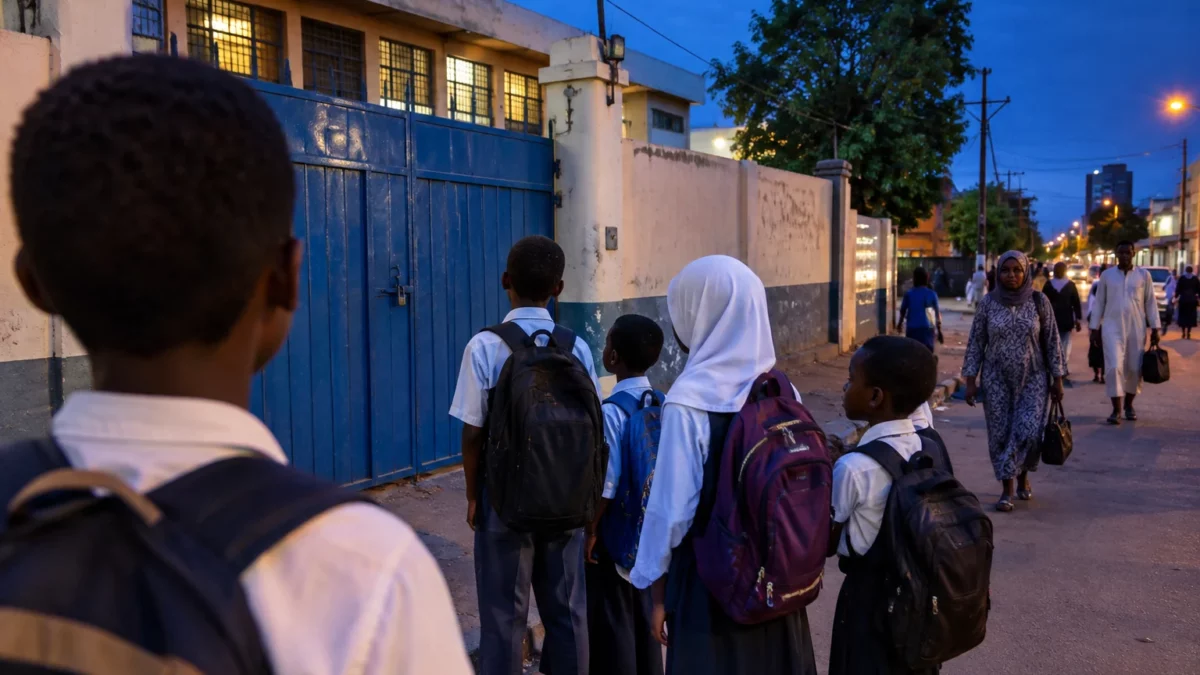
For a Sudanese child, war is measured not only in fighting. It can also close schools, put healthcare out of reach and make aid difficult to access. A new global assessment highlights the scale of this exposure, while Sudan illustrates its concrete consequences for daily life.
Measuring exposure, not counting casualties
In 2025, around 589 million children lived in areas affected by armed conflict — nearly one in four children worldwide. This is the highest level in the series tracked since 1990, according to Save the Children’s 2026 report, which is based on data from the Peace Research Institute Oslo (PRIO). The figure estimates geographical exposure to conflict; it does not mean that all these children were directly injured or targeted.
PRIO counts children living within 50 kilometres of recorded conflict events. This method makes it possible to compare changes over time and between regions. However, it does not describe the intensity of fighting in each locality or the individual experiences of children.
The regional breakdown is particularly stark for Africa. The continent had around 260 million children living in conflict zones in 2025, accounting for 44% of the global total. Nearly two in five children there were affected. These proportions describe exposure across the continent, but should not obscure differences between countries, regions and communities.
In Sudan, war disrupts essential services
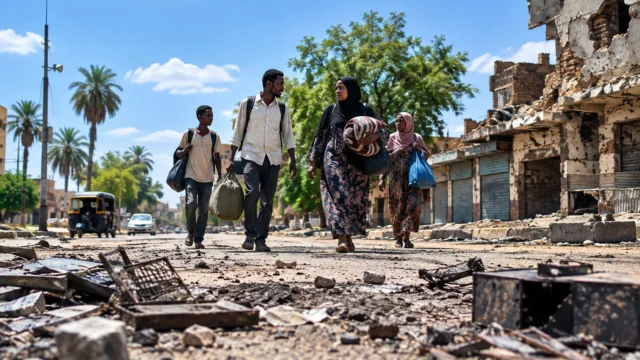
In Sudan, fighting between the Sudanese Armed Forces and the Rapid Support Forces broke out in April 2023. It has affected many regions, including the capital, Khartoum. The conflict is part of a trajectory marked by an interrupted political transition and rivalries over power. It has also caused displacement and disrupted the institutions on which families depend.
For children, the consequences go beyond the immediate risk of gunfire and bombardment. Access to school, healthcare, clean water and protection becomes uncertain when facilities close, staff are displaced or roads are no longer safe. UNICEF says its partners provided education, protection and psychosocial support to 3.5 million children in Sudan in 2025, while noting that access and funding constraints limited the response.
This assessment also serves as a reminder that aid cannot replace stable public services. Temporary learning spaces and mobile teams can help maintain contact with children. However, they guarantee neither continuous schooling nor a rapid return to normal conditions. Displaced families and those living in hard-to-reach areas face different obstacles from households that have remained near urban centres.
At regional level, Sudan is part of the IGAD region — the Intergovernmental Authority on Development — which brings together several countries in the Horn of Africa and neighbouring parts of East Africa. The war therefore has effects beyond its borders, particularly through population displacement and pressure on host communities. The African Union is also involved in efforts to find a political settlement and protect civilians.
Violence against children takes many forms
Exposure to conflict does not only mean the risk of being hit by a weapon. Children may lose access to education, be separated from their families or experience repeated displacement. Attacks on schools and hospitals, abductions and the blocking of aid are also among the violations monitored by child-protection organisations.
These incidents must be distinguished from global estimates of people living near fighting. The figure of 589 million is not a casualty count. Likewise, any figures for deaths, injuries or abductions should be attributed to the organisation that produced them and presented with the relevant timeframe and methodology. Such caution is essential in conflicts where independent access to affected areas remains limited.
Wars do not affect every child in the same way. The closure of a school disrupts learning, but also affects safety and social ties. Families forced to leave their region may need to find housing, documents and services. Adolescent girls, children with disabilities and those separated from their families may face specific risks that are difficult to measure using a global geographical indicator.
A regional and continental protection challenge
The increase observed in Africa is part of a broader rise in children’s exposure to conflict. It puts prevention efforts, humanitarian access and the ability of states and regional organisations to maintain essential services to the test. But needs are not uniform: the priorities in a conflict zone in Sudan differ from those of a host community in a neighbouring country.
For regional actors, the challenge is twofold: reduce violence and preserve living conditions that allow children to continue their education and access healthcare. The report’s data provide a measure of the scale of the problem; on their own, they do not show which responses will work in each context. In Sudan, changes in humanitarian access, continuity of education and regional mediation efforts will remain key indicators.
Background sources: Save the Children’s 2026 report on children and conflict, PRIO analysis of children’s exposure to conflict between 1990 and 2025, UNICEF’s 2025 humanitarian assessment for Sudan.