
 Algeria
 Egypt
 Libya
 Morocco
 Sudan
 Tunisia
 Benin
 Burkina Faso
 Cabo Verde
 Côte d'Ivoire
 Ghana
 Guinea
 Guinea-Bissau
 Liberia
 Mali
 Mauritania
 Niger
 Nigeria
 Sierra Leone
 The Gambia
 Togo
 Cameroon
 Central African Republic
 Chad
 DR Congo
 Equatorial Guinea
 Gabon
 Republic of the Congo
 São Tomé and Príncipe
 Burundi
 Comoros
 Djibouti
 Eritrea
 Ethiopia
 Kenya
 Madagascar
 Malawi
 Mauritius
 Mozambique
 Rwanda
 Seychelles
 Somalia
 South Sudan
 Tanzania
 Uganda
 Angola
 Botswana
 Eswatini
 Lesotho
 Namibia
 South Africa
 Zambia
 Zimbabwe
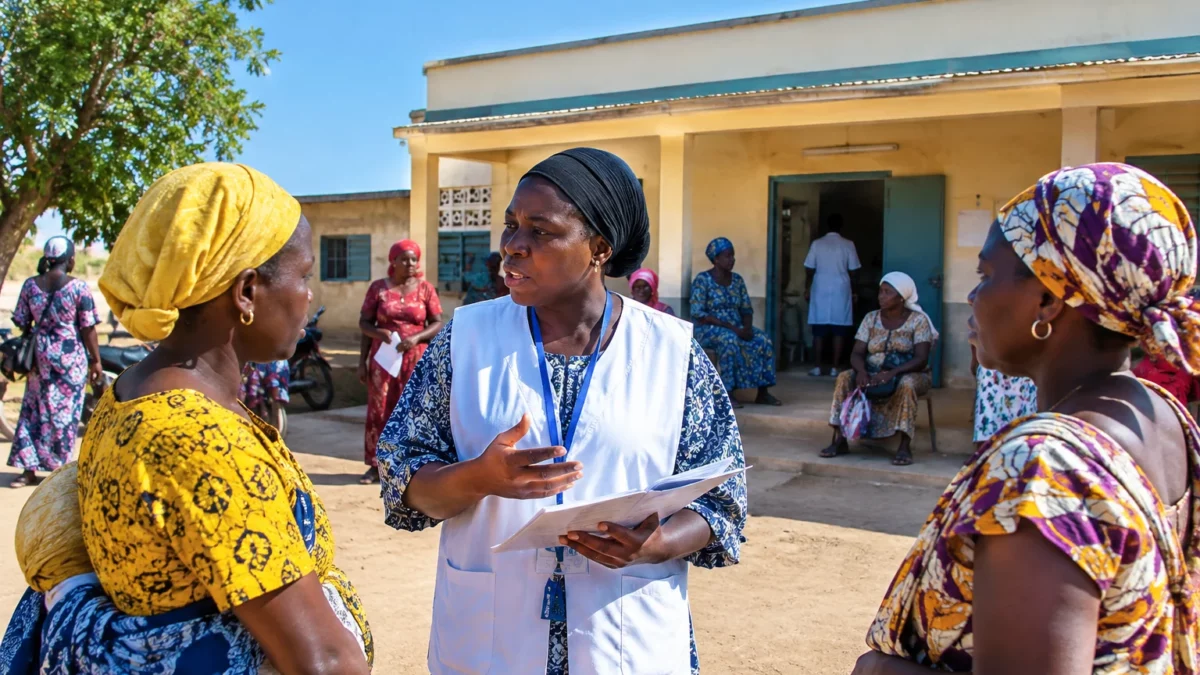
In Sadatou, in eastern Senegal, the death of a newborn has brought a question to the fore that reaches beyond the courtroom: how can girls be protected when banned practices persist in some communities? The criminal investigation is under way. But enforcement of the law alone is not enough to end social pressures and practices passed down from one generation to the next.
New developments in the Sadatou investigation
The infant, a girl born on 11 November at the Sadatou health post in Bakel department, is reported to have died after undergoing female genital mutilation when she was two days old. Initial reports say she suffered severe bleeding. She died while being transferred to the regional hospital in Tambacounda. Several media outlets have reported these details, but the precise circumstances remain to be established as part of the investigation.
The case has developed since initial reports said two women had been arrested. On 19 November, three people appeared before an investigating judge in Tambacounda: the child’s father and two women, one suspected of carrying out the procedure and the other described as her assistant. According to the Senegalese press, the father and the assistant were remanded in custody, while the person suspected of carrying out the mutilation was placed under judicial supervision. These decisions do not imply guilt, which is for the courts to establish.
The Associated Press, citing a local official, also reported three arrests and the child’s death following bleeding. The judicial details and charges brought are evolving as the proceedings continue. It is therefore important to distinguish reported facts from allegations and from conclusions that may be established by the investigation.
A banned practice, but an uneven fight against it
In Senegal, Law No. 99-05 of 29 January 1999 incorporated female genital mutilation into the Criminal Code. The law punishes the practice and may also apply to those who organise it or assist in carrying it out. It establishes a national framework, but does not automatically eliminate a clandestine practice or the social norms that may sustain it.
National data show that prevalence varies considerably by region and generation. In its 2023 Continuous Demographic and Health Survey, the National Agency of Statistics and Demography estimates that 20% of girls aged 0 to 14 in Tambacounda have undergone FGM. Across the country, rates differ markedly from one region to another. These statistics describe a collective situation: they cannot explain decisions made by a particular family or reduce a community to a single practice.
The challenge, then, is not simply to set the law against the population. Commitments to end the practice are also built locally. In July 2025, the Senegalese Press Agency reported that 14 people described as practitioners had pledged to abandon the practice in Tambacounda. A few days before the Sadatou tragedy, communities in 55 villages in the Mampatim arrondissement, in the Kolda region, declared an end to FGM and child marriage. These initiatives demonstrate that mobilisation is under way, but cannot on their own guarantee an end to clandestine acts.
The criminal response and its limits
The judicial proceedings must establish who did what, in what circumstances and with what degree of responsibility. The death of an infant demands a rigorous investigation, without a premature verdict. It also underscores the need for prevention to protect children before medical complications arise. In areas far from major centres, rapid access to emergency care is an additional concern, although the available information does not allow us to conclude that the time taken to transfer the child determined the outcome in this case.
For families, health professionals, local authorities and associations, the challenge is to share reliable information and provide trusted points of support. Awareness campaigns are more effective when they involve women, young people, community leaders and health workers. They should set out the risks and the legal framework without portraying Senegalese people as a homogeneous group or stigmatising an entire region.
The cross-border dimension also warrants attention. Senegal shares borders with several West African countries, where practices, legal frameworks and public responses are not the same. ECOWAS, a regional cooperation organisation, provides a forum for dialogue between states. But in this case, no public information supports claims of a cross-border dimension: the investigation concerns alleged acts in Sadatou and the Senegalese justice system.
What the case will put to the test
In the short term, the next steps in the investigation will show how the judge assesses the responsibility of the three people implicated and what medical and physical evidence is considered. In the longer term, the challenge will be to determine whether the legal ban is accompanied by effective protection for girls, including in communities far from Dakar.
The contrast between public declarations to abandon the practice and the persistence of clandestine acts does not make community initiatives pointless. Rather, it shows that progress is neither uniform nor irreversible. In Sadatou, the courts will have to establish the facts. For the authorities and local actors, the broader challenge remains: to prevent FGM, support families and make healthcare accessible, without conflating individual responsibility with a community’s identity.
Documentary sources: Associated Press report on the arrests and death ; Senegalese report on the 19 November court appearance ; ANSD 2023 Continuous Demographic and Health Survey ; text of Senegalese Law No. 99-05 ; pledges to abandon the practice reported in Tambacounda in 2025 ; declaration by 55 villages in Mampatim.



