
 Algeria
 Egypt
 Libya
 Morocco
 Sudan
 Tunisia
 Benin
 Burkina Faso
 Cabo Verde
 Côte d'Ivoire
 Ghana
 Guinea
 Guinea-Bissau
 Liberia
 Mali
 Mauritania
 Niger
 Senegal
 Sierra Leone
 The Gambia
 Togo
 Cameroon
 Central African Republic
 Chad
 DR Congo
 Equatorial Guinea
 Gabon
 Republic of the Congo
 São Tomé and Príncipe
 Burundi
 Comoros
 Djibouti
 Eritrea
 Ethiopia
 Kenya
 Madagascar
 Malawi
 Mauritius
 Mozambique
 Rwanda
 Seychelles
 Somalia
 South Sudan
 Tanzania
 Uganda
 Angola
 Botswana
 Eswatini
 Lesotho
 Namibia
 South Africa
 Zambia
 Zimbabwe
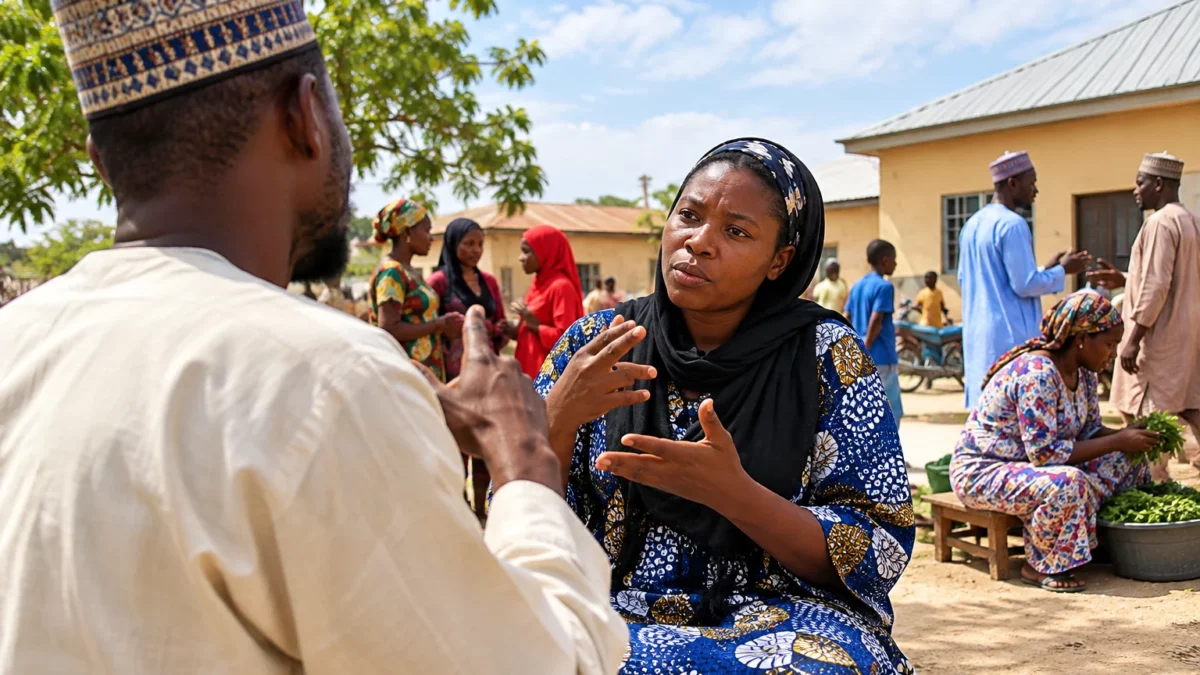
In Nigeria, access to school does not only shape the education of deaf people: it can also determine which sign language they use in everyday life. In the north of the country, Hausa Sign Language connects people who have not always been reached by formal education. For its users, it also carries a history and an identity.
A living language beyond the classroom
In Zuba, on the outskirts of Abuja, deaf people communicate in Hausa Sign Language. The language has become a shared means of communication in parts of northern Nigeria. Umaru Zayyanu, 37, uses it to say, “I am Nigerian”. He says this way of signing existed in his community before he went to school.
Nigeria has around 500 spoken languages, but the number of sign languages in the country is unknown. Researchers have studied Hausa Sign Language and that of the Bura community in the north-east, among others. Other communities may have developed their own practices, but these have yet to be widely documented.
These community languages should be distinguished from Nigerian Sign Language, which is taught in schools. The latter was influenced by formal education introduced in Nigeria in the 1960s by Andrew Foster, a deaf African-American educator who helped open schools for deaf people in several African countries. Nigerian researchers point out, however, that the language used in schools has evolved locally: it is not simply the same as American Sign Language.
Academic research also highlights the diversity of practices in and outside schools. In some communities, people who have not attended school use signs that differ from those taught in the classroom. These are not necessarily an incomplete version of the language used at school: they may constitute linguistic systems in their own right, with their own vocabulary and rules.
Education, transmission and recognition
This diversity raises a practical question: how can access to education be guaranteed without erasing the languages already used by children and their families? Languages taught at school can open doors to further study and public services. But those used in homes and communities make communication possible before children start school, particularly for people who have not been educated.
Taiwo Ajayi, a sign language interpreter and researcher, advocates documenting these practices to facilitate communication with people who are not proficient in the language taught at school. A university study published in 2018 had already noted the lack of in-depth research and recommended better documentation of Nigeria’s deaf communities. It identified Hausa and Bura sign languages in particular, while stressing that the available data do not cover the whole country.
Local initiatives are seeking to address some of this shortfall. Save the Deaf and Endangered Languages Initiative, a Nigerian organisation, describes a project to document on video sign languages used in several communities. Its work includes the Magajingari Sign Language in Kaduna State and plans to collect vocabulary, stories and cultural expressions. These resources can help pass on the languages, but their reach will depend on their accessibility and use by the communities themselves.
The issue goes beyond archives. When teaching resources and training prioritise a single language, children risk encountering a different language at school from the one they use at home. Conversely, recognising local practices does not mean giving up a common language for national services. It means bringing the two together more effectively: training teachers and interpreters, producing suitable materials and involving deaf people in decisions.
An inclusion issue across West Africa
The consequences vary according to location and personal circumstances. In large cities such as Abuja, proximity to schools, associations or interpreters can make it easier to access some services. In less well-served areas, someone who has not been to school may rely more heavily on the signs known to those around them. At work, the language chosen can also affect access to information and the ability to communicate with colleagues or customers.
Nigerian politicians have sometimes used people signing in Hausa at election rallies. Their presence makes visible an audience that campaigns must be able to inform. But it is no substitute for lasting services: interpretation in government offices, access to education and health resources that can be understood in the languages people actually use.
The issue also concerns neighbouring countries. In West Africa, several sign language education systems have been influenced by American Sign Language. Yet local languages and community realities differ from one country to another. The Economic Community of West African States (ECOWAS), a regional organisation of West African states, provides a forum for discussing inclusion and access to education, without implying that the entire region should have a single sign language.
The debate, then, is less about choosing between an official language and local languages than about how they can coexist. The immediate questions are who documents these languages, who decides their place in education, and how the resulting tools reach families, including those outside urban centres. In Nigeria, continued research by linguists and deaf activists will be crucial to understanding this diversity and assessing the need to pass these languages on.
For deaf people, preserving a language is not just a matter of heritage. It is also a condition for access to communication, education and public life. Hausa Sign Language and the sign languages of other Nigerian communities remain poorly documented; their place in education policy therefore remains an issue to watch.



