
 Algeria
 Egypt
 Libya
 Morocco
 Sudan
 Tunisia
 Benin
 Cabo Verde
 Côte d'Ivoire
 Ghana
 Guinea
 Guinea-Bissau
 Liberia
 Mali
 Mauritania
 Niger
 Nigeria
 Senegal
 Sierra Leone
 The Gambia
 Togo
 Cameroon
 Central African Republic
 Chad
 DR Congo
 Equatorial Guinea
 Gabon
 Republic of the Congo
 São Tomé and Príncipe
 Burundi
 Comoros
 Djibouti
 Eritrea
 Ethiopia
 Kenya
 Madagascar
 Malawi
 Mauritius
 Mozambique
 Rwanda
 Seychelles
 Somalia
 South Sudan
 Tanzania
 Uganda
 Angola
 Botswana
 Eswatini
 Lesotho
 Namibia
 South Africa
 Zambia
 Zimbabwe
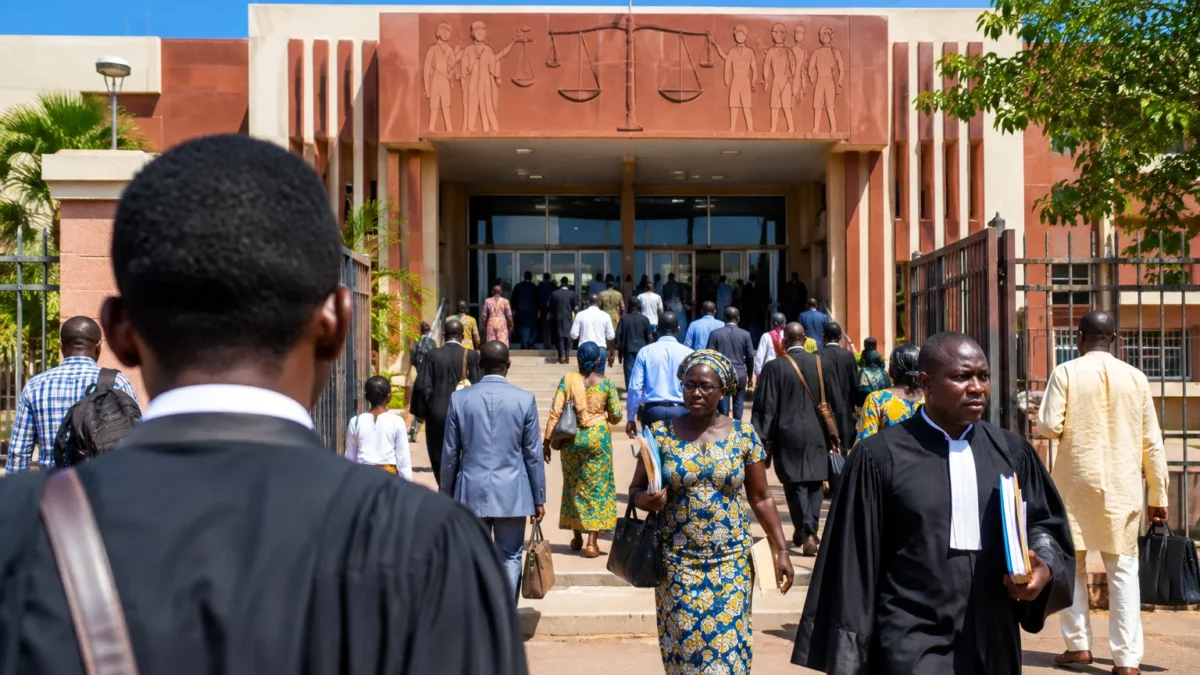
Can a counter-terrorism investigation cross borders without turning judicial cooperation into a tool of political pressure? In Burkina Faso, this question has arisen after the announcement of proceedings targeting people living in several countries, including journalists and figures critical of the government.
Proceedings launched in Ouagadougou, steps taken abroad
On 13 November, Désiré Sawadogo, the prosecutor general at the Ouagadougou Court of Appeal, announced the opening of six proceedings by the specialised judicial division responsible for prosecuting acts of terrorism. According to his statements, they concern at least 45 natural and legal persons. This figure does not mean that all 45 individuals are subject to a warrant or an extradition request.
The prosecutor’s office also reported international arrest warrants and extradition requests sent to Côte d’Ivoire, France and the United States. The Burkinabè press reported that 14 people living abroad were targeted by warrants accompanied by requests for their surrender. The scope described in different reports varies: the proceedings, warrants and extradition requests do not refer to one and the same list. It is therefore important not to confuse the total number of people named in the cases with the number of people sought abroad. Human Rights Watch reports the prosecutor’s statements; the Xinhua news agency and Burkinabè media outlet Faso7 have also reported on the judicial announcement.
Names cited in the reports include journalists Ahmed Newton Barry, Issaka Lingani, Inoussa Ouédraogo, Adama Ouédraogo and Abdoulaye Barry, cyberactivist Naïm Touré, former foreign minister Alpha Barry and journalist Wassim Nasr. The authorities accuse them of various offences, including alleged links to terrorist organisations, glorifying terrorism or undermining the morale of the armed forces. These accusations remain allegations: their announcement is neither a judgment nor proof of guilt.
The prosecutor also said that Burkina Faso was seeking the help of the US authorities to work with Meta and identify the administrators of Facebook pages accused of promoting terrorism. This step broadens the issue beyond extradition proceedings: it also concerns digital cooperation and how investigators interpret content published online.
A context shaped by war and control of information
Since 2017, Burkina Faso has been fighting Islamist armed groups. The war is weighing on communities, public services and security forces, while the military authorities present counter-terrorism as a national priority. In this context, terrorism-related offences may address real threats. But their definition and use must remain verifiable; otherwise, public debate and journalistic work risk being conflated with support for armed groups.
Human Rights Watch considers the announced proceedings part of a broader crackdown on critical voices. The organisation says those targeted had denounced abuses committed during military operations. It also questions the safeguards of the specialised court, citing prolonged pre-trial detention and violations of the right to a fair trial. These are the organisation’s assessments; the information available does not, on its own, make it possible to conclude that every proceeding is politically motivated.
The legal context has become tougher. On 20 October, the People’s Legislative Assembly adopted a new Criminal Code that reinstates the death penalty for certain offences, including terrorism, treason and espionage, according to the Burkina Information Agency. This change does not prove that those sought face the death penalty: that will depend on the charges brought and the course of the judicial proceedings. It nevertheless raises the stakes for any state asked to consider an extradition, particularly if the person risks a capital sentence.
The consequences are not limited to political figures or well-known journalists. For people in exile, a request for surrender can lead to arrest, legal proceedings and uncertainty about their safety. For their relatives who remain in the country, it can also deepen fears about speaking out or sharing information. Newsrooms, civic organisations and digital media must distinguish documented investigations from official accusations, without downplaying the security risks facing the country.
Extradition will depend on safeguards and foreign decisions
An international warrant does not automatically lead to a person’s arrest or transfer. Each state approached applies its own rules, examines the case documents and may assess the risks of ill-treatment, arbitrary detention or an unfair trial. Human Rights Watch is calling on the governments concerned to examine the requests with caution and not to return anyone who risks serious violations of their rights.
The reintroduction of the death penalty adds a further point of concern. France and Burkina Faso are bound by an extradition convention, but the decision rests with the competent authorities and depends on the safeguards provided for under the applicable law. The legal framework does not make it possible to presume the outcome of the requests sent to Paris, Abidjan or Washington. At this stage, the prosecutor’s announcements do not mean that these countries have agreed to an extradition.
A test for regional relations
The case is unfolding in a West Africa whose institutions are changing. Burkina Faso, Mali and Niger left ECOWAS, the Economic Community of West African States, on 29 January 2025 and have strengthened their cooperation within the Alliance of Sahel States. ECOWAS has nevertheless announced the temporary continuation of certain arrangements, including free movement for citizens of the three countries. This transition does not erase relations between states: requests for legal assistance and extradition will continue to test regional cooperation, as well as the safeguards each country provides to people who are sought.
The next challenge will be concrete: will the states approached confirm that they have received the requests, and what avenues of appeal will be available to those concerned? The answers will show how counter-terrorism, judicial sovereignty and the protection of freedoms are being reconciled in the region. For Burkinabè people, the balance is crucial: fighting armed groups while preserving transparent proceedings and the ability to report alleged abuses.



