Algeria
 Egypt
 Libya
 Morocco
 Sudan
 Tunisia
 Benin
 Burkina Faso
 Cabo Verde
 Côte d'Ivoire
 Ghana
 Guinea
 Guinea-Bissau
 Liberia
 Mali
 Mauritania
 Niger
 Nigeria
 Senegal
 Sierra Leone
 The Gambia
 Togo
 Cameroon
 Central African Republic
 Chad
 DR Congo
 Equatorial Guinea
 Gabon
 Republic of the Congo
 São Tomé and Príncipe
 Burundi
 Comoros
 Djibouti
 Eritrea
 Ethiopia
 Kenya
 Malawi
 Mauritius
 Mozambique
 Rwanda
 Seychelles
 Somalia
 South Sudan
 Tanzania
 Uganda
 Angola
 Botswana
 Eswatini
 Lesotho
 Namibia
 South Africa
 Zambia
 Zimbabwe
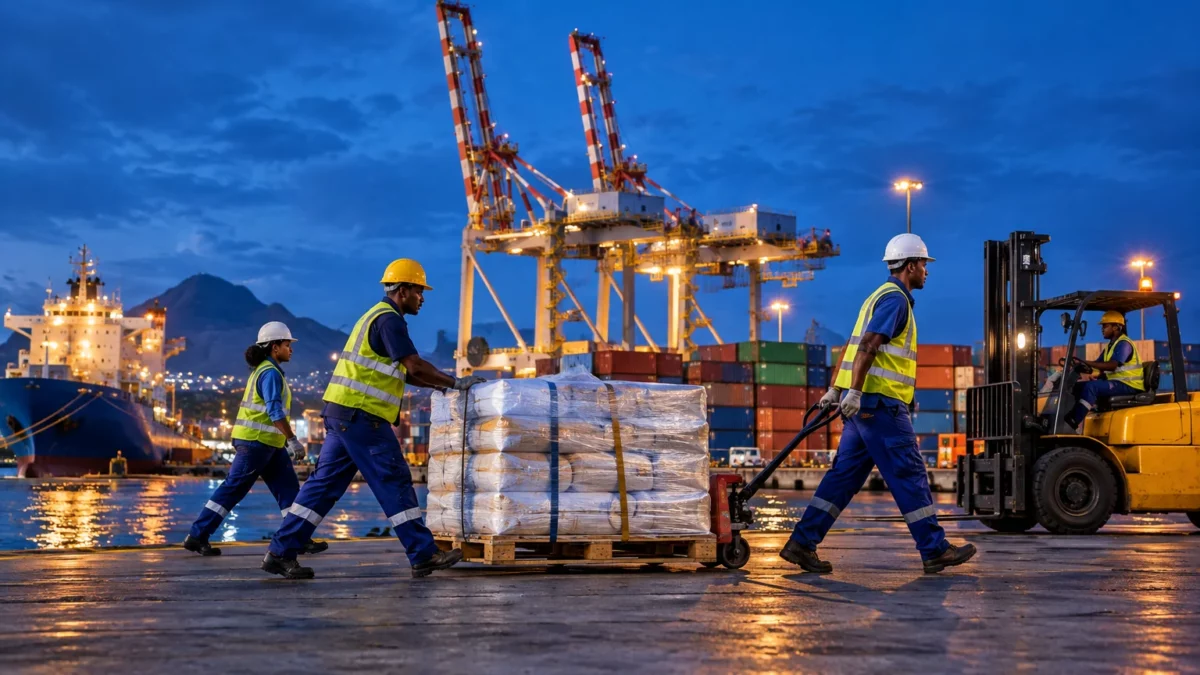
In the western Indian Ocean, maritime cooperation also hinges on ports, fuel stocks and the ability to deliver equipment quickly. Madagascar and the United States have just added a new instrument to their military relations. But this logistics agreement alone does not determine how far their rapprochement will go.
An agreement to exchange logistical support
On 17 November 2026 in Antananarivo, General Thomas M. Armas, deputy director of operations at the United States Africa Command (AFRICOM), and General Maminirina Ely Razafitombo, Madagascar’s Minister of the Armed Forces, signed an agreement known as an ACSA. The acronym refers to a mechanism that allows two armed forces to exchange supplies, services and logistical support.
In practical terms, the arrangement can cover needs such as refuelling, transport or services required for an exercise, a humanitarian operation or an emergency response. It provides for exchanges under terms agreed by the two parties. In itself, it is neither a defence alliance nor a general authorisation for US forces to be stationed in Madagascar.
The US Command describes Madagascar as the 30th African partner to join this type of network. The pan-African news agency APA, for its part, refers to a group of “more than 30” partners. The exact ranking therefore depends on the scope used and is not stated consistently in the available reports. The central fact, confirmed by Malagasy and regional media, is that the agreement was signed.
Antananarivo strengthens its maritime capabilities
The signing follows a visit to Madagascar by US officials from 2 to 4 November. The delegation, led by Lieutenant General John W. Brennan, AFRICOM’s deputy commander, met Malagasy officials and visited facilities related to maritime surveillance, including the Regional Maritime Information Fusion Centre and the naval base at Antsiranana.
These centres bring together and analyse information on activities at sea. They can help authorities detect illegal fishing, trafficking or suspicious movements. The cooperation therefore addresses a practical challenge for Madagascar, whose vast maritime domain stretches along the Mozambique Channel and busy shipping routes.
The channel links the south-western Indian Ocean to the maritime routes that run along southern Africa. Its surveillance is of interest to littoral states, as well as their partners. It concerns the safety of ships, fishing and the protection of marine resources. For Malagasy coastal communities, the management of these resources also has a direct impact on economic activity and livelihoods.
Potential benefits and questions to watch
For Madagascar’s armed forces, the agreement could reduce the time needed to obtain certain goods or services during a crisis, an exercise or a relief operation. Madagascar is regularly exposed to cyclones and emergencies that complicate the delivery of aid. A logistics framework can facilitate coordination, but its effectiveness will depend on available resources, agreed procedures and the ability of national institutions to use them.
For Washington, such a mechanism also makes it easier to work with partners and prepare exercises. General Armas described logistics at the ceremony as a condition for successful operations and cited natural disasters and surveillance of the Mozambique Channel. This official rationale sets out US objectives; it is not enough to establish that the two countries’ priorities fully coincide.
The question of reciprocity therefore merits attention. What services will Madagascar be able to provide? Under what rules will costs and exchanges be calculated? Which authorities will oversee their implementation? The public information consulted does not detail all the financial and operational terms of the agreement. It is therefore premature to infer that US forces will have permanent access to Malagasy ports or bases.
The effects will not be the same for everyone. Military officials may benefit from better coordination and faster support. Residents could benefit indirectly from better-organised emergency responses. But the cooperation guarantees neither additional equipment nor an automatic improvement in public services. These outcomes will depend on decisions by both governments and on the resources actually committed.
A partnership in a region attracting interest
Madagascar is pursuing this cooperation amid a political transition and efforts to diversify its external partnerships. The island has relations with several international actors. The agreement with Washington thus adds to a diplomacy seeking to preserve room for manoeuvre, rather than signalling an alignment that could be inferred from a single signature.
At regional level, Madagascar is a member of the Southern African Development Community (SADC), an organisation for cooperation among Southern African countries, and the Indian Ocean Commission. Maritime security there also depends on information-sharing and coordination between states. Bilateral arrangements can support these efforts, provided they complement rather than replace regional mechanisms.
The next step will be to see how the agreement is implemented: what exchanges take place, how they are regulated and whether Malagasy forces have the resources needed to benefit from it. The regional exercise Cutlass Express 2027, mentioned during the US visit in November, will also provide a concrete indication of the role Madagascar will play in maritime cooperation in the western Indian Ocean.