
 Algeria
 Egypt
 Libya
 Morocco
 Sudan
 Tunisia
 Benin
 Burkina Faso
 Cabo Verde
 Côte d'Ivoire
 Ghana
 Guinea
 Guinea-Bissau
 Liberia
 Mali
 Mauritania
 Niger
 Nigeria
 Senegal
 Sierra Leone
 The Gambia
 Togo
 Cameroon
 Central African Republic
 Chad
 DR Congo
 Equatorial Guinea
 Gabon
 Republic of the Congo
 São Tomé and Príncipe
 Burundi
 Comoros
 Djibouti
 Eritrea
 Ethiopia
 Kenya
 Madagascar
 Malawi
 Mauritius
 Mozambique
 Rwanda
 Seychelles
 Somalia
 South Sudan
 Tanzania
 Uganda
 Angola
 Botswana
 Eswatini
 Lesotho
 Namibia
 Zambia
 Zimbabwe
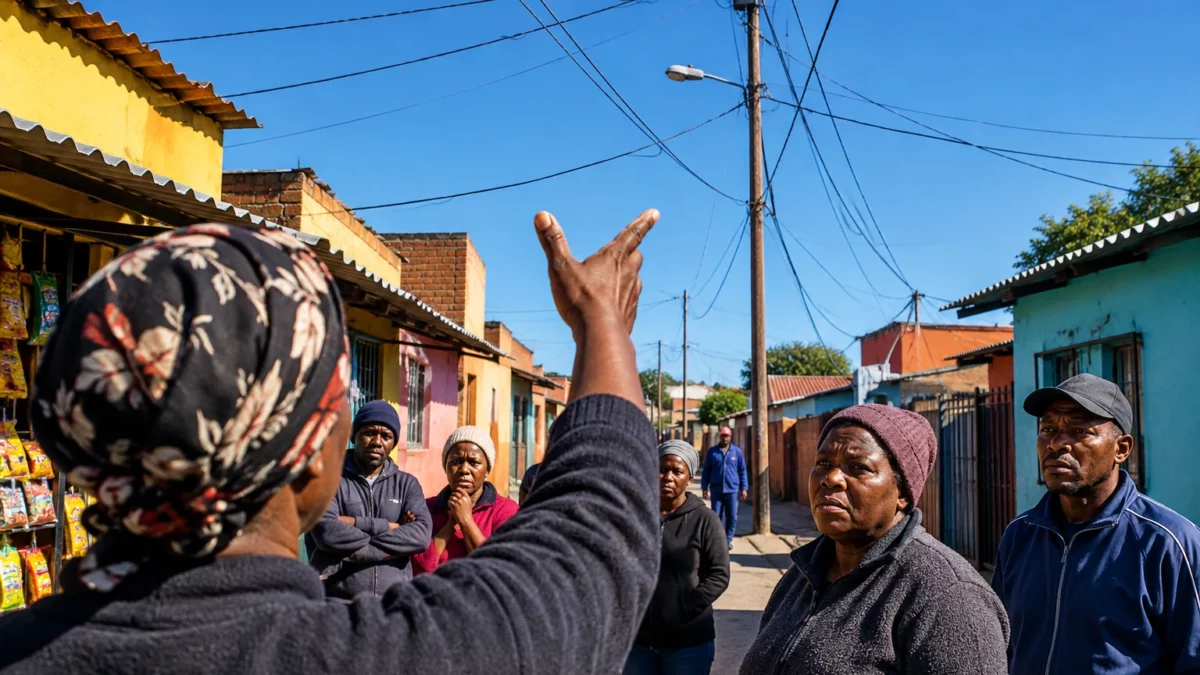
In a street where electricity has returned but can still be cut at certain times, improvements to the national grid do not solve everything. In South Africa, the challenge is shifting from power stations to the lines that supply neighbourhoods.
This distinction matters to households and small businesses. Sufficient generation at national level does not, by itself, guarantee a regular supply in every area.
Two types of outage, two different problems
“Load shedding” refers to scheduled outages across the grid when generation is insufficient to meet demand. “Load reduction”, by contrast, targets specific areas where local lines risk being damaged by overloading.
Eskom, the state-owned company that generates and distributes much of South Africa’s electricity, links these overloads in particular to illegal connections and meter tampering. The measure protects equipment, but leaves affected residents with a restricted supply.
This distinction helps explain the current paradox: the country can avoid national power cuts while maintaining local restrictions. According to Eskom, South Africa has had no “load shedding” since 16 May 2025. On 16 November 2026, the counter stood at 546 consecutive days without scheduled outages, a milestone also reported by South African media.
The number of customers still affected is falling
In its update of 13 November, Eskom said 1,591,837 customers had returned to a normal supply. The number of customers still subject to “load reduction” is said to have fallen from about 1.69 million to 102,551, a reported decrease of 94%. The company aims to end these restrictions by March 2027.
Seven of the nine provinces are said to have exited the scheme. Work is continuing in areas of Gauteng and KwaZulu-Natal, where local grids remain exposed to overloads. This concentration is a reminder that national averages mask different experiences across regions and neighbourhoods.
Eskom’s programme covers 971 supply lines, known as “feeders”, serving different areas. Planned solutions include smart meters, the integration of decentralised energy resources and broader access to free basic electricity for eligible households.
Eskom had already noted in an earlier communication that the installation of more than 122,000 planned meters had been delayed by work stoppages, security incidents or local resistance. These obstacles are not purely technical: the work also requires access to neighbourhoods and co-operation with communities.
Available data should nevertheless be read with caution. A communication published by Eskom in September reported 512,257 meters installed and 571 lines removed from the scheme. These figures do not directly correspond to the totals cited for November in the available information. The reference dates and scope therefore need to be specified before any comparison is made.
Generation is improving, but distribution remains decisive
The recovery in generation is another strand of the turnaround. The energy availability factor measures the share of generation capacity that is actually available. According to figures provided by Eskom and reported by Eyewitness News, it stood at about 68% in early November 2026, while the company says it has recovered nearly 6,481 megawatts of capacity in three years.
This progress can reduce the risk of a national shortfall. But it does not automatically repair an overloaded transformer or a weakened neighbourhood line. Investment in power stations and investment in distribution address related but distinct needs.
The consequences are also unevenly distributed. For households still subject to restrictions, limited access complicates everyday tasks. For small businesses, interruptions can disrupt opening hours and equipment. Businesses with backup solutions are better placed than those without them, while neighbourhoods prioritised for work depend on the pace of actual installations.
The rollout of smart meters can help monitor consumption more effectively and reduce some losses. But its effectiveness will depend on the reliability of the equipment, maintenance of the grids and Eskom’s ability to explain the changes to affected residents. Technology is no substitute for maintenance or local trust.
A South African challenge, a signal for Southern Africa
In South Africa, Pretoria bears national political responsibility, while practical difficulties also play out in municipalities and local grids. Co-ordination between Eskom, municipal authorities and communities will therefore be crucial to turning improvements at power stations into a more regular service.
At regional level, SADC — the Southern African Development Community — provides a framework for co-operation among countries in the region, particularly on energy. The South African case highlights a shared challenge: having generation capacity is not enough if transmission and distribution grids cannot deliver electricity reliably.
The next stated deadline is March 2027, when Eskom wants to have eliminated “load reduction”. Until then, the indicators to watch are the actual number of customers still affected, progress on work in Gauteng and KwaZulu-Natal, and the ability to sustain generation gains. The extent of the national recovery will be measured by these local results.



