Algeria
 Egypt
 Libya
 Morocco
 Sudan
 Tunisia
 Benin
 Burkina Faso
 Cabo Verde
 Côte d'Ivoire
 Ghana
 Guinea
 Guinea-Bissau
 Liberia
 Mali
 Mauritania
 Niger
 Nigeria
 Senegal
 Sierra Leone
 The Gambia
 Togo
 Cameroon
 Central African Republic
 Chad
 DR Congo
 Equatorial Guinea
 Gabon
 Republic of the Congo
 São Tomé and Príncipe
 Burundi
 Comoros
 Djibouti
 Eritrea
 Ethiopia
 Kenya
 Madagascar
 Malawi
 Mauritius
 Mozambique
 Rwanda
 Seychelles
 Somalia
 South Sudan
 Tanzania
 Uganda
 Angola
 Botswana
 Eswatini
 Lesotho
 Namibia
 South Africa
 Zambia
 Zimbabwe
Can an electric truck earn its place on African roads without relying on a dense charging network? For Sinotruk, the Chinese heavy-truck manufacturer, construction sites, commercial fleets and local assembly offer an initial answer: start where vehicles work and recharge in the same place.
Different markets, the same industrial bet
The roll-out does not follow a single model. In Nigeria, Ghana and Côte d’Ivoire, the manufacturer relies on commercial or industrial partners. In Ethiopia, electric trucks have been assigned to a major construction project. In Rwanda, the introduction of vehicles has been announced, without a specific timetable. These experiences do not mean that electric heavy trucks are already widely available in these countries.
This expansion is taking place in a sector where diesel trucks remain essential to freight transport, public works and mining. For companies, electric vehicles can reduce some energy costs and emissions during use. But their appeal depends in particular on the purchase price, range under a heavy load, availability of parts and access to electricity.
The regional context also matters. Nigeria is West Africa’s largest economy and a major domestic market. Ghana and Côte d’Ivoire, members of the Economic Community of West African States (ECOWAS), could serve as bases for regional commercial activities. In the east, Ethiopia and Rwanda have different national dynamics: announcements in one country do not automatically describe conditions in the other.
From assembled truck to first uses
In Nigeria, Dangote Sinotruk West Africa Limited, a joint venture between Nigerian group Dangote and the Chinese manufacturer, unveiled a locally assembled heavy electric truck in November 2026. Nigerian media outlet Punch reports that the company describes it as the first electric heavy truck assembled in the country. This claim is attributed to the company and does not, by itself, amount to independent verification of the entire market.
According to Dangote, the joint venture, established in 2014, has assembled more than 8,000 vehicles in Nigeria. It also offers tipper trucks, vans, pick-ups and buses. The arrival of an electric model therefore expands an existing range; it does not mark the immediate replacement of combustion-engine vehicles. For hauliers, the challenge will be to compare total operating costs, including purchase, charging, maintenance and downtime.
In Ghana, local partner Zonda Tec unveiled the HOWO V7X electric tipper truck in Tema in July 2026. An initial order of ten units was announced for construction company Big Aidoo. The launch and order have been reported by industry sources and the partner. A construction site is a targeted use: a vehicle regularly returns to a base, which in principle makes it easier to organise charging, without guaranteeing that operations will be profitable in all conditions.
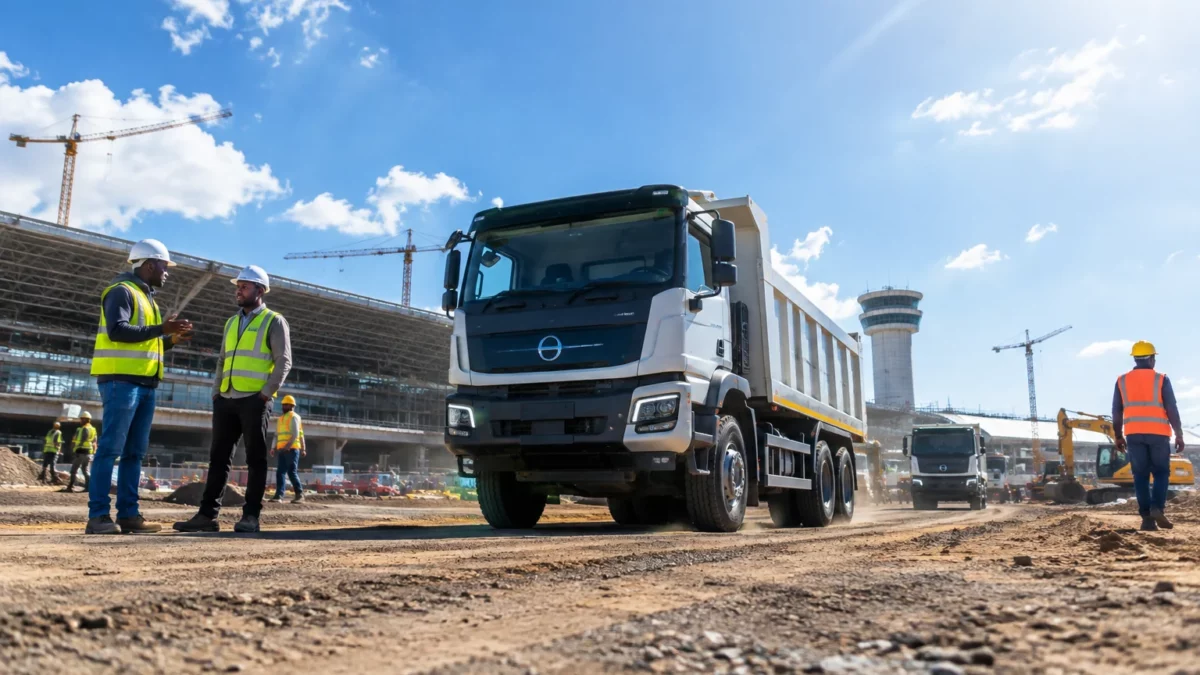
In Ethiopia, 50 heavy electric trucks entered service on 29 April 2026 at the site of the new Bishoftu International Airport, near Addis Ababa. Xinhua attributes their deployment to China Communications Construction Company, the firm responsible for the project. This is therefore a use on a major construction site, not proof of general availability to Ethiopian hauliers. The Chinese news agency also reported that more vehicles were expected.
In Rwanda, distributor Asia Machinery Investments announced in July its intention to introduce electric trucks for domestic transport. No launch timetable was provided in the available information. In Abidjan, Sinotruk unveiled three vehicles, including a heavy electric truck, at a regional meeting on 9 November 2026, according to the Ivorian News Agency.
Local assembly, a central issue
The strategy is not limited to electrification. In Côte d’Ivoire, Sinotruk and Yeshi Group began work on a heavy-truck assembly plant in Yopougon, in the Abidjan district, on 8 November. Its announced capacity is 5,000 vehicles a year. The developers plan to supply several markets, including Mali, Burkina Faso, Guinea and Liberia. This is an industrial objective, whose fulfilment will depend on the site becoming operational, demand and regional commercial conditions.
In Algeria, another of the group’s markets, production of the 3,000th truck under its partnership with Tirsam was announced in August 2026 at the Batna site. The partners also referred to a new welding line. These projects show that Sinotruk’s presence still relies largely on conventional vehicles and assembly capacity. Electric vehicles are being added to this base rather than replacing it.
The decision to manufacture or assemble locally can support jobs and bring after-sales service closer to customers. However, assembly does not necessarily mean that all parts are produced locally. The benefits will depend on local content, technical training, the suppliers involved and the ability to provide repairs and spare parts beyond major cities.
Charging and costs will determine what comes next
The first opportunities are emerging mainly in activities with predictable routes: construction, on-site transport and commercial fleets. These uses make it possible to plan vehicle rotations and install charging points at a base or on a construction site. By contrast, long-distance transport between several cities requires accessible charging along routes, downtime compatible with operations and a reliable maintenance network.
The effects will also differ between operators. A large company can invest in chargers and replace several vehicles at once. An independent haulier or small public-works company must first be able to finance the truck and bear the cost of any downtime. The climate benefits will depend on how the electricity is generated and how the vehicles are actually used.
Market estimates cited in the available data put African truck consumption at 481,000 units in 2024, worth $14.3bn, and project 525,000 units in 2035. These figures, attributed to IndexBox, cover the truck market as a whole: they do not measure demand for electric vehicles. They indicate the scale of the sector, but do not allow conclusions about whether the electric transition will be rapid.
The next stage will therefore depend less on announcements than on operating results: the number of vehicles actually delivered, charging costs, range in working conditions, availability of technicians and repeat orders. For the West African countries concerned, the announced plants and regional trade could expand production. But commercial integration will not be enough without suitable infrastructure and services. Experience from construction sites in Nigeria, Ghana and Ethiopia will provide concrete benchmarks, without prejudging the pace of adoption in other markets.