Algeria
 Egypt
 Libya
 Morocco
 Sudan
 Tunisia
 Benin
 Burkina Faso
 Cabo Verde
 Côte d'Ivoire
 Ghana
 Guinea
 Guinea-Bissau
 Liberia
 Mauritania
 Niger
 Nigeria
 Senegal
 Sierra Leone
 The Gambia
 Togo
 Cameroon
 Central African Republic
 Chad
 DR Congo
 Equatorial Guinea
 Gabon
 Republic of the Congo
 São Tomé and Príncipe
 Burundi
 Comoros
 Djibouti
 Eritrea
 Ethiopia
 Kenya
 Madagascar
 Malawi
 Mauritius
 Mozambique
 Rwanda
 Seychelles
 Somalia
 South Sudan
 Tanzania
 Uganda
 Angola
 Botswana
 Eswatini
 Lesotho
 Namibia
 South Africa
 Zambia
 Zimbabwe
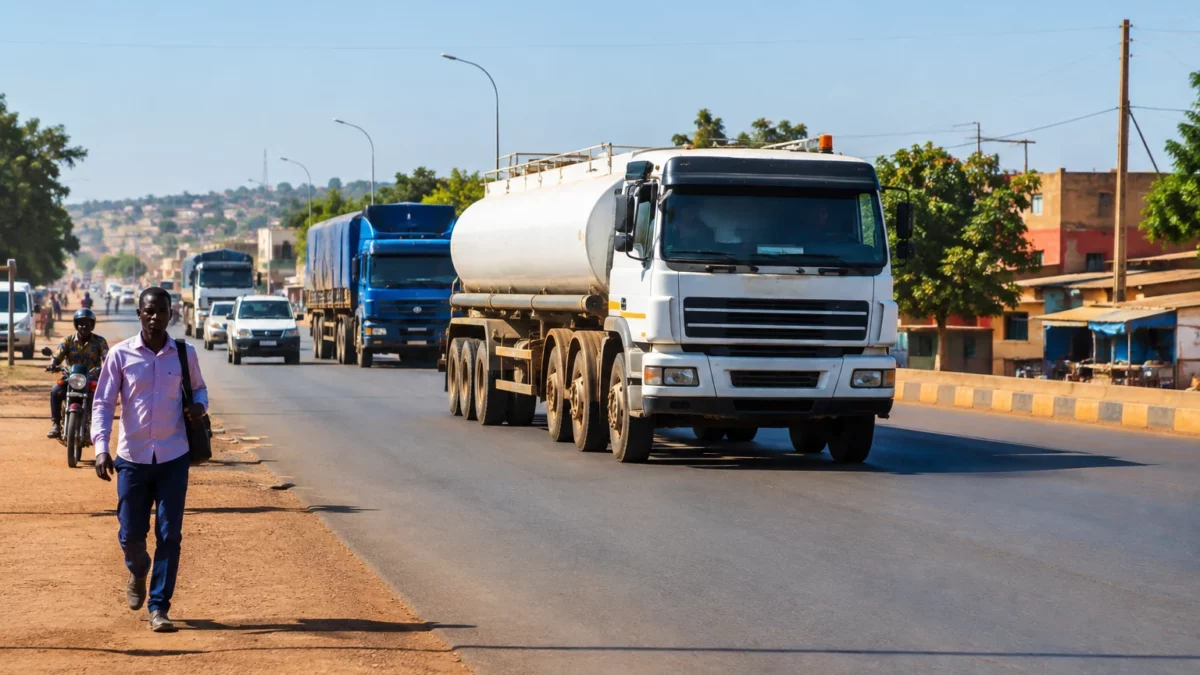
When a tanker truck is delayed on its way to Bamako, the effects go beyond petrol stations. The movement of goods slows, costs rise and the activity of cities and regions becomes more dependent on fuel availability. In response to this vulnerability, Mali is now assigning new public companies roles in supply and logistics.
A landlocked country where regional routes are decisive
Mali depends on corridors linking it to ports in neighbouring countries. Fuel arrives in particular along the Abidjan-Bamako and Dakar-Bamako routes. This geography makes trade vulnerable to incidents on the roads, transport delays and decisions taken beyond Mali’s borders.
The convoy crisis, which began in September 2025, showed how heavily this dependence can affect daily life. FEWS NET, a food security analysis network, says attacks on tanker trucks disrupted supplies and increased transport costs. Its October 2026 report notes that flows along the Dakar-Bamako route remain reduced, although those via Abidjan have improved. Disruptions do not affect every region in the same way: households and markets far from the main routes also face access constraints and distribution costs. FEWS NET’s analysis of Mali in October 2026 describes these differences and their effects on trade.
The regional framework has also changed. Mali, Burkina Faso and Niger’s withdrawal from ECOWAS, the Economic Community of West African States, took effect on 29 January 2025. Trade and transport links with neighbouring countries nevertheless remain essential. Bamako’s ability to secure its supplies therefore still depends on practical cooperation with transit countries. ECOWAS confirmed the date on which the withdrawal took effect.
SUGU adds to the public-sector framework
On Wednesday 18 November 2026, Mali’s Council of Ministers adopted the texts establishing SUGU S.A. and setting out its organisation and operations. According to a report carried by the African Press Agency, the company is to acquire goods and services and conduct exports of strategic products on behalf of the state. The statement does not yet specify its capital, funding or the list of products concerned. SUGU S.A.’s announced responsibilities are also reported in the minutes of the Council of Ministers meeting on 18 November.
The new body joins the Malian Transport and Logistics Company (SMTL-SA), whose creation was approved in September. The state-owned company is to transport people and goods in Mali and abroad. On 7 October, it signed a contract worth more than 30 billion CFA francs with Russian manufacturer KAMAZ for the supply of vehicles. The authorities have also announced maintenance and training services. The government has raised the possibility of setting up a service centre in Bamako, followed by an assembly unit, but these remain plans. The Malian government has outlined the objectives of the KAMAZ contract.
This approach forms part of a broader expansion of public-sector involvement. In April 2026, the government established a national security stock of petroleum products, described as equivalent to 45 days’ consumption of fuel and butane gas. The stated aim is to better absorb supply interruptions and market pressures. However, storing, purchasing and transporting are distinct functions: their coordination will determine whether the new bodies reinforce one another or overlap.
Practical results remain to be seen
For traders and transporters, the central promise is more reliable flows. A public fleet could increase available capacity and help move essential goods. SUGU, for its part, could organise some state purchases and support exports of products considered strategic. But these aims alone do not guarantee lower prices or uninterrupted supply.
Households feel supply disruptions through transport costs, access to goods and services that depend on fuel. Small businesses and informal operators, which often have less financial leeway than major importers, may be particularly exposed to delays or rising costs. In areas far from Bamako, moving goods also means covering distances and overcoming security constraints that the purchase of vehicles cannot eliminate.
The precedent of the Malian Import and Export Company (SOMIEX), established in 1960, has prompted questions about SUGU’s future role. SOMIEX had, among other things, held monopolies over the import of essential goods and the export of groundnuts. It gradually lost its privileges in the 1980s and was liquidated in 1988 as part of liberalisation reforms. There is no indication that SUGU will follow this model: no monopoly has been announced. The comparison nevertheless highlights the importance of clarifying competition rules and relations with private operators and existing bodies, including the Mali Agricultural Products Office.
Logistical sovereignty also depends on neighbours
The decision to strengthen public companies addresses a genuine economic security concern. But FEWS NET’s reports show that the availability of goods depends as much on roads, transporters and the security situation as on Bamako’s institutional capacity. A national company cannot, on its own, protect a corridor that crosses several countries.
For West Africa, Mali’s experience raises a broader question: how can greater national control be reconciled with trade that relies on regional networks? The next indicators will be concrete: SUGU’s resources and governance, the deployment of SMTL’s vehicles, the continuity of flows on the Dakar-Bamako and Abidjan-Bamako routes, and changes in costs for businesses and consumers. The new framework’s significance will be measured by these results, rather than by announcements of its creation.