Algeria
 Egypt
 Libya
 Morocco
 Sudan
 Tunisia
 Benin
 Burkina Faso
 Cabo Verde
 Côte d'Ivoire
 Guinea
 Guinea-Bissau
 Liberia
 Mali
 Mauritania
 Niger
 Nigeria
 Senegal
 Sierra Leone
 The Gambia
 Togo
 Cameroon
 Central African Republic
 Chad
 DR Congo
 Equatorial Guinea
 Gabon
 Republic of the Congo
 São Tomé and Príncipe
 Burundi
 Comoros
 Djibouti
 Eritrea
 Ethiopia
 Kenya
 Madagascar
 Malawi
 Mauritius
 Mozambique
 Rwanda
 Seychelles
 Somalia
 South Sudan
 Tanzania
 Uganda
 Angola
 Botswana
 Eswatini
 Lesotho
 Namibia
 South Africa
 Zambia
 Zimbabwe
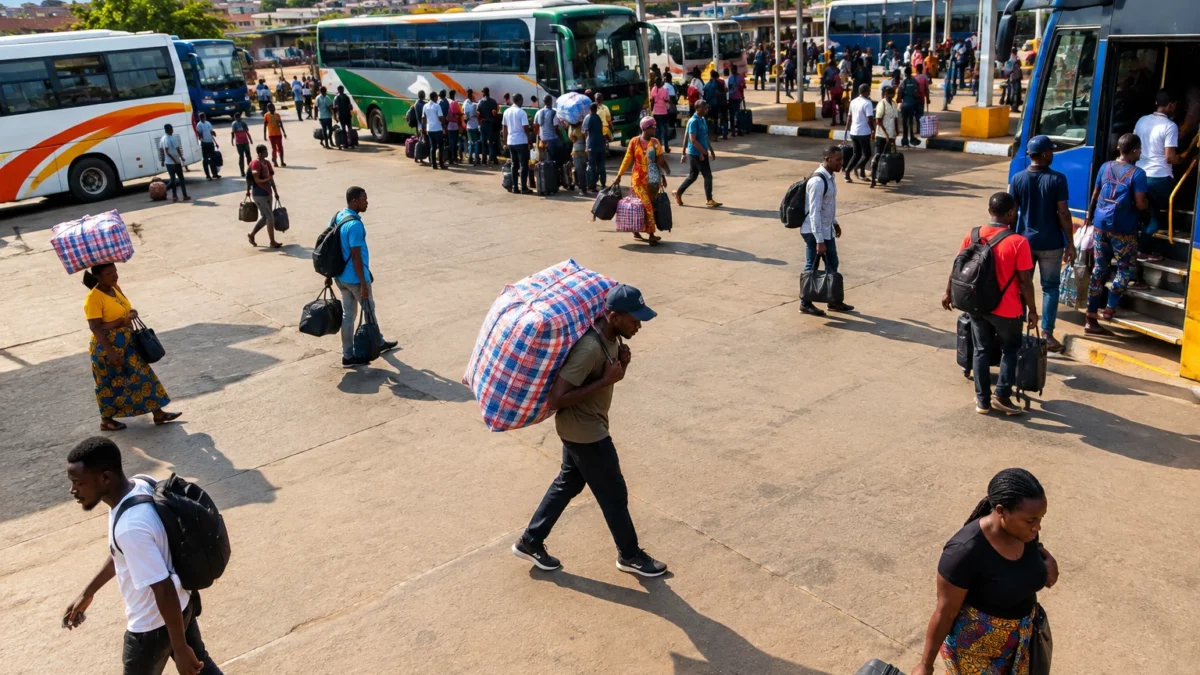
In Accra’s markets, the checked bag is used to carry goods, clothes or provisions. But its name recalls another purpose: luggage packed in haste when families had to leave Nigeria in 1983. Its story thus connects everyday life in Ghana with West African debates over borders, citizenship and free movement.
A memory linked to the 1983 expulsions
The nickname “Ghana Must Go” refers to the expulsion of West African migrants ordered by Nigeria in early 1983. Estimates of the number of people forced to leave vary according to sources and the scope used. Academic studies cite more than one million Ghanaians expelled, while other estimates count all the migrants affected. It is therefore more prudent not to reduce the event to a single figure.
Nigeria’s president, Shehu Shagari, justified the departures at the time by citing the irregular status of many migrants, amid economic difficulties and tensions over employment. The authorities gave them little time to leave the country. Strong, inexpensive woven-plastic bags became a way for some to carry their belongings. The name associated with the expulsion order subsequently became attached to the bag itself.
However, this sequence did not begin in 1983. In 1969, Ghana, under Kofi Abrefa Busia’s government, adopted a measure requiring many foreign residents without permits to leave. Nigerians were among those affected. The successive expulsions form part of a regional history in which governments have sometimes set national sovereignty against the mobility of people. A study published in the journal Past & Present traces the expulsions between Ghana and Nigeria and their political and legal roots.
Free movement, a principle put to the test
Ghana and Nigeria are two West African powerhouses. Both belong to the Economic Community of West African States (ECOWAS), which aims, among other things, to facilitate the movement of people and goods across the region. The expulsions of the 1960s and 1980s nevertheless show the potential gap between regional commitments and decisions taken during economic or political crises.
The consequences extend beyond relations between Accra and Abuja. Mass expulsion upends the lives of those affected: workers, traders and families can lose their homes, incomes and networks. On their return, pressure falls on host communities, public services and labour markets. But the experience varies according to people’s circumstances: a formal-sector employee, a female vendor or a schoolchild does not experience displacement in the same way.
The historical context also cautions against a one-sided account. Both countries have pursued policies expelling foreign nationals. This reciprocity does not erase the responsibilities of each government or individual suffering. Rather, it helps explain how economic difficulties and debates over national belonging could undermine regional cooperation. Academic research describes the expulsions of 1969 and 1983 as a blow to the principle of free movement in Africa.
From return luggage to everyday object
Today in Ghana, the bag is sold in markets and shops as a practical, affordable container available in several sizes. Its everyday use does not mean its past has disappeared. For some families, the name remains associated with forced departure and return. For others, it refers above all to a functional object that has become familiar over generations.
Ghanaian artists also use its pattern in works about migration and memory. In Accra, artist Abdur Rahman Muhammad has incorporated it into his paintings, giving a popular object a place in a cultural setting. This appropriation does not turn expulsion into a triumphant story; rather, it shows that a painful symbol can be reinterpreted without erasing its origins.
The bag also circulates beyond the continent. In Hong Kong, migrant domestic workers, particularly Filipinas, use large bags and parcels to gather goods for relatives back home. A report by Namibia’s NAMPA news agency describes this practice in the city’s shopping streets. The gesture evokes family distance and transnational exchanges, but these shipments should not be confused with the specific history of the 1983 expulsions: the same object accompanies different migration experiences.
A shared symbol, but not a uniform memory
“Ghana Must Go” now spans several settings: Accra’s markets, regional journeys, shops and networks for sending goods. Its spread shows how an object can acquire new uses. But that does not make its history the same everywhere. In Ghana, Nigeria and migrant communities in Asia, the bag may evoke coercion, family memory or simply convenience.
Across West Africa, its history is a reminder that free movement also depends on national policies, the protection of migrants and cooperation between states. ECOWAS remains the relevant regional framework for these issues. The bag’s journey does not sum up African migration; it makes one tangible part of it visible: the belongings people take with them, the ties they maintain and the memories that travel with them.