Algeria
 Egypt
 Libya
 Morocco
 Sudan
 Tunisia
 Benin
 Burkina Faso
 Cabo Verde
 Côte d'Ivoire
 Ghana
 Guinea
 Guinea-Bissau
 Liberia
 Mali
 Mauritania
 Niger
 Nigeria
 Senegal
 Sierra Leone
 The Gambia
 Togo
 Cameroon
 Central African Republic
 Chad
 DR Congo
 Equatorial Guinea
 Gabon
 Republic of the Congo
 São Tomé and Príncipe
 Burundi
 Comoros
 Djibouti
 Eritrea
 Ethiopia
 Kenya
 Madagascar
 Malawi
 Mauritius
 Mozambique
 Rwanda
 Seychelles
 Somalia
 Tanzania
 Uganda
 Angola
 Botswana
 Eswatini
 Lesotho
 Namibia
 South Africa
 Zambia
 Zimbabwe
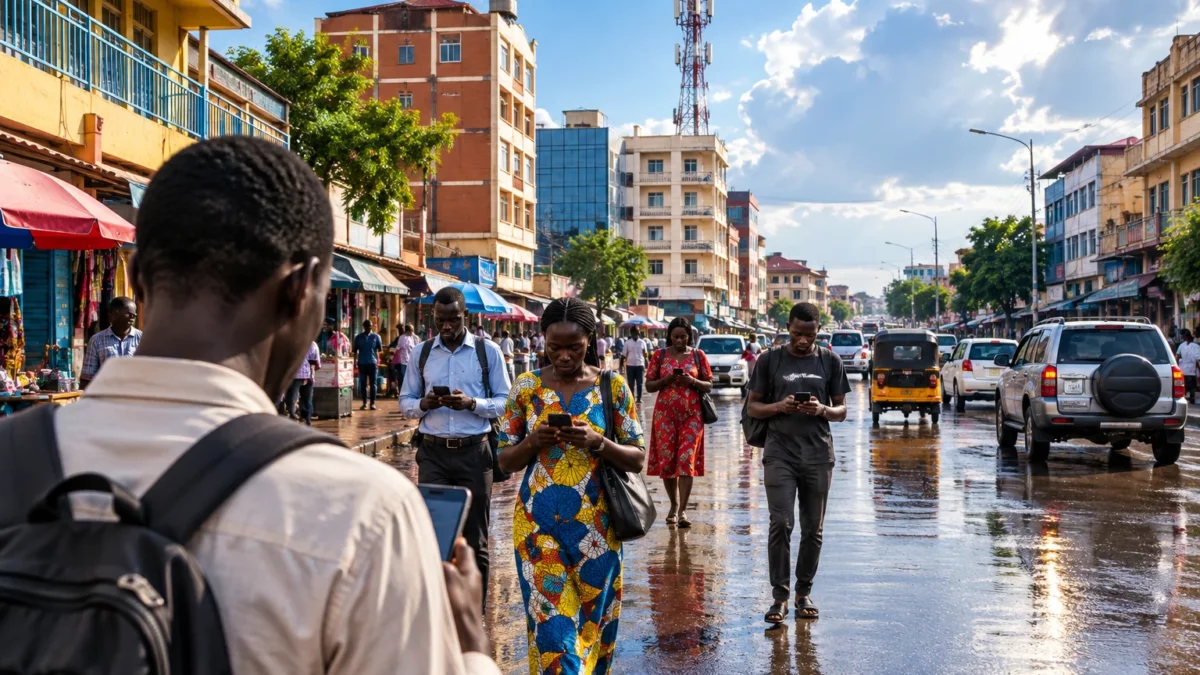
When operators lack foreign currency to buy equipment or maintain their networks, the effects are felt far beyond company offices. In South Sudan, the quality and continuity of communications also depend on monetary decisions, the availability of payment methods and the authorities’ ability to enforce sector rules.
A vital network in an economy under strain
In Juba, telecommunications rely mainly on MTN, Zain and Digitel. Mobile services enable people to contact family and colleagues, as well as access the internet and digital financial services. Expanding and maintaining a network requires regular investment, particularly to import equipment and power mobile masts.
Subscription figures should be treated with caution. DataReportal estimates that South Sudan had 5.89 million active mobile connections at the end of 2025. This figure refers to connections, not necessarily an equal number of distinct people. It also differs from the estimate of 6.78 million cited for the market in some data reported in 2026. The periods and methods are not identical, so these figures alone do not establish a definite increase.
The regional context also matters. South Sudan is a member of IGAD, the regional organisation for East Africa. But the difficulties described here are primarily national: they affect access to foreign currency, cash transactions, regulation and operating costs. They compound disparities in access between Juba and less well-served areas.
Regulator and operators hold talks
The National Communication Authority (NCA), South Sudan’s telecommunications regulator, met MTN South Sudan’s management to examine operational obstacles affecting the company and the continuity of services. The meeting is part of a series of consultations with operators.
Discussions focused in particular on access to foreign currency, difficulties with cash transactions and the shift to digital payments. These issues do not concern MTN alone: they also affect companies’ ability to pay expenses, import equipment and maintain infrastructure.
A ministerial meeting held in Juba on 2 March 2026 had already brought together representatives of MTN, Zain and Digitel, as well as the regulator. Discussions covered taxation, delays in delivering equipment, restrictions on access to foreign currency and customs clearance for SIM cards. The use of electronic payments and the coordination of tariffs were also among the issues raised.
Exchange rates: balancing viability and customers’ bills
In June 2026, the NCA approved a gradual adjustment to the reference exchange rate used to calculate certain telecoms tariffs. The decision aimed to bring the rate closer to economic conditions and take account of rising costs borne by operators. According to reports published at the time by Radio Tamazuj and Eye Radio, the first stage was due to take effect on 26 June.
The measure leaves the authorities facing a delicate balance. A reference rate better aligned with costs could ease financial pressure on operators and support network maintenance. But if the adjustment feeds through to prices, customers will feel the impact, particularly those who rely on prepaid top-ups and have limited incomes. Zain said the adjustment did not change base tariffs, but aligned their conversion with the adopted exchange rate. This is the company’s account; what matters is the actual change in the amount customers pay.
The foreign currency issue is also being discussed with the Bank of South Sudan. Better availability of foreign currencies could make it easier to buy imported equipment and carry out some maintenance. However, announcements about consultations have yet to specify what volumes would be available, under what rules or on what timetable.
At the same time, the NCA intends to act against unauthorised providers and enforce licensing requirements. The stated aim is to maintain regulated competition and protect consumers. Implementation will, however, need to distinguish proven breaches from difficulties accessing services in areas where networks remain limited.
The shift to digital also depends on trust
The authorities are encouraging electronic payments, while operators see them as a way to reduce their reliance on cash. But the shift cannot simply be decreed. Customers need to be able to deposit and withdraw money, merchants need to accept mobile payments and fees must remain clear.
A meeting organised by the Bank of South Sudan in June 2025 had already brought together operators and the NCA to examine the links between mobile money services and banks. Participants discussed interoperability — the ability to transfer payments between different systems — as well as withdrawal fees. This shows that digital money still depends in practice on access to cash and confidence in financial services.
Companies, with the support of the GSMA, are also calling for some taxes to be reduced, including excise duty on mobile services, and for taxes on imported SIM cards to be revised. These are requests from the sector. Any tax changes will need to be assessed for their effects on public revenue and the prices paid by customers.
Commitments must lead to verifiable measures
For South Sudanese people, the stakes are reflected in daily activities: being able to make a call, buy credit, use a mobile service or keep a business running when the network is unreliable. Companies, meanwhile, must contend with import costs, payments and regulatory obligations. The authorities are seeking to preserve services without losing control of tariffs and the market.
At regional level, the issue is a reminder that digital infrastructure depends as much on networks as on the economic conditions that make them possible to finance. IGAD provides a framework for East African cooperation, but the announced measures are primarily the responsibility of South Sudanese institutions. The next test will be their implementation: rules on access to foreign currency, the tariff timetable, tax treatment and licence enforcement.
Consultations between the NCA, ministries, the central bank and operators will therefore need to produce specific mechanisms. Without a public timetable or monitoring of the effects on network quality and customers’ spending, it will be difficult to know whether the decisions strengthen services over the long term or simply shift costs to users.