Algeria
 Egypt
 Libya
 Morocco
 Sudan
 Tunisia
 Benin
 Burkina Faso
 Cabo Verde
 Côte d'Ivoire
 Ghana
 Guinea
 Guinea-Bissau
 Liberia
 Mali
 Mauritania
 Niger
 Nigeria
 Senegal
 Sierra Leone
 The Gambia
 Togo
 Cameroon
 Central African Republic
 Chad
 DR Congo
 Equatorial Guinea
 Gabon
 Republic of the Congo
 São Tomé and Príncipe
 Burundi
 Comoros
 Djibouti
 Eritrea
 Ethiopia
 Kenya
 Madagascar
 Malawi
 Mauritius
 Mozambique
 Rwanda
 Seychelles
 Somalia
 South Sudan
 Tanzania
 Uganda
 Angola
 Eswatini
 Lesotho
 Namibia
 South Africa
 Zambia
 Zimbabwe

Yamoussoukro and Gaborone are far apart, and their economies are very different. Yet Côte d’Ivoire and Botswana are seeking common ground: turning diplomatic agreements into tangible investment and trade, particularly in mining and energy.
Two economies, complementary interests
Botswanan President Duma Gideon Boko’s state visit to Côte d’Ivoire, from 15 to 18 November 2026, comes as both countries seek to broaden their partnerships. Botswana, a country in southern Africa and a member of the Southern African Development Community (SADC), relies heavily on mining. Côte d’Ivoire, in West Africa, is a member of ECOWAS, the regional economic community for that part of the continent.
The two economies therefore have different priorities, but interests that could converge. Gaborone is seeking to diversify its markets and economic activities. Abidjan wants to attract capital and further develop its mineral and energy resources. This South-South rapprochement could also broaden economic ties beyond each country’s traditional trading partners.
Botswana’s circumstances underscore the importance of this drive to diversify. Diamonds accounted for about 70% of the value of its exports in 2024, according to the United States Geological Survey report on Botswana’s mining industry. This concentration leaves export earnings exposed to changes in the global gemstone market. It also makes the search for new partners and sectors a strategic priority.
Agreements to provide a framework for trade
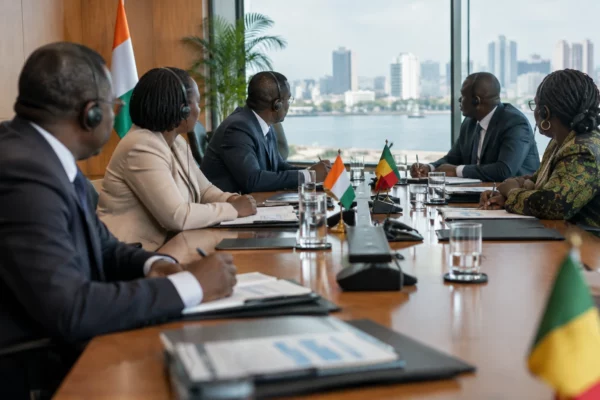
On 16 November in Abidjan, Presidents Alassane Ouattara and Duma Boko held talks before attending the signing of several bilateral agreements. The areas identified by the Ivorian authorities include political and economic cooperation, mining, oil, energy, and animal and fisheries resources. The agreements also provide for reciprocal visa exemptions for holders of diplomatic and service passports.
These commitments build on a memorandum of understanding on mining, oil and energy signed in Gaborone in July 2026. The visit therefore does not start from scratch: it builds on an initial diplomatic step with new areas of cooperation. However, details of the arrangements and the timetable for implementing the agreements have not been made public in the information available.
After meeting his counterpart, Alassane Ouattara said that trade between the two countries “does not at all reflect the potential of our economies”. This assessment, reported by the Ivorian presidency, sums up the challenge: moving from cordial diplomatic relations to measurable trade flows and projects.
An economic forum held in Abidjan on 17 November put businesses at the heart of this ambition. Ivorian authorities invited Botswanan operators to explore investment opportunities in the mining and oil sectors, as well as in projects under the 2026-2030 National Development Plan. The official account of the forum confirms the priority given to private investment.
From potential to local benefits
For Côte d’Ivoire, the potential benefits go beyond an influx of capital. Botswana’s expertise in organising its diamond industry could support technical and professional exchanges. But cooperation will bring lasting benefits only if projects translate into local skills, skilled jobs, public revenue and processing within the country.
These benefits are not automatic. In extraction areas, communities may be directly affected by access to land, water and infrastructure. Formal businesses, local suppliers and informal economic operators do not necessarily benefit equally from investment. The announced agreements do not yet specify how these issues will be addressed or what monitoring mechanisms will be put in place.
Botswana, for its part, could find in Côte d’Ivoire access to a West African market and to companies active in mining, energy and related services. But an economic partnership is also judged by its ability to withstand price fluctuations and genuinely diversify income. For a country whose exports rely heavily on diamonds, adding more partners will not be enough if its production structure remains concentrated.
Bilateral trade figures cited in some publications remain modest, but the available data do not allow them to be independently verified here. It is therefore preferable not to present them as an established record. The key point is instead one acknowledged by both governments: current trade relations do not match their ambitions.
A test for African economic integration
The institutional geography makes this rapprochement noteworthy. Côte d’Ivoire and Botswana belong to different regional communities: ECOWAS in West Africa and SADC in southern Africa. The African Continental Free Trade Area (AfCFTA), which aims to facilitate trade between countries on the continent, provides a common framework for overcoming these regional boundaries. It does not, however, replace missing infrastructure, customs procedures or practical agreements between businesses.
The visit’s pan-African significance will therefore depend less on ceremonies than on what follows: signed contracts, mobilised financing, sustained trade and the participation of local businesses. The two governments will also need to clarify how the agreements will be implemented and which sectors will move first. The visit programme reported by the African Press Agency had already linked diplomatic engagements to an economic forum and visits to Ivorian mining and energy facilities.
This partnership thus links two African regions with different specialisations. If it leads to transparent projects, shared expertise and improved flows of goods and services, it could give concrete substance to continental cooperation. For now, the agreements set a direction; their implementation will show whether the announced trade actually grows.