Algeria
 Egypt
 Libya
 Morocco
 Sudan
 Tunisia
 Benin
 Burkina Faso
 Cabo Verde
 Côte d'Ivoire
 Ghana
 Guinea
 Guinea-Bissau
 Liberia
 Mali
 Mauritania
 Niger
 Nigeria
 Senegal
 Sierra Leone
 The Gambia
 Togo
 Cameroon
 Central African Republic
 Chad
 DR Congo
 Equatorial Guinea
 Gabon
 Republic of the Congo
 São Tomé and Príncipe
 Burundi
 Comoros
 Djibouti
 Eritrea
 Ethiopia
 Kenya
 Madagascar
 Malawi
 Mauritius
 Mozambique
 Rwanda
 Seychelles
 Somalia
 South Sudan
 Tanzania
 Uganda
 Angola
 Botswana
 Eswatini
 Lesotho
 Namibia
 Zambia
 Zimbabwe
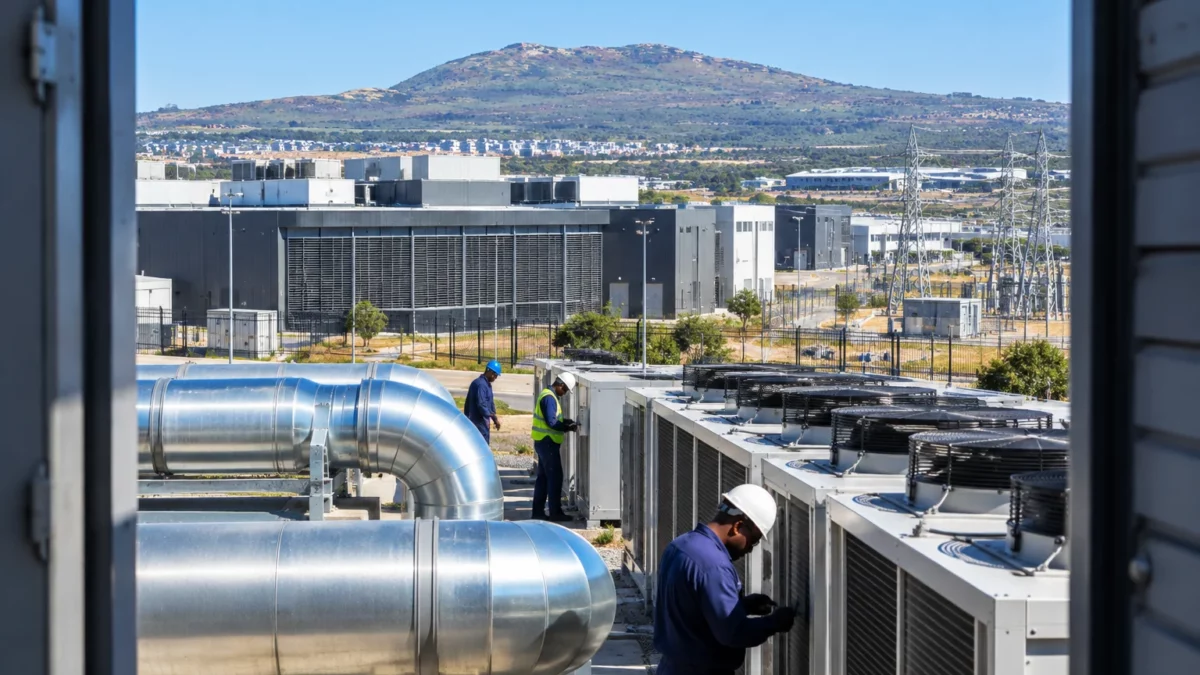
For South Africa, attracting investment in artificial intelligence is about more than hosting servers. It is also about turning an infrastructure lead into jobs, skills and services that benefit the public. That equation is at the heart of President Cyril Ramaphosa’s visit to California.
A tour to learn as well as attract capital
From 15 to 21 November 2026, the head of state is leading a South African delegation to Silicon Valley. The programme brings together public officials, businesses, researchers and students. It covers the uses of artificial intelligence, as well as data centres, computing capacity, energy and investment opportunities, according to the South African presidency.
The visit comes amid a global contest in which access to processors, networks and large-scale storage capacity is becoming strategic. For Pretoria, holding direct talks with technology companies and investors could open the door to partnerships. But a visit guarantees neither funding nor skills transfer. Results will depend on the projects announced and their implementation in the country.
On Monday 16 November, Ramaphosa took part in the “Silicon Valley and the World” forum in Menlo Park, organised by Semafor. He made the case for hosting data centres in South Africa. According to remarks reported at the event, he said the country hosted nearly 70% of the data centres established on the continent and had surplus electricity capacity to support their development.
That figure, however, needs some qualification: estimates vary depending on whether they count facilities, their power or the computing capacity actually available. A study of Southern African markets estimates that South Africa accounts for about 70% of the continent’s operational capacity. The government also cites a similar proportion for hyperscale data centres — the large facilities used by cloud services. South Africa’s advantage is real, but the percentage depends on the measure used.
An infrastructure advantage, with real constraints
The country benefits from a relatively developed digital market, a high concentration of operators and international connections through submarine cables. Facilities have developed particularly around Johannesburg, in Gauteng, and Cape Town. This position can serve South African businesses as well as clients and public administrations in other countries in the region.
The government presents available electricity capacity as an asset. But a temporary surplus must be distinguished from a reliable long-term supply. Data centres consume large amounts of electricity and also need cooling systems. Their growth therefore raises practical questions: who will pay for grid connections, what energy will power the facilities, and what local uses justify their consumption?
These concerns are not theoretical. In September, South African civil society organisations called for an assessment of the effects of new data centres on water, land and electricity. The South African Human Rights Commission told the Associated Press that it had received more than 250 submissions after inviting views. The controversy is therefore less about innovation versus rejection than about project transparency, collective costs and how benefits are distributed.
The benefits may be uneven. Operators and investors gain new opportunities. Local businesses may have access to digital services that are closer at hand and potentially less dependent on capacity located outside the continent. But residents will not automatically benefit from these investments. Job creation, training, the cost of electricity and access to broadband will all shape the outcome, particularly beyond the major economic hubs.
A national strategy still to be consolidated
The visit comes as South Africa still needs to stabilise its public framework for artificial intelligence. In June 2026, the government approved the withdrawal of a draft national policy for revision and the development of standards for the responsible use of AI. The process suffered a setback after fictitious references were found in the document submitted for consultation, the public agency SAnews reported. For investors and researchers alike, credible rules matter as much as equipment.
Ramaphosa’s visit also has a diplomatic dimension. Relations with Washington are strained, notably since a 2025 meeting at the White House at which Donald Trump made allegations of persecution of white South Africans. In California, Ramaphosa described that episode as an “ambush” and challenged the evidence presented during the exchange. This political friction does not erase shared commercial interests, but it is a reminder that technology partnerships also develop amid power politics.
The decision to focus on infrastructure also reflects regional ambitions. South Africa is a member of the Southern African Development Community, SADC, which is working on digital transformation and cooperation in information technology. If the country attracts computing capacity, skills and businesses, this base could support activity beyond its borders. That will require affordable connections, skills-sharing and compatible rules among neighbouring countries.
From a California showcase to African benefits
Pretoria’s challenge is not to measure its success solely by the number of servers installed or the capital announced. A sustainable policy will also need to specify the benefits for universities, start-ups and workers, as well as safeguards for data and the use of AI. South Africa’s National Treasury already regards digital infrastructure as essential to the economy and is exploring ways to encourage its development.
Across the continent, the question goes beyond South Africa’s place in the ranking of digital hubs. African economies want access to AI tools, but also want to avoid remaining mere markets for technologies designed elsewhere. What happens next will therefore depend on investment decisions, the new national policy and SADC’s ability to make digital cooperation a regional project. The California tour opens a door; it does not yet answer the central question: who will control the infrastructure, and who will benefit from the value it creates?