Algeria
 Egypt
 Libya
 Morocco
 Sudan
 Tunisia
 Benin
 Burkina Faso
 Cabo Verde
 Côte d'Ivoire
 Ghana
 Guinea
 Guinea-Bissau
 Liberia
 Mali
 Mauritania
 Niger
 Nigeria
 Senegal
 Sierra Leone
 The Gambia
 Togo
 Cameroon
 Central African Republic
 Chad
 DR Congo
 Equatorial Guinea
 Gabon
 Republic of the Congo
 São Tomé and Príncipe
 Burundi
 Comoros
 Djibouti
 Eritrea
 Ethiopia
 Kenya
 Madagascar
 Malawi
 Mauritius
 Mozambique
 Rwanda
 Seychelles
 Somalia
 South Sudan
 Tanzania
 Uganda
 Angola
 Botswana
 Eswatini
 Lesotho
 Namibia
 South Africa
 Zambia
 Zimbabwe
A film can fill cinemas in Dakar or rack up millions of online views without its producers earning enough to finance the next project. In the six markets studied, the projected growth of pay-TV and streaming therefore does not resolve the central question: how can films be circulated, made accessible and generate lasting income for the people who create them?
A growing market, but distribution channels remain narrow
Combined pay-TV and streaming revenues in Egypt, Kenya, Nigeria, Rwanda, Senegal and South Africa could reach $5.2bn in 2030. This projection, based on data covering 2020 to 2026, applies to these six markets, not the continent as a whole.
The study Made in Africa, Watched Globally?, conducted by Dalberg at the request of GIZ and Afreximbank through its Creative Africa Nexus (CANEX) programme, is based on 91 interviews, a survey of 1,630 viewers and five case studies. The Ivorian Press Agency has also reported on its main findings.
The countries studied do not constitute a single market. Nigeria has a large-scale production industry, while Egypt and South Africa have more structured audiovisual ecosystems. Kenya and Senegal combine developing production sectors with more fragmented funding channels. Rwanda, smaller in volume, is focusing in particular on partnerships and long-term policies.
Across these different contexts, one common point emerges: producing more is not enough. Films need distributors, broadcasters and platforms able to buy rights, finance works and promote them to audiences.
Distance and price also determine access
The report estimates that there is around one cinema screen for every 787,000 people on the continent, compared with one for every 8,700 in the United States. Cinemas are also concentrated in a few major cities. In Egypt, around 90% of screens are in Cairo and Alexandria. In Kenya, more than three-quarters of the fewer than 50 screens recorded are in Nairobi.
This geography limits potential revenues and puts cinema releases out of reach for audiences living beyond the major cities. For producers, it reduces opportunities to recoup a film’s costs. For viewers, it can mean longer, more expensive journeys, or having no cinema nearby.
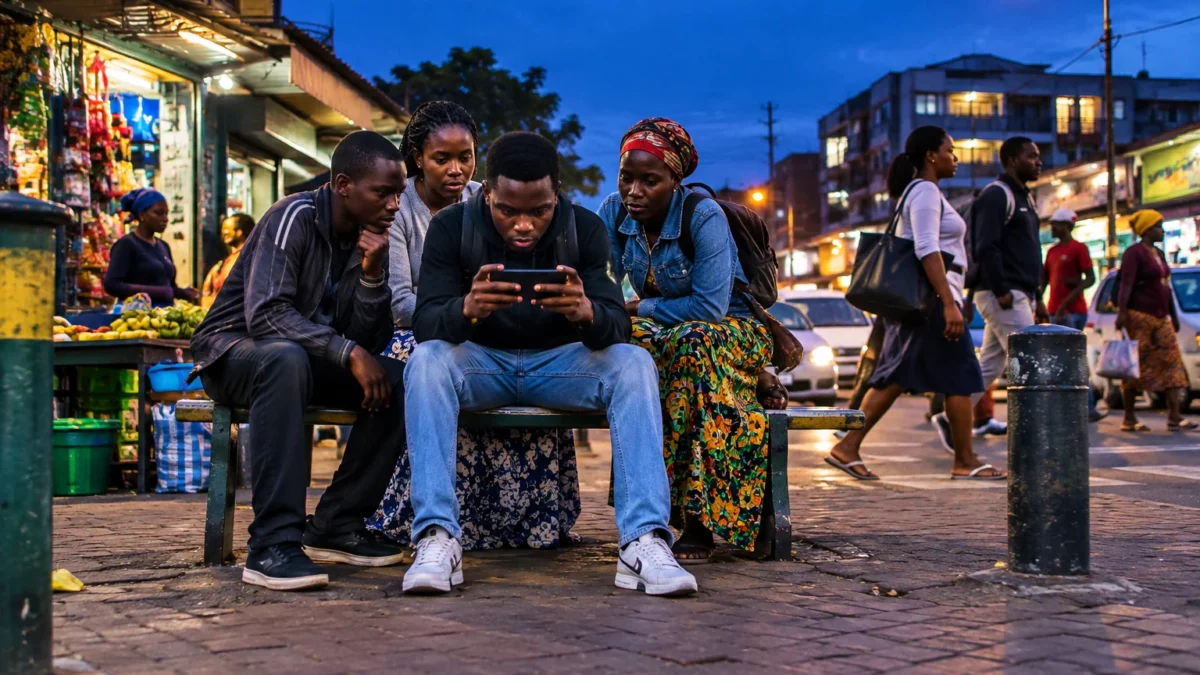
Mobile phones offer another route, but watching online also comes at a cost. According to the study, one gigabyte of mobile data is equivalent to 3.1% of monthly income in many African markets, above the global benchmark of 2%. In South Africa, 31% of respondents to a National Film and Video Foundation survey considered the data needed to watch videos expensive.
The cost of data packages particularly affects lower-income households and viewers who rely on mobile phones. A platform can be technically accessible without being affordable. Digital distribution therefore does not eliminate inequalities in access: it partly shifts them to the cost of data, connection quality and available payment methods.
Local models point to other approaches
Initiatives across the continent demonstrate more flexible formats. In Senegal, Marodi TV has attracted 8.67 million subscribers on YouTube and amassed 4.6 billion views with a free, advertising-funded service. In Kenya, Viusasa offered 24-hour subscriptions starting at 10 to 20 Kenyan shillings, sparing users the need to commit to a full month.
These examples show that an audience can be built with prices suited to local habits. However, they do not in themselves guarantee sufficient revenues for producers. Advertising income varies, and view counts do not automatically translate into funding for new works.
The report therefore recommends advertising-funded services, offline downloads, video packages bundled with cheaper data, and payments integrated with mobile money or telecoms services. It also recommends analysing viewers’ habits more closely to test prices and viewing options for different audiences, rather than imposing a single formula.
The funding link remains vulnerable
Platforms and aggregators play a decisive role between filmmakers and audiences. They can buy rights, commission productions and invest in marketing, subtitles or dubbing. However, this intermediary segment has been weakened by the withdrawal or reduction of some international investment.
Showmax ceased operations on 30 April 2026. Its parent company, MultiChoice, announced the decision in March, citing annual losses it deemed unsustainable. The closure removed an important outlet for African content, although the group says it intends to maintain its investment in programming through its other services. The concrete impact will therefore depend on the commissions, rights acquired and distribution options that follow.
This development comes in a sector where producers often have few viable buyers. Competition among them can put pressure on licence prices and limit their bargaining power. A work may then find an audience without generating enough revenue to finance the next one. The problem concerns the entire economic chain, not just the number of films produced.
Taking films across borders
To strengthen distribution, the study proposes supporting African platforms and distributors already capable of reaching an audience. National or regional funds could cover promotion, subtitles, dubbing and coordinated releases. It also recommends licensing agreements between countries, so that a film is not confined to its home market.
The African Continental Free Trade Area (AfCFTA), which aims to facilitate trade between African countries, could contribute to this circulation, provided the rules and partnerships are put in place. Better-organised regional releases would expand the potential audience and could reduce dependence on a small number of major buyers.
The $5.2bn projection signals commercial expansion, but does not measure either the share that will go to African producers or the diversity of works available. The indicators to watch next will be rights acquisitions, commissioned productions, the actual cost of viewing and the ability of African distributors to release films in several countries. That is where the transition from a larger market to a more viable creative industry will be decided.