Algeria
 Egypt
 Libya
 Morocco
 Sudan
 Tunisia
 Benin
 Burkina Faso
 Cabo Verde
 Côte d'Ivoire
 Ghana
 Guinea
 Guinea-Bissau
 Liberia
 Mali
 Mauritania
 Niger
 Nigeria
 Senegal
 Sierra Leone
 The Gambia
 Togo
 Cameroon
 Central African Republic
 Chad
 Equatorial Guinea
 Gabon
 Republic of the Congo
 São Tomé and Príncipe
 Burundi
 Comoros
 Djibouti
 Eritrea
 Ethiopia
 Kenya
 Madagascar
 Malawi
 Mauritius
 Mozambique
 Rwanda
 Seychelles
 Somalia
 South Sudan
 Tanzania
 Uganda
 Angola
 Botswana
 Eswatini
 Lesotho
 Namibia
 South Africa
 Zambia
 Zimbabwe
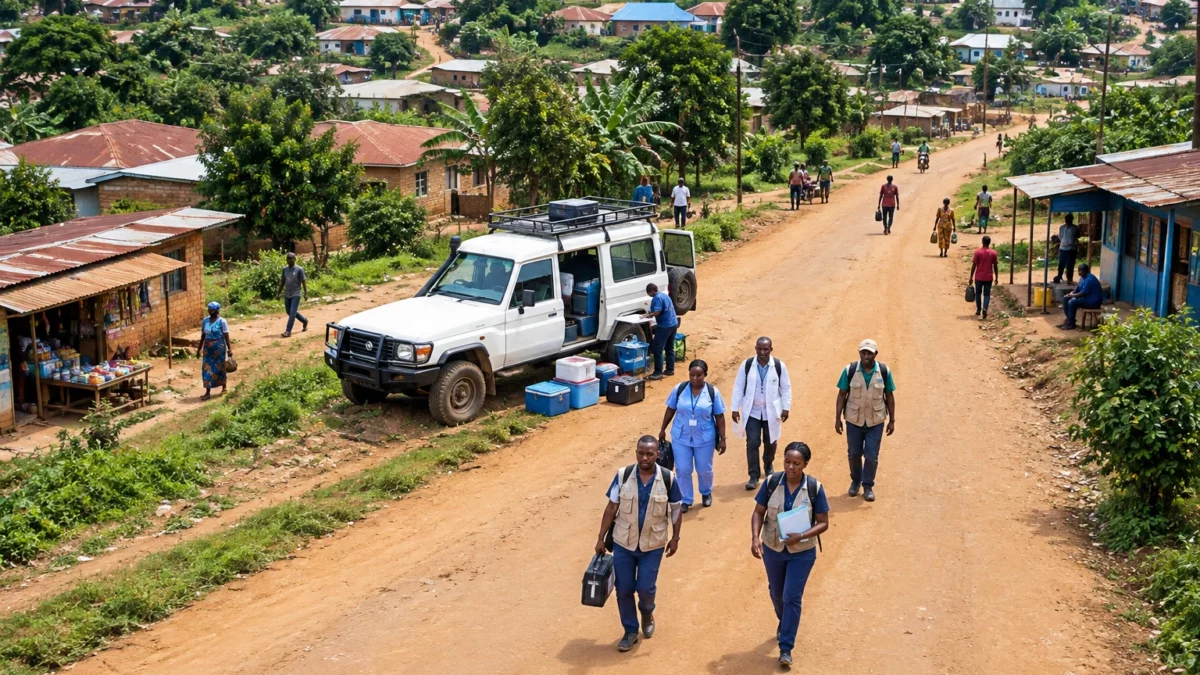
In the east of the Democratic Republic of the Congo, health teams must continue the Ebola response as insecurity complicates access to communities. A deadly attack near Cantine-Aloya is a reminder that the epidemic is also being fought on the ground, where treating patients, raising the alarm and tracing contacts are becoming more difficult.
A response confronted with realities on the ground
The current outbreak is caused by the Bundibugyo virus, an Ebola strain distinct from the one involved in previous major epidemics in DR Congo. Declared in May 2026, it has spread to several provinces. On 15 November, the World Health Organization (WHO) reported more than 11,000 cases and 5,400 deaths since the start of the epidemic. These figures change as surveillance and health checks progress.
The scale of the toll has been confirmed by several organisations, but the data must be read with their reference dates in mind: on 11 November, the WHO director-general spoke of nearly 11,000 confirmed cases and more than 5,300 deaths. Four days later, the WHO reported a total of more than 11,000 cases and 5,400 deaths. These are reported figures, which may be revised as teams record and verify cases.
Ituri province, in the north-east of the country, is among the worst-affected areas. Bunia, its provincial capital, is home to treatment and surveillance activities. But travel between towns, access to medical facilities and the tracing of people who have been in contact with a patient remain dependent on security and available resources.
The Cantine-Aloya attack and its health consequences
On 5 November, an armed attack struck Cantine-Aloya, in North Kivu. Africa CDC, the African Union’s public health agency, reports that 66 civilians were killed and attributes the attack to the Allied Democratic Forces (ADF), an armed group active in eastern DR Congo and linked to the Islamic State organisation. The death toll and attribution are reported by this institution; they should not be presented as an independent assessment of the circumstances of the attack.
Three health workers were reportedly among the victims. Their deaths highlight the risks faced by those tasked with maintaining care and surveillance in areas affected by violence. Wessam Mankoula, head of emergency preparedness at Africa CDC, warned that insecurity could allow the virus to “get a head start” on the response.
In practical terms, a team unable to reach a town will find it harder to identify new patients, collect samples quickly and trace contacts effectively. Families may also hesitate to travel to a treatment centre if the journey is dangerous. These obstacles do not mean that every attack leads to an immediate rise in infections. They do, however, reduce the ability to detect and quickly interrupt chains of transmission.
A health emergency with unequal effects
The consequences are not evenly distributed. Residents of isolated towns depend more heavily on mobile teams and community alerts. In urban centres, the concentration of services can make it easier to access care, without removing the difficulties caused by an influx of patients or the need to maintain essential services.
Health workers, surveillance officers and community health workers play a central role: they identify symptoms, refer patients and explain prevention measures. When their safety is threatened, trust between them and residents can also be weakened. The response therefore does not rely solely on treatment centres. It also depends on the ability to listen to communities and provide local services.
DR Congo has considerable experience in managing Ebola epidemics, but this capacity cannot neutralise the effects of prolonged conflict. The current epidemic is a reminder that medical expertise, laboratories and surveillance systems are not always enough when access to populations is disrupted. The challenge is at once a health, logistical and security one.
A regional issue beyond borders
The crisis primarily affects the provinces and Congolese communities concerned, but it also calls for regional coordination. DR Congo shares borders with several countries in Central and East Africa. Cross-border movements make the rapid exchange of information, surveillance at crossing points and preparedness among neighbouring health services valuable. The WHO has reported cases linked to this outbreak outside DR Congo, reinforcing the importance of coordinated action without equating the risk with a general closure of exchanges.
Africa CDC, the WHO and the Congolese authorities must therefore combine epidemiological surveillance, humanitarian access and staff safety. At African Union level, the episode tests the ability of continental institutions to support a response led alongside the actors in the country concerned, rather than at a distance from local realities.
The next decisive step will be to maintain case detection and access to care in areas where violence is obstructing movement. Health figures, the geographical spread of the epidemic and the safety of teams will provide a clearer measure of the ability to regain the initiative against the virus.
Sources consulted: WHO Africa statement on the epidemic and the Cantine-Aloya attack, Africa CDC statement on the attack and WHO director-general’s briefing on 11 November 2026.