Algeria
 Egypt
 Libya
 Morocco
 Sudan
 Tunisia
 Benin
 Burkina Faso
 Cabo Verde
 Ghana
 Guinea
 Guinea-Bissau
 Liberia
 Mali
 Mauritania
 Niger
 Nigeria
 Senegal
 Sierra Leone
 The Gambia
 Togo
 Cameroon
 Central African Republic
 Chad
 DR Congo
 Equatorial Guinea
 Gabon
 Republic of the Congo
 São Tomé and Príncipe
 Burundi
 Comoros
 Djibouti
 Eritrea
 Ethiopia
 Kenya
 Madagascar
 Malawi
 Mauritius
 Mozambique
 Rwanda
 Seychelles
 Somalia
 South Sudan
 Tanzania
 Uganda
 Angola
 Botswana
 Eswatini
 Lesotho
 Namibia
 South Africa
 Zambia
 Zimbabwe
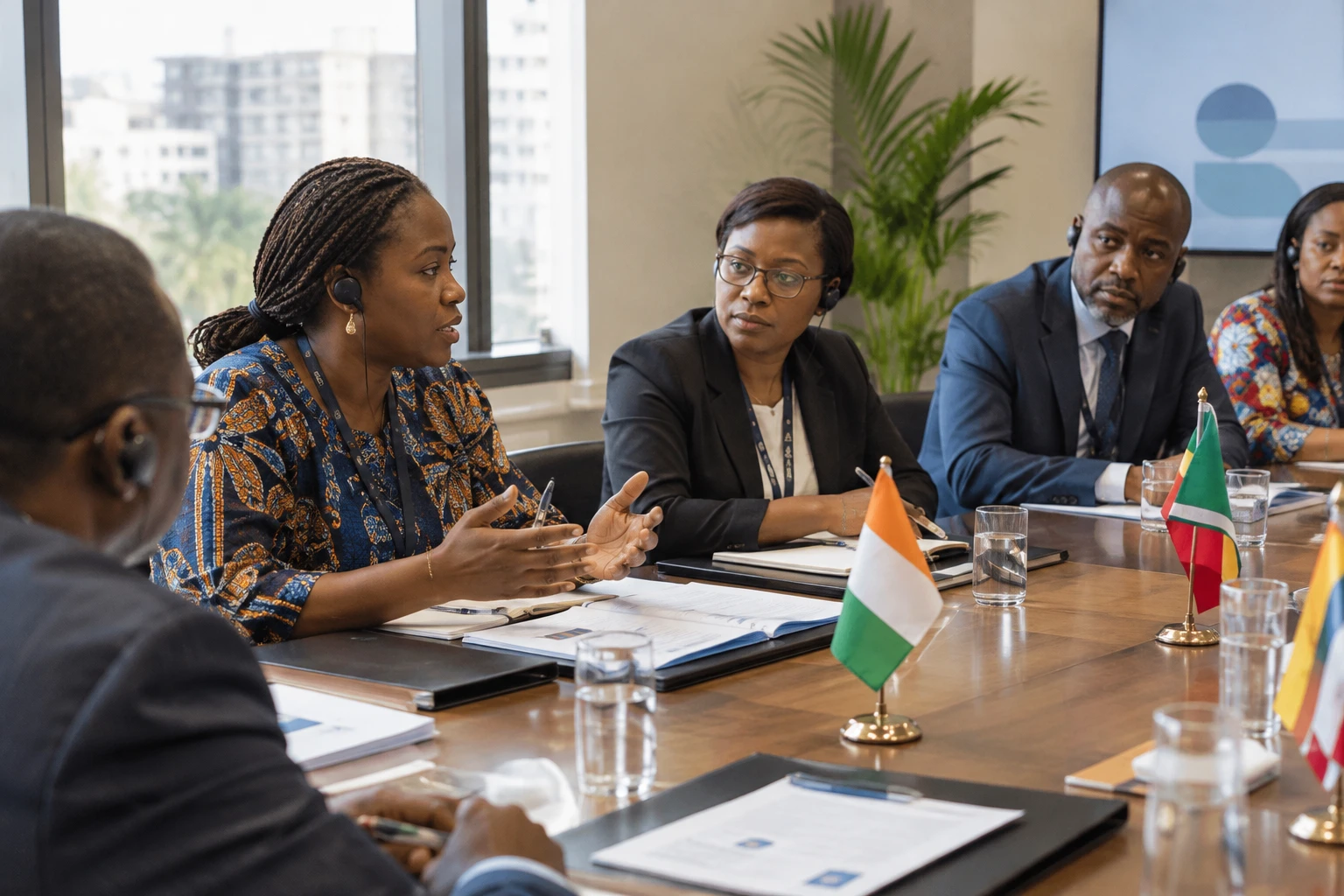
Training a business leader is not enough to grow her company. She must also be able to access credit, markets and professional networks. It is this bridge between skills and finance that lies at the heart of HEC Stand Up’s new cohort in Côte d’Ivoire.
A new cohort for 105 women entrepreneurs in Abidjan
On 5 November 2026, FIN’Elle, the African Guarantee Fund (AGF) and HEC Paris signed a partnership in Abidjan to roll out the programme. Applications opened on 10 November. The partners say they aim to support and certify 105 women with business ideas or who run companies. These details were reported by the organisers and picked up by an Ivorian media outlet. The report on the launch in Abidjan confirms the 5 November signing and the cohort’s target.
The announced programme is free and lasts ten weeks. It combines training, mentoring and preparation for financing. Participants will work on structuring their businesses, their approach to leadership and implementing their projects. The training itself, however, does not constitute a promise of a loan: access to credit will depend on financial institutions’ criteria and the strength of each application.
This new phase builds on a pilot programme held in Abidjan in January 2025. A local organisation, COMMAN-YA, says 15 women entrepreneurs took part in that session. The figure and date are thus corroborated by an Ivorian organisation directly involved in the entrepreneurial ecosystem. COMMAN-YA’s account of the pilot session dates it from 6 to 10 January 2025.
From training to effective access to credit
The programme is part of AFAWA, the African Development Bank’s initiative to facilitate financing for women-led businesses. AGF helps reduce the risk borne by lenders through guarantee mechanisms. The AfDB also describes a role in training and supporting financial institutions. AFAWA’s overview of access to finance sets out these levers.
The continent-wide financing gap is estimated at $42bn in AfDB publications. This figure gives a sense of a structural obstacle, but does not by itself describe the situation in Côte d’Ivoire. Financing needs and access to credit vary by sector, company size, available collateral and location. A pan-African estimate should therefore not be applied mechanically to every woman entrepreneur or every country. The AfDB presents the $42bn estimate.
In Côte d’Ivoire, FIN’Elle, a subsidiary of the COFINA group, specialises in mesofinance, which serves, among others, small businesses whose needs fall between microfinance and conventional bank lending. Its role could bring training closer to the realities of credit applications. But the outcome will also depend on participants’ ability to provide collateral, the availability of suitable products and lenders’ decisions.
Bringing together a financial institution, a guarantee organisation and a business school is a response to this challenge. Training can help participants draw up a business plan, track cash flows and present a project. A guarantee, in turn, can encourage a lender to consider an application it might otherwise have judged too risky. These tools are complementary, but none removes economic constraints or guarantees a company’s growth.
Impact will also depend on local circumstances
The programme’s practical reach will be measured by more than the number of participants certified. It will be important to see whether they actually obtain finance, access new markets and consolidate jobs. Small informal businesses or those far from financial institutions may face different obstacles from companies already established in Abidjan. The beneficiaries’ location and profile will therefore matter in assessing who really benefits from the programme.
The partners present the cohort as a contribution to Ivorian economic growth. This ambition can only be assessed through published results: the number of applications received, the profiles selected, the projects financed and how businesses perform after the training. Without such data, certification remains an indicator of participation, not a sufficient measure of economic impact.
Côte d’Ivoire, whose political capital is Yamoussoukro and whose main economic centre is Abidjan, is part of a broader debate in West Africa: how to turn women’s entrepreneurship into better-financed, more resilient businesses. ECOWAS, the regional economic community of West African states, provides a framework for co-operation, but credit conditions remain largely tied to each country’s markets and institutions.
For this first expanded cohort, the next milestone is the selection of candidates following the call opened on 10 November 2026. The challenge will then be to connect learning with financing decisions and track results over time. It is at this stage that the alliance between training, finance and guarantees will be able to demonstrate its value to women entrepreneurs in Côte d’Ivoire.