Algeria
 Libya
 Morocco
 Sudan
 Tunisia
 Benin
 Burkina Faso
 Cabo Verde
 Côte d'Ivoire
 Ghana
 Guinea
 Guinea-Bissau
 Liberia
 Mali
 Mauritania
 Niger
 Nigeria
 Senegal
 Sierra Leone
 The Gambia
 Togo
 Cameroon
 Central African Republic
 Chad
 DR Congo
 Equatorial Guinea
 Gabon
 Republic of the Congo
 São Tomé and Príncipe
 Burundi
 Comoros
 Djibouti
 Eritrea
 Ethiopia
 Kenya
 Madagascar
 Malawi
 Mauritius
 Mozambique
 Rwanda
 Seychelles
 Somalia
 South Sudan
 Tanzania
 Uganda
 Angola
 Botswana
 Eswatini
 Lesotho
 Namibia
 South Africa
 Zambia
 Zimbabwe
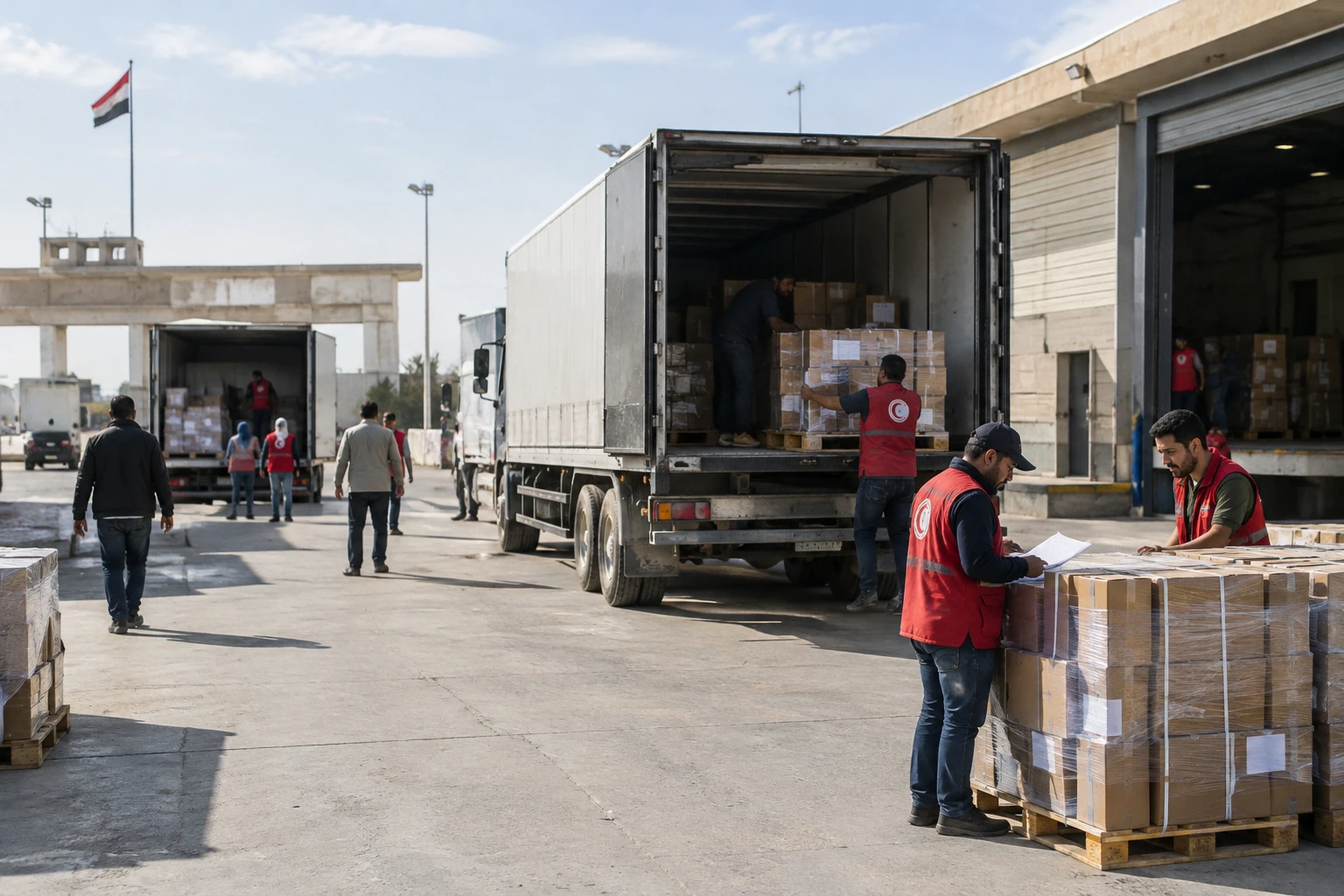
In Rafah, the distance between a warehouse full of packages and a family in need is measured in more than kilometres. It also depends on inspections, authorised crossings and the pace at which convoys can enter the Gaza Strip. This was the logistics chain, as well as the situation facing civilians, that Lewis Hamilton came to observe in Egypt.
A crossing at the heart of a logistics chain
On Tuesday 10 November 2026, the British driver and seven-time Formula One world champion visited the Egyptian side of the Rafah border crossing, in North Sinai governorate. He met humanitarian teams and toured logistics facilities run by the Egyptian Red Crescent in El-Arish, a city about 45 kilometres from the border. North Sinai Governor Khaled Megawer accompanied him. The Associated Press and Egyptian newspaper Ahram Online report the same main stages of the visit.
The visit was intended to help Hamilton better understand how Egypt receives, sorts and prepares goods destined for Gaza. The Egyptian Red Crescent has coordinated a significant part of this effort since October 2023. Shipments from Egypt and abroad are transported to logistics hubs, including in El-Arish, before being dispatched. Coordination with the authorities and humanitarian organisations is essential: storing goods does not mean they can cross the border immediately.
The Rafah crossing is particularly important. It directly links Egypt to Gaza and is a potential entry point for aid, but operations depend on movement and security conditions on the ground. The crossing alone is therefore no guarantee of delivery. Shipments can be prepared on the Egyptian side while their entry into the enclave remains subject to separate constraints.
Preparing aid is not enough to get it delivered
This distinction is central to understanding the issue. In a statement issued after the January 2025 ceasefire, the UN described the Egyptian Red Crescent’s role in coordinating deliveries with local authorities and its partners. The organisation said that goods transiting through Egypt were taken to El-Arish for inspection and coordination before being sent to Gaza. Logistics therefore involve a series of steps, any one of which can delay the arrival of essential goods.
Figures announced by institutions must also be read precisely. The Egyptian Red Crescent said it dispatched its 308th convoy to Gaza on Monday 9 November, carrying more than 2 581 tonnes of supplies, including tents for people affected by a winter storm. It also says that more than one million tonnes of aid have been transported since October 2023. These figures are attributed to the organisation: they measure shipments dispatched, not necessarily the volumes distributed to recipients in Gaza. Ahram Online reports these figures, attributing them to the Red Crescent.
The Associated Press, for its part, reports that deliveries remain well below the threshold of 600 trucks a day set out in the ceasefire agreement concluded the previous year. This comparison highlights the gap between needs, commitments and the flows actually observed. It does not mean that every day proceeds at the same pace, or that tonnage and the number of trucks are directly comparable.
Egypt, a frontline player and regional diplomat
For Egypt, aid to Gaza is both a responsibility as a neighbouring country and a major diplomatic issue. Cairo has hosted discussions and worked with other mediators on arrangements for the enclave. In North Sinai, this regional dimension takes concrete form: Red Crescent teams, warehouses, hospitals and local authorities are at the forefront of the response. Residents of the region thus live alongside a humanitarian logistics operation that has mobilised infrastructure and personnel over an extended period.
This mobilisation should not, however, obscure the system’s limitations. Egypt can receive goods, organise their storage and prepare convoys. It does not alone control all the conditions for access to Gaza or the final distribution of aid inside the territory. The system depends on decisions and authorisations involving several actors. For humanitarian organisations, the decisive factors remain predictable crossings and the ability to deliver supplies where needs are most urgent.
Egypt’s role also sits within a continental framework. Egypt is a member of the African Union and the Arab League, but does not belong to a regional economic community such as ECOWAS or SADC. On Gaza, its influence is exercised mainly through its border, its logistical capacity and its role as a mediator in the Middle East. The humanitarian response therefore depends on cooperation that extends beyond Africa’s borders, while having direct consequences for a North African country.
A star’s visibility, without confusing it with results
Hamilton’s presence attracts international attention that humanitarian teams do not always receive. It can raise the profile of the preparatory work on the Egyptian side and serve as a reminder that aid depends on very practical mechanisms. But a visit is neither an independent inspection of operations nor proof of improved deliveries. The information released about his visit describes a meeting and a tour of sites, not a change in crossing rules.
The next useful measure will therefore not be the length of the visit, but how flows change: how many convoys can actually enter, at what pace, and whether goods reach civilians. For several years, the UN has highlighted the importance of coordination between the Egyptian Red Crescent, the authorities and humanitarian partners. For Gaza’s residents, the difference is between aid ready to leave and aid received. For Egypt, it is between the logistical capacity already mobilised and the political and operational conditions that determine its effectiveness.