Algeria
 Egypt
 Libya
 Morocco
 Sudan
 Tunisia
 Benin
 Burkina Faso
 Cabo Verde
 Côte d'Ivoire
 Ghana
 Guinea
 Guinea-Bissau
 Liberia
 Mali
 Mauritania
 Niger
 Nigeria
 Senegal
 Sierra Leone
 The Gambia
 Togo
 Cameroon
 Central African Republic
 Chad
 DR Congo
 Equatorial Guinea
 Republic of the Congo
 São Tomé and Príncipe
 Burundi
 Comoros
 Djibouti
 Eritrea
 Ethiopia
 Kenya
 Madagascar
 Malawi
 Mauritius
 Mozambique
 Rwanda
 Seychelles
 Somalia
 South Sudan
 Tanzania
 Uganda
 Angola
 Botswana
 Eswatini
 Lesotho
 Namibia
 South Africa
 Zambia
 Zimbabwe
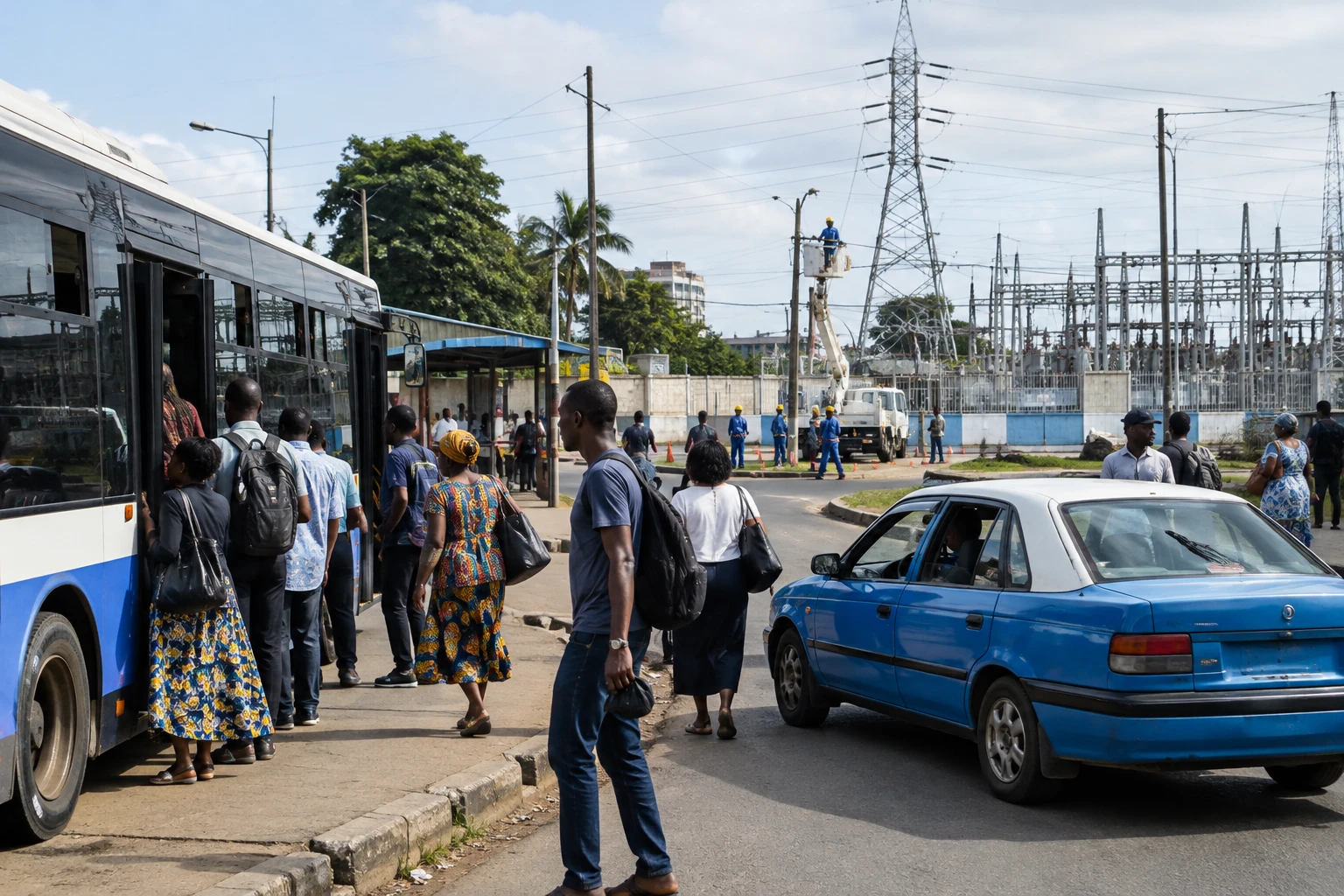
A power plant can add electricity to the grid and, while it is being connected, make less available. This is the paradox facing residents of Greater Libreville from 8 to 15 November 2026: works to prepare for the arrival of Kinguélé Aval are bringing rolling power cuts before new megawatts are due to be fed into the grid.
Works temporarily reduce available power
Connecting Kinguélé Aval requires work on a 225-kilovolt high-voltage line. According to the Gabonese presidency, temporarily taking it out of service reduces the available output from the Tchimbélé and Kinguélé plants from 94 to 55 megawatts. The shortfall during the works is therefore 39 megawatts.
Load-shedding affects Libreville, Akanda, Owendo and Ntoum. On 9 November, President Brice Clotaire Oligui Nguema asked the Gabon Energy and Water Company (SEEG), the company responsible for distribution, to publish a precise daily schedule of power cuts and meet the 15 November deadline. He also asked for the newly announced capacity to be fed into the grid in line with the planned timetable. These details appear in the presidency’s statement on the works and load-shedding.
The plant is expected to add 35 megawatts. The Ministry of Energy expects the first electricity to be fed into the grid at the end of November, followed by a gradual increase in output before the end of 2026. Connection does not mean that this electricity is already available: testing and commissioning are still required. The project developer, Gabon Power Company, confirms that tests will precede the arrival of the first megawatts on Libreville’s interconnected grid.
Generation alone is not enough: the grid must keep pace
The project highlights an essential distinction: a country’s installed capacity is not always the same as the electricity its residents can actually use. A power plant may be built, but its equipment, fuel, transmission lines or peak-hour demand can sometimes limit the electricity available. In this case, work on a line is temporarily reducing the output accessible from dams already in service.
The Gabon National Energy Compact puts installed electricity capacity at 886 megawatts in 2024. It sets a target of 1,100 megawatts by 2030 and provides, among other things, for the strengthening of transmission networks. The document also distinguishes between several interconnected grids and isolated installations. In other words, adding power plants does not, by itself, guarantee a stable supply in every city or neighbourhood.
For households, a power cut can make it harder to keep food fresh, access pumped water or work from home. For small businesses and informal-sector activities, it can interrupt sales and force them to turn to backup solutions. Businesses with generators can partly maintain operations, but at additional cost. The effects therefore vary according to income, available equipment and the actual duration of interruptions.
In this context, transparency about the schedule is a practical concern. Announcements by neighbourhood help residents organise their activities and make it possible to check whether cuts remain within the stated limits. The presidential request also gives SEEG a measurable deadline: complete the works and inform users, without confusing the end of the project with a lasting restoration of service.
A vulnerability that extends beyond Greater Libreville
Supply difficulties are not new. In February 2025, the Gabonese government signed an agreement to buy 70 megawatts from Karpowership to strengthen supply to Greater Libreville. The current episode does not prove that this capacity has disappeared; rather, it is a reminder that electricity security depends on several sources of generation and on networks capable of delivering power at the right time. In April 2025, the Gabonese Press Agency also reported the presentation of a five-year plan to modernise SEEG.
The challenge is also territorial. The energy compact notes that Gabon operates several separate grids, making their interconnection and improved reliability important beyond the capital. Residents of Libreville and its outskirts are directly affected by the current works. In other regions, access depends more on local installations and available connections. An increase in national capacity will therefore not automatically bring uniform improvements.
At the regional level, the issue also concerns energy cooperation in Central Africa. CEMAC, the Economic and Monetary Community of Central Africa, presented the commissioning of a power line between Gabon and Equatorial Guinea in February 2025 as a step towards energy integration. This interconnection shows that a more resilient grid can extend beyond national borders, although it does not replace the investment needed within Gabon.
The next immediate deadline is 15 November, the announced date for the end of the works causing load-shedding. This will be followed by the gradual commissioning of Kinguélé Aval’s 35 megawatts and an assessment of their actual effect on supply. The test will not concern the plant’s output alone: it will also be necessary to see whether the grid can carry this electricity and whether power cuts ease for households and economic activity.