Algeria
 Egypt
 Libya
 Morocco
 Sudan
 Tunisia
 Benin
 Burkina Faso
 Cabo Verde
 Ghana
 Guinea
 Guinea-Bissau
 Liberia
 Mali
 Mauritania
 Niger
 Nigeria
 Senegal
 Sierra Leone
 The Gambia
 Togo
 Cameroon
 Central African Republic
 Chad
 DR Congo
 Equatorial Guinea
 Gabon
 Republic of the Congo
 São Tomé and Príncipe
 Burundi
 Comoros
 Djibouti
 Eritrea
 Ethiopia
 Kenya
 Madagascar
 Malawi
 Mauritius
 Mozambique
 Rwanda
 Seychelles
 Somalia
 South Sudan
 Tanzania
 Uganda
 Angola
 Botswana
 Eswatini
 Lesotho
 Namibia
 South Africa
 Zambia
 Zimbabwe
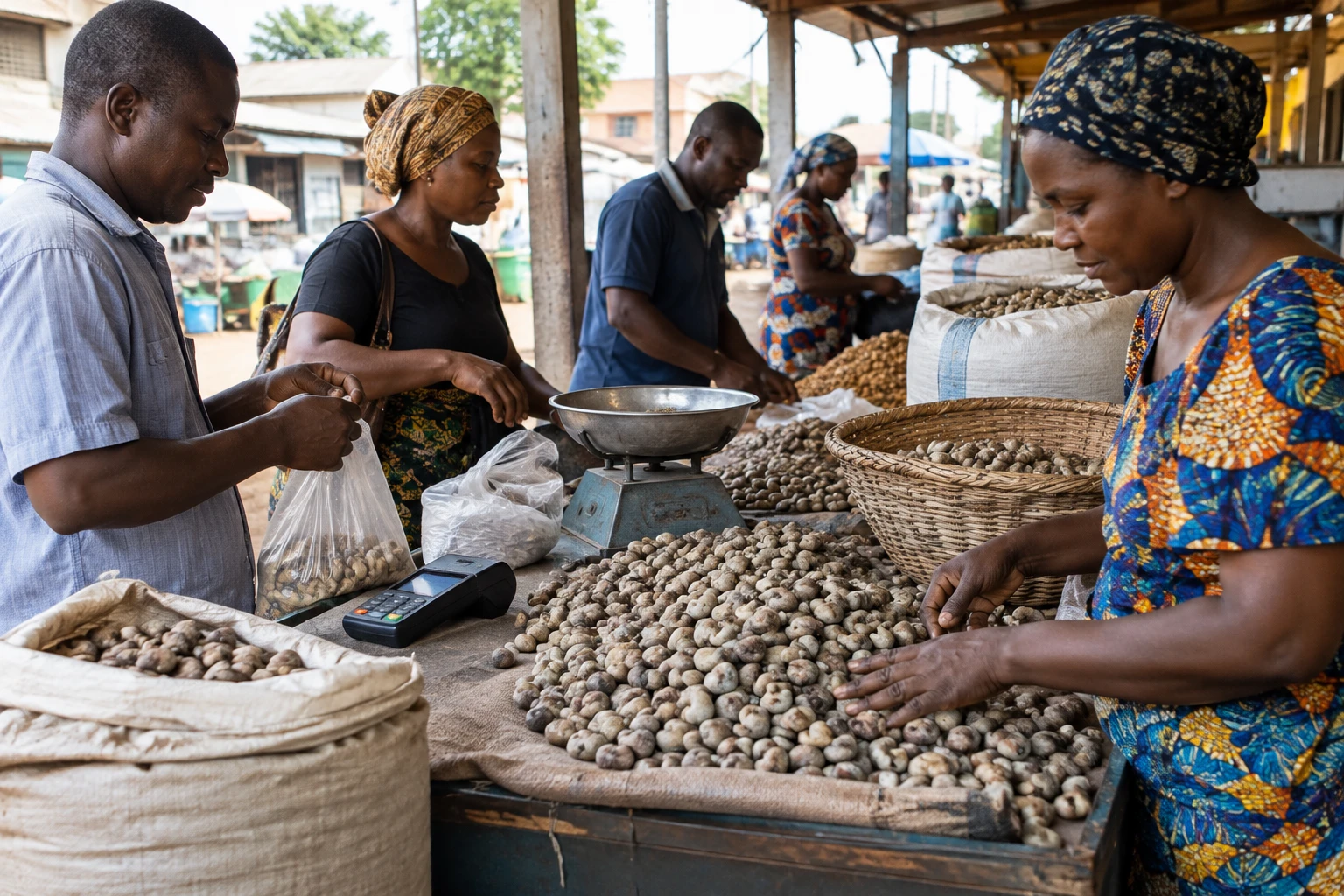
Processing more cashew nuts locally means retaining a greater share of the value created by one of Côte d’Ivoire’s major agricultural sectors. Two factory projects announced in 2026 illustrate investors’ interest. But their capacity alone cannot guarantee that revenues will be shared more fairly or that industrial activity will be sustainable.
From orchard to factory: Côte d’Ivoire’s industrial bet
The cashew sector connects producers, collectors, shelling plants and export markets. Côte d’Ivoire, the world’s largest producer of raw cashew nuts, has accelerated local processing over the past decade. In 2011, less than 10,000 tonnes were processed in the country. In 2025, the volume exceeded 659,000 tonnes, or about 43% of the harvest, according to data from the Group of Cashew Industry Operators of Côte d’Ivoire (GIC-CI). Government figures also put the rate at close to 43%.
This expansion is underpinned by plants located in producing regions and public measures to encourage investment. The sector has about 37 factories, 24 of them majority-owned by Ivorians, according to the government’s review. The industrial presence also translates into jobs: the authorities count nearly 20,000 direct jobs, with women making up the majority of those employed.
At regional level, the development of this activity forms part of a broader ambition: to process a greater share of the continent’s agricultural raw materials before they are exported. Côte d’Ivoire, a member of ECOWAS — the Economic Community of West African States — is seeking to consolidate an industry able to supply international markets while creating opportunities in producing areas.
Two investments at different stages
On 9 November 2026, the Belgian Investment Company for Developing Countries (BIO) announced a €9 million loan to TAN Ivoire SA. The company plans to build a factory in Korhogo, in the north of the country, with the capacity to process 30,000 tonnes of raw nuts a year. The company, which trades in agricultural products, intends to enter local processing. The announced financing is a loan commitment; it does not mean the factory has already been built or is operating.
Another project is being led by the Emirati group Dorado FZCO. Its Ivorian subsidiary plans a plant in Yamoussoukro with annual capacity of 50,000 tonnes. The International Finance Corporation (IFC), a member of the World Bank Group, approved a $15 million loan for the project on 9 October, with total costs estimated at $18 million. As of 4 November, the financing was still awaiting signature. The distinction matters: approval paves the way for financing, but does not confirm that the plant has begun operating.
Together, the two projects represent up to 80,000 tonnes of additional annual capacity if completed. They add to an already expanding processing sector. However, announced capacity should not be confused with the volume actually processed: operations also depend on regular supplies, electricity, seasonal financing and access to markets.
Value added also depends on production conditions
Processing can diversify jobs and economic activity, particularly in northern and central towns closer to producing areas than the major ports. It creates demand for transport, storage, maintenance and services. Producers, however, do not automatically benefit from increased industrial capacity. How value is shared also depends on purchase prices, contracts, quality requirements and the bargaining power of cooperatives and farms.
The 2026–2030 National Development Plan sets a target of processing 70% of cashew nuts locally by 2030, compared with about 45% in the baseline used by the government. The challenge will be to keep the factories operating long enough to approach that target. Processors must secure supplies of raw nuts, while the authorities must continue investing in infrastructure and incentives without undermining producers’ incomes.
Processing does not stop at the kernel. On 11 September 2026, the Cotton, Cashew and Shea Council (CCAK), the Côte d’Ivoire Investment Promotion Centre (CEPICI) and Indian company Essar Biofuels signed a memorandum of understanding on a project announced at $75 million. It aims to make use of cashew shells by extracting their liquid to produce cardanol, a raw material used in various industrial applications. The agreement marks a step in cooperation, not proof that the investment has been made.
Turning capacity into lasting results
These projects bring the Ivorian sector closer to more complete processing, from nuts to by-products. They could also strengthen the country’s position among the world’s major processors. To assess their impact, the next steps will need to be tracked: the formal signing of financing, construction of the plants, recruitment and the volumes actually processed.
Industrial growth also raises practical questions about energy availability, waste management and supply-chain traceability. Shells, once considered waste, can become a resource, provided their use is accompanied by environmental standards and transparent monitoring. Côte d’Ivoire’s challenge is therefore not just to announce more capacity, but to connect factories with producers and markets without allowing value added to accrue solely to industrial and commercial players.