
 Algeria
 Egypt
 Libya
 Morocco
 Sudan
 Tunisia
 Benin
 Burkina Faso
 Cabo Verde
 Côte d'Ivoire
 Ghana
 Guinea
 Guinea-Bissau
 Liberia
 Mali
 Mauritania
 Niger
 Nigeria
 Senegal
 Sierra Leone
 The Gambia
 Togo
 Cameroon
 Central African Republic
 Chad
 DR Congo
 Equatorial Guinea
 Republic of the Congo
 São Tomé and Príncipe
 Burundi
 Comoros
 Djibouti
 Eritrea
 Ethiopia
 Kenya
 Madagascar
 Malawi
 Mauritius
 Mozambique
 Rwanda
 Seychelles
 Somalia
 South Sudan
 Tanzania
 Uganda
 Angola
 Botswana
 Eswatini
 Lesotho
 Namibia
 South Africa
 Zambia
 Zimbabwe
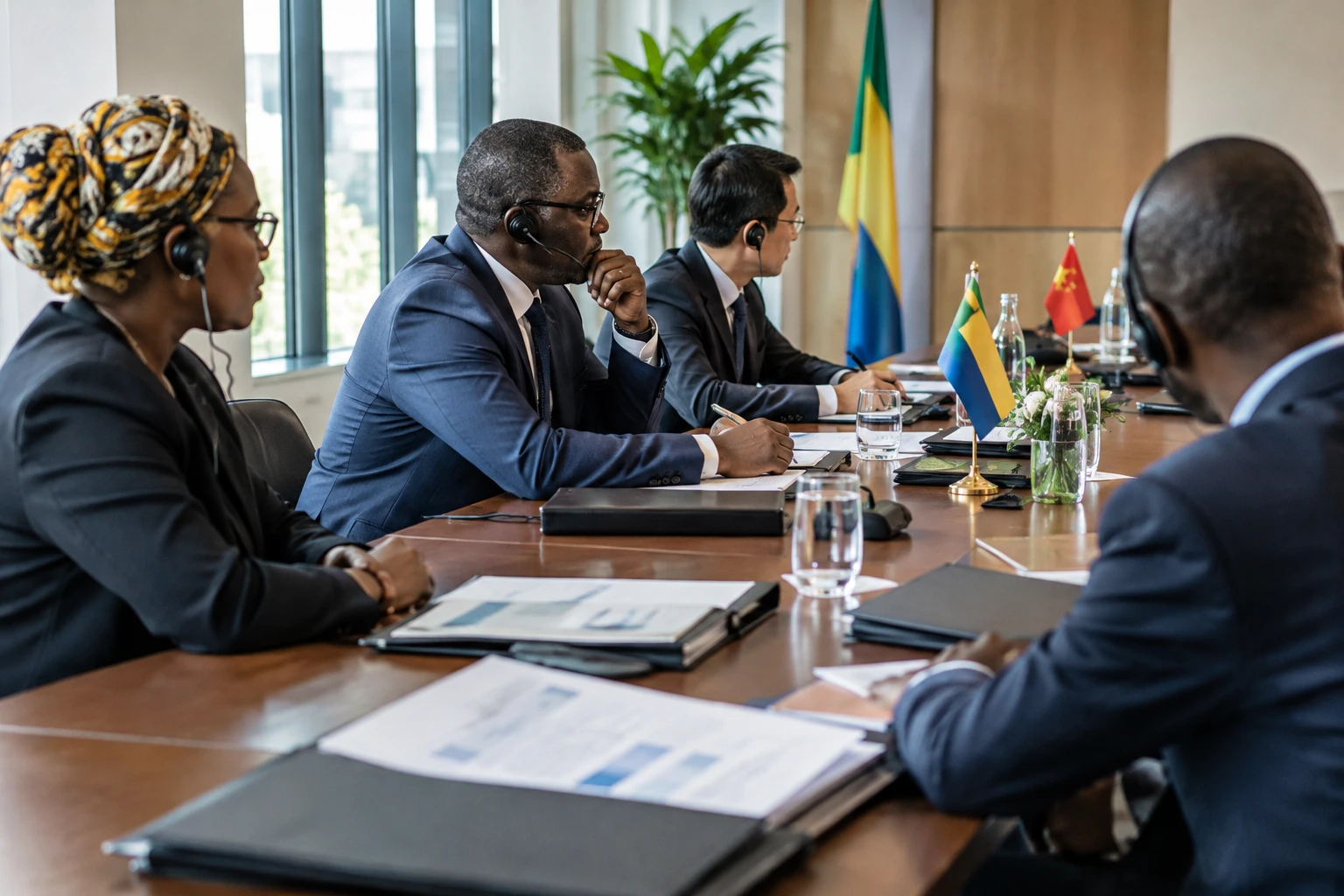
Processing manganese in Gabon is about more than building a plant. The ore must also be transported, large amounts of electricity generated and a tight schedule met. In Libreville, agreements with Chinese partners are advancing several proposals, but their announcement guarantees neither secured financing nor the start of construction.
A national deadline, a regional issue
On 30 May 2025, Gabon’s Council of Ministers set 1 January 2029 as the date for a ban on raw manganese exports. The government wants more processing and industrial activity to take place in the country. The policy affects a resource that is central to Gabon’s economy and to the companies that extract, transport or market it.
The timetable is demanding. A plant must be designed, financed, built and connected to functioning infrastructure. In July 2026, the state and Eramet-Comilog set out a roadmap aiming for up to 700,000 tonnes of ore to be processed locally each year by the end of 2031. Some of the planned facilities may therefore only come into operation after the 2029 deadline.
Gabon is a member of CEMAC, the Economic and Monetary Community of Central Africa. Its decision is national, but its effects could extend beyond its borders: industrial capacity, ore transport and energy supply will weigh on trade across the subregion. Local processing could also support downstream activities, including steelmaking, if costs and infrastructure allow.
Agreements with Beijing, projects to be defined
During a state visit to China from 3 to 7 November 2026, President Brice Clotaire Oligui Nguema led discussions on mining and infrastructure. The joint statement of 6 November affirmed the two countries’ willingness to co-operate in, among other areas, the exploration, extraction and local processing of resources. This diplomatic direction opens the way for further work; by itself, it does not amount to a firm commitment to build.
The most detailed project concerns the M’Bembélé deposit, near Ndjolé. On 6 November, Gabon’s Ministry of Industry announced the signing of a memorandum of understanding with South Manganese Investment. The project is valued at 116.7 billion CFA francs. Its first phase would target annual production of 180,000 tonnes of metallurgical products, with output expected to rise to more than one million tonnes by 2030.
A memorandum sets out an intention to co-operate, but the available information does not yet specify a full construction timetable or the final financing structure. The ministry presents the project as a step towards processing in Gabon. For people in the area, the benefits will depend in particular on jobs actually created, training offered and infrastructure delivered, rather than on announced capacity alone.
Chinese companies’ presence in Gabon’s mining sector did not begin with this agreement. South Manganese already operates in the country through CICMHZ. Other memorandums, signed in 2024 with Zhongning Mining Company for iron ore at Mont Mbilan and with Shanghai Milestone Technology for resource exploration, mainly concerned the early stages of mining. The M’Bembélé project stands out for its explicit aim of metallurgical processing.
Electricity, the decisive test
Metallurgical production requires a reliable and competitive electricity supply. The issue also affects Eramet-Comilog, which already processes some of the ore at Moanda. The roadmap agreed in July 2026 sets out several industrial proposals, including a manganese oxide plant and an alloy facility intended for steelmaking. The overall target is to process up to 700,000 tonnes of ore a year by the end of 2031.
On 5 November, the Gabonese state, Eramet-Comilog and Chinese group Sinohydro signed a letter of intent to study electricity supply for a future alloy plant. The Ngoulmendjim hydroelectric site, near Libreville, is among the options under consideration. The letter provides for a study, not a final decision to build a power plant. The choice will depend on technical solutions, cost and the plant’s actual needs.
This project illustrates how closely the announcements are linked. Without power available at the right time, a plant may be delayed or produce at a cost that undermines its viability. Rail and other logistical facilities also matter. In the east, discussions on the Belinga iron ore project include rail and energy infrastructure. Their progress will determine whether the announced ambitions lead to a coherent industrial chain.
The expected effects will not be the same for everyone. The state is seeking greater added value and revenue from local activity. Mining groups must weigh their investments against operational constraints. Workers could benefit from new jobs and training if these materialise. Communities near the sites, meanwhile, will need infrastructure and benefits that go beyond the plants’ operations.
From announcements to delivery
The visit to China strengthens the political framework for bilateral relations, but the partners’ actual contribution will be measured by concrete steps: investment agreements, financing, completed studies, construction and the start of operations. For M’Bembélé, further details on the timetable and financing will be decisive. For the project linked to Comilog, electricity supply and investment decisions remain essential conditions.
The gap between the 2029 ban and some facilities’ announced start dates of 2030 or 2031 presents Libreville with a practical choice. It will have to accelerate projects, clarify how the measure will be implemented, or specify how operators whose facilities are not ready in time will be treated. So far, the available information does not establish that a postponement or exemptions have been decided.
For Central Africa, Gabon’s experience highlights a question shared by mineral-rich countries: how can more processing be done locally without neglecting energy, transport, skills and financial viability? The next indicator will not be the number of agreements signed, but whether they are turned into operational capacity before the deadline set by Gabon.



