
 Algeria
 Egypt
 Libya
 Morocco
 Sudan
 Tunisia
 Benin
 Burkina Faso
 Cabo Verde
 Côte d'Ivoire
 Ghana
 Guinea
 Guinea-Bissau
 Liberia
 Mali
 Mauritania
 Niger
 Nigeria
 Sierra Leone
 The Gambia
 Togo
 Cameroon
 Central African Republic
 Chad
 DR Congo
 Equatorial Guinea
 Gabon
 Republic of the Congo
 São Tomé and Príncipe
 Burundi
 Comoros
 Djibouti
 Eritrea
 Ethiopia
 Kenya
 Madagascar
 Malawi
 Mauritius
 Mozambique
 Rwanda
 Seychelles
 Somalia
 South Sudan
 Tanzania
 Uganda
 Angola
 Botswana
 Eswatini
 Lesotho
 Namibia
 South Africa
 Zambia
 Zimbabwe
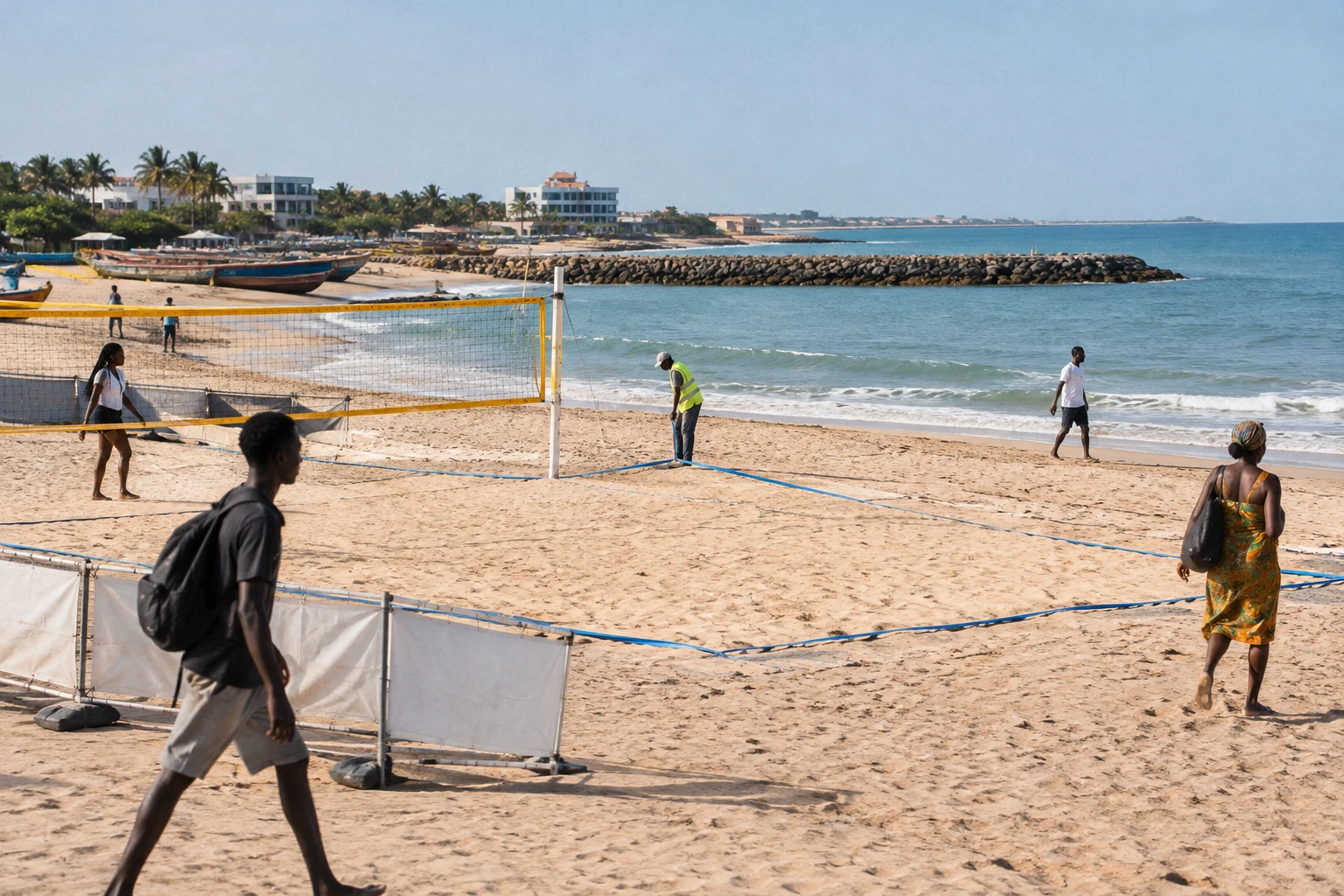
In Saly, the coastline is both a competition venue and a daily resource. During the Youth Olympic Games (YOG), the beach is hosting international events. A few kilometres away, erosion is a reminder that this area also supports fishing, tourism and life in coastal neighbourhoods.
One coastline, two realities
Dakar 2026 YOG will take place from 31 October to 13 November across three hubs: Dakar, Diamniadio and Saly. It is the first Olympic event to be held on the African continent. At Saly Beach West, six sports are scheduled: beach handball, beach volleyball, beach wrestling, coastal rowing, sailing and triathlon. The programme and venues are detailed by the International Olympic Committee. The Associated Press confirms the dates and the organisation of the Games in the three host cities.
Saly is on the Petite-Côte, south of Dakar, in the Mbour department. The proximity of the two towns does not mean their shorelines are changing in the same way. Scientific research on the area describes contrasting patterns: some stretches are retreating, while others are temporarily gaining ground. A study by Assane Seck University of Ziguinchor examines erosion and local responses in Mbour and Saly Portudal.
This distinction matters. Beaches are not just a backdrop for visitors or competitions. They support the activities of fishers, hotels, businesses and workers who depend on these sectors. In Mbour, fishing and related services underpin part of the local economy; in Saly, tourism plays an important role. Shoreline degradation therefore does not affect all residents in the same way.
Useful measures, but no definitive solution
Shoreline retreat is documented along the Petite-Côte. A Senegalese environmental atlas estimates erosion in the Mbour and Saly areas at varying levels, while a university study covering the municipalities of Mbour and Saly Portudal highlights differences from one stretch to another. These estimates depend on the periods and methods used: they do not describe a uniform rate along the entire coast.
Senegal has already undertaken protection and restoration works in Saly. The World Bank says the project, carried out along seven kilometres, restored 325,000 square metres of beach and installed 19 groynes and breakwaters. The works also covered two fishing villages, so residents could relaunch their boats close to home. These structures have addressed immediate needs. However, regular monitoring remains necessary, as do measures to manage the risk of erosion shifting to other stretches of coastline.
The phenomenon results from several factors acting together: waves and currents, coastal development, occupation of the shoreline and rising sea levels. The relative importance of each varies by location. Structures can protect a beach or buildings, but their effects on sand transport must be assessed across the whole coastline. A decision made for a hotel, port or road can affect neighbouring uses.
The Games’ legacy will also be measured after the events
For organisers, hosting competitions in Saly brings new visibility to beach sports and could support local activity. Visitors, teams and suppliers create temporary opportunities. Facilities or improvements associated with the Games could also benefit young people and clubs, provided they remain accessible and are maintained after the competition.
The benefits are not automatic, however. Tourism revenue is not shared equally between large establishments, small businesses, fishers and informal workers. Nor does media exposure for a beach guarantee the protection of homes or landing sites. The challenge, then, is to link investment in sport with coastal planning that takes account of neighbouring municipalities and existing activities.
Nationally, the issue extends beyond the Petite-Côte. Dakar and other parts of the coastline are also facing erosion and flood risks. Adaptation choices must balance the protection of people, access to the sea, fishing, tourism and the preservation of natural environments. For the Senegalese authorities, the experience in Saly can inform this discussion, although solutions cannot simply be copied from one site to another.
A shared challenge in West Africa
Senegal’s coastline is part of a regional area where currents, sediment and human activities do not stop at national borders. ECOWAS, a cooperation organisation for West African countries, provides a framework for sharing data and coordinating some coastal responses. But implementation still depends first and foremost on national and local decisions: zoning, building regulations, maintenance of structures and the participation of affected communities.
The YOG are thus putting Saly in the spotlight as Senegal welcomes the sporting world. The event’s impact will also be felt after the delegations have left: in the use of facilities, the benefits for residents and the ability to monitor changes to the shoreline. The competition makes the beach visible. The sustainable management of this coastline, however, is a long-term undertaking.



