Algeria
 Egypt
 Libya
 Morocco
 Sudan
 Tunisia
 Benin
 Burkina Faso
 Cabo Verde
 Côte d'Ivoire
 Ghana
 Guinea
 Guinea-Bissau
 Liberia
 Mali
 Mauritania
 Niger
 Nigeria
 Senegal
 Sierra Leone
 The Gambia
 Togo
 Cameroon
 Central African Republic
 Chad
 DR Congo
 Equatorial Guinea
 Gabon
 Republic of the Congo
 São Tomé and Príncipe
 Burundi
 Comoros
 Djibouti
 Eritrea
 Ethiopia
 Madagascar
 Malawi
 Mauritius
 Mozambique
 Rwanda
 Seychelles
 Somalia
 South Sudan
 Tanzania
 Uganda
 Angola
 Botswana
 Eswatini
 Lesotho
 Namibia
 South Africa
 Zambia
 Zimbabwe
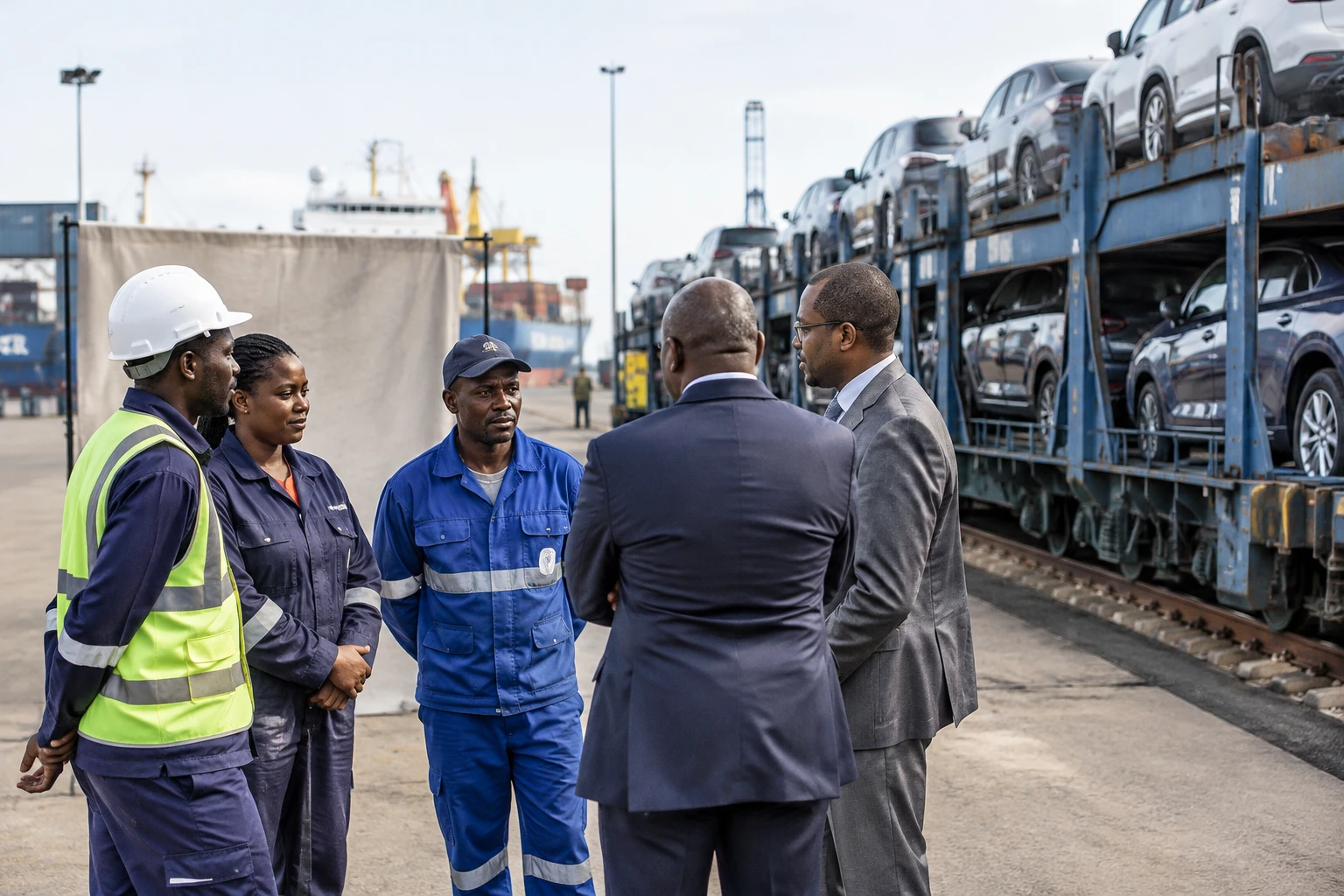
In Mombasa, transporting a car unloaded from a ship sustains far more than buyers and dealerships. It also involves drivers who take the vehicles to Nairobi, as well as the small businesses and services along the route. The arrival of rail in this segment promises a faster journey, but already raises questions about how the benefits and jobs will be shared.
An eight-hour rail journey, but a service still in its early stages
On 29 October 2026, Kenya Railways ran its first train from the port of Mombasa to the inland terminal at Embakasi, in Nairobi. According to the state operator, it carried 21 vehicles on four specialised wagons, as part of a train that also transported containers. The journey took about eight hours. These figures were reported by the Kenya Broadcasting Corporation, which confirmed the launch and the stated journey time.
Kenya Railways is targeting 700 vehicles a month. This is a target, not a volume already achieved. The carrier is working with dealership Autobarn East Africa, which also plans to transport up to 700 vehicles a month. The wagons can carry several makes, including Toyota, Nissan, Honda, Suzuki and Volkswagen. The company also says it offers insurance, vehicle securing and customs processing.
The precise scope of the service for customers remains unclear. The official announcement gives no price list or regular departure schedule. Nor does it detail port handling times, collection arrangements at Embakasi or the total cost of associated services. The eight hours therefore describes the inaugural rail journey, not necessarily the time from a vehicle’s unloading to its delivery to the buyer.
The corridor from the port to the hinterland
This new activity relies on a logistics route already central to Kenya. The port of Mombasa serves Nairobi and trade with the country’s interior. The Embakasi container terminal brings port operations closer to importers based in the capital. The Kenya Ports Authority says the Nairobi terminal is linked to the port by the standard gauge railway (SGR) and the metre-gauge network.
For importers, rail could reduce the mileage added to vehicles before they are sold and limit their exposure to road-related risks. For buyers, however, the benefits will depend on the price, formalities and ease of collecting the car at Embakasi. Customs clearance does not disappear with a change in transport: it must be coordinated with the relevant authorities and licensed agents. Faster delivery between two terminals therefore does not, on its own, guarantee that the vehicle will be made available to the customer sooner.
The service also relates to Kenya Railways’ regional ambitions. The KBC reports that the operator is targeting importers and traders in neighbouring countries, including Uganda, Tanzania, Rwanda, Burundi, South Sudan and the Democratic Republic of the Congo. This prospect fits within the East African Community (EAC), which brings together several economies linked to Kenya’s transport corridors. But rail delivery to Nairobi is only one stage: cross-border connections and transport from the terminal will also have to be organised.
Reconciling logistics gains with local livelihoods
Moving cars on to rail affects more than companies that import or sell vehicles. In Mombasa, independent drivers currently take some of the unloaded cars to Nairobi and other destinations. The Kenyan daily The Standard has documented the concerns of these workers, who are paid per trip, as well as the indirect income generated along the route for traders, mechanics and small service providers.
These accounts give a social dimension to the congestion-reduction goal cited by Kenya Railways. If dealerships consolidate large volumes on trains, some road journeys and the income associated with them could decline. The scale of this effect will depend on take-up of the service, its prices and the number of operators affected. Available data do not yet make it possible to measure job losses attributable to the new service. It is therefore important to distinguish drivers’ expressed fears from an established economic impact.
The precedent of container freight shows that shifting activity to rail can redistribute jobs between regions and occupations. The authorities may seek to improve corridor efficiency and diversify railway revenues. In Mombasa, workers and small businesses have an interest in ensuring that this change does not suddenly eliminate their sources of work. Training, new roles in handling or the organisation of local transport could help support the transition, although no such measures have been announced at this stage.
The test will be regular service
The launch forms part of a broader challenge for Kenya: making the railway network a regular component of domestic and regional trade, beyond its initial operations. For the car service to expand, its prices, schedules, actual capacity and handling guarantees will need to be known. The quality of connections between the port, Embakasi and final destinations will matter as much as the stated time on the rails.
In the short term, the coming months will show whether the target of 700 vehicles a month is met and whether other importers join the scheme. The distribution of costs and revenues along the corridor, from the coast to Nairobi, will also need to be watched. The new service adds another logistics option; its record will depend as much on its commercial reliability as on how its gains are shared.