Algeria
 Egypt
 Libya
 Morocco
 Sudan
 Tunisia
 Benin
 Burkina Faso
 Cabo Verde
 Côte d'Ivoire
 Ghana
 Guinea
 Guinea-Bissau
 Liberia
 Mali
 Niger
 Nigeria
 Senegal
 Sierra Leone
 The Gambia
 Togo
 Cameroon
 Central African Republic
 Chad
 DR Congo
 Equatorial Guinea
 Gabon
 Republic of the Congo
 São Tomé and Príncipe
 Burundi
 Comoros
 Djibouti
 Eritrea
 Ethiopia
 Kenya
 Madagascar
 Malawi
 Mauritius
 Mozambique
 Rwanda
 Seychelles
 Somalia
 South Sudan
 Tanzania
 Uganda
 Angola
 Botswana
 Eswatini
 Lesotho
 Namibia
 South Africa
 Zambia
 Zimbabwe
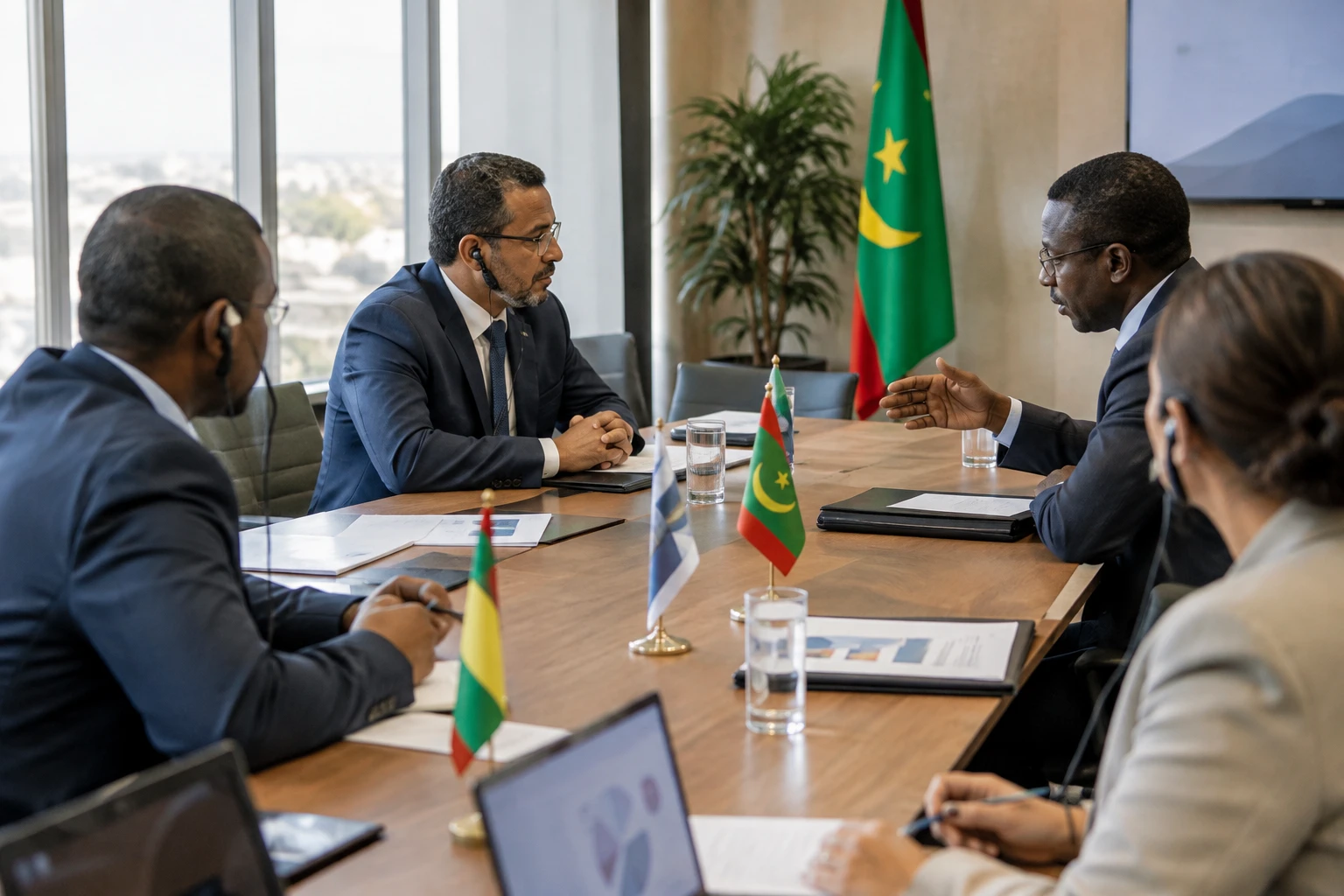
An oil contract does not, on its own, turn a discovery into production. For Mauritania, the agreement signed with Murphy Oil therefore raises a practical question: can new exploration and old fields lead to viable projects, with benefits beyond the extractive sector?
Two blocks, two different challenges
On 3 November 2026, in Nouakchott, Mauritania’s Ministry of Energy and Petroleum signed two exploration and production contracts with US company Murphy Oil. They concern the offshore C10 and Tiof blocks in the coastal basin. The agreements were signed by minister Mohamed Abdel Vettah and Christopher Charles Olson, Murphy’s vice-president for exploration and geology. President Mohamed Ould Cheikh El Ghazouani had received the company’s delegation earlier that day.
The two areas are at different stages. C10 remains an exploration area, where indications still need to be confirmed through further work. Tiof, by contrast, is an old oil discovery, identified in the early 2000s but never brought into commercial production. The ministry estimates its reserves at about 280 million barrels and says the feasibility of redevelopment is under study. This figure is an official estimate, not a measure of oil that can already be recovered.
C10’s geological potential does not equate to proven reserves either. Gas discoveries at Merou and an oil discovery at Labeidna have been reported there, but the prospects discussed by the industry require further drilling. Exploration can confirm a resource, but it can also yield traces too small to justify development. The results of a well drilled by Shell in 2023, which reportedly encountered only traces of hydrocarbons, are a reminder of this uncertainty; this information was not included in the day’s official announcements.
Financial terms still unknown
The authorities describe the signing as a revival of exploration in the coastal basin. However, the information made public does not detail drilling commitments, planned spending, the duration of the contracts or the division of interests between partners. Without these details, it is difficult to assess the pace of operations and the share of risk borne by the company or the state.
A production-sharing contract sets out the rules under which the company funds operations and any production is shared with the state. But the terms specific to these agreements have not yet been made public. A cabinet decision of 31 December 2025 had authorised an exemption from competitive bidding for blocks C7 and C10, as well as Tiof, to allow direct negotiations. This process makes publication of the commitments and negotiated terms all the more important.
For Mauritanians, the stakes therefore go beyond the volume announced beneath the sea. They also concern public revenue, local jobs, procurement from domestic companies and skills transfer. These benefits depend on the contracts, infrastructure and the ability to turn revenues into services or investment. People in Nouakchott and coastal towns will not necessarily feel the effects in the same way as households far from the economic hubs.
A sector to build for the long term
Mauritania’s oil trajectory has already seen a contrast between discovery and production. Chinguetti, the country’s first commercial discovery, ceased operations in 2017. By contrast, the Greater Tortue Ahmeyim gas project shows that offshore development can take on a regional dimension: located on the maritime border between Mauritania and Senegal, it produced its first gas in late 2024, followed by its first liquefied natural gas in February 2025. The first exports followed in April 2025.
This experience offers a point of reference, but does not guarantee the same path for C10 or Tiof. The gas project involves infrastructure and partners from both countries. The blocks covered by the agreements with Murphy Oil, by contrast, involve new oil assessments and an old discovery to be reconsidered. In both cases, the allocation of interests, technical capacity and transport to markets affect viability.
Regionally, Mauritania is a member of the African Union and the Arab Maghreb Union, and an associate member of ECOWAS, the West African economic community. The energy partnership with Senegal around GTA also shows that offshore resources can involve practical cross-border co-operation. The benefits and risks do not stop at maritime borders.
The next step will be less symbolic than practical: publish work programmes, specify the contractual terms and report on the first technical results. Until this information is available, the agreements mark an opening for exploration, not a guarantee of production or revenue. Their significance for the Mauritanian economy can be judged only on that basis.