Algeria
 Egypt
 Libya
 Morocco
 Sudan
 Tunisia
 Benin
 Burkina Faso
 Cabo Verde
 Côte d'Ivoire
 Ghana
 Guinea
 Guinea-Bissau
 Liberia
 Mali
 Mauritania
 Niger
 Nigeria
 Senegal
 Sierra Leone
 The Gambia
 Togo
 Cameroon
 Central African Republic
 Chad
 DR Congo
 Equatorial Guinea
 Gabon
 Republic of the Congo
 São Tomé and Príncipe
 Burundi
 Comoros
 Djibouti
 Eritrea
 Ethiopia
 Kenya
 Madagascar
 Malawi
 Mauritius
 Mozambique
 Rwanda
 Seychelles
 Somalia
 South Sudan
 Tanzania
 Uganda
 Angola
 Botswana
 Eswatini
 Lesotho
 Namibia
 Zambia
 Zimbabwe
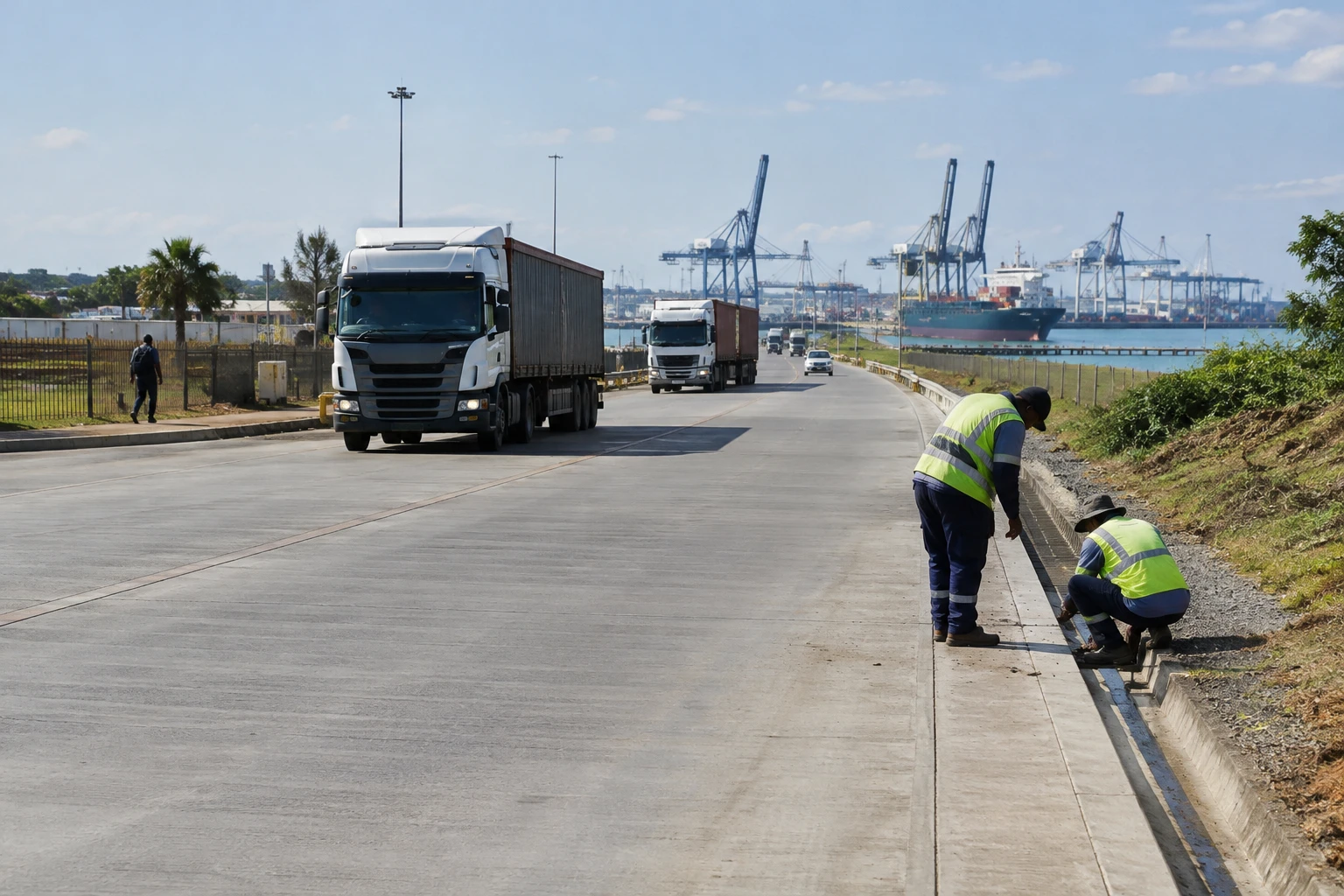
At the port of Richards Bay, a few kilometres of road can affect an entire export chain. When heavy vehicles slow down between terminals and exits, delays do not stay on the road: they can ripple through port operations and affect businesses moving their goods.
A major port under logistical pressure
Located in KwaZulu-Natal province, Richards Bay is one of South Africa’s main bulk ports. It connects the country’s mining and industrial activities with maritime markets, particularly in Asia. In 2024, the port handled 83,358 million tonnes of cargo, according to statistics from the Transnet National Ports Authority (TNPA), the public body responsible for managing South Africa’s port infrastructure. South African port traffic data for 2024 put Richards Bay at the top of the country’s ports by total tonnage.
Coal illustrates the importance of this hub, though it does not account for all of its activity. In 2024, about 90% of South Africa’s coal exports passed through the Richards Bay Coal Terminal and the neighbouring port, according to the Minerals Council South Africa. The terminal exported 52.1 million tonnes that year, a figure also reported by S&P Global Energy. These volumes depend on several links in the chain: mining, rail, access roads, terminals and ships.
Regionally, Richards Bay is part of southern African trade, with South African ports also serving as outlets for industrial and mining flows from the country’s interior. The Southern African Development Community (SADC) brings the region’s states together to co-operate on economic matters and infrastructure. But an efficient corridor depends as much on co-ordination between networks as on the capacity of any one port.
Three roads included in the works
The TNPA has launched a rehabilitation programme valued at 375 million rand and scheduled to last 18 months. The work covers Urania Road, Newark Road and Ventura Road, three routes serving the terminals and operational facilities. A Transnet tender published in 2025 confirms the scope of this first phase and its planned duration. The TNPA tender documents state that the project involves rehabilitating and upgrading these concrete roads.
The TNPA says rising heavy-vehicle traffic has accelerated road wear. The programme includes widening and strengthening the roads, laying concrete surfaces, and upgrading drainage and stormwater systems. Safety equipment will also be added. The stated aim is to facilitate the movement of goods, reduce truck turnaround times and improve road-user safety.
The project follows separate work on Newark Road. In September 2025, the TNPA said that rehabilitation, valued at about 20 million rand, was 75% complete and due to finish in December. It estimated then that the road carried 35,000 heavy vehicles and more than 67,000 light vehicles each month. Transnet’s progress update shows that local traffic and access to the port were already key operational concerns.
Benefits will depend on the entire chain
A more durable road surface can reduce delays and the costs associated with them. However, it is not enough to guarantee lasting improvement. Trucks must be able to reach terminals without causing queues, while loading operations and rail links must be able to handle volumes efficiently. If another link remains congested, the gains on the roads may simply shift elsewhere rather than eliminate the problem.
This interdependence is particularly important at Richards Bay, where rail carries a vital share of the coal destined for export. Terminal figures also show that volumes can change with logistics performance and demand in foreign markets. S&P Global Energy reports that coal exports rose in 2024, driven both by improved performance in some flows and by sustained demand in Asia. Port roads alone therefore do not determine competitiveness: they complement rail capacity, port management and commercial conditions.
The work will also have practical effects while it is under way. Diversions and access restrictions may complicate journeys for drivers, port workers and businesses in the area. Previous work on Newark Road required alternative routes to separate light and heavy vehicles as far as possible. Traffic management and keeping road users informed will therefore be as important to the project’s overall record as the quality of the finished road.
A test for Transnet’s strategy
The programme is part of the TNPA’s efforts to renew its assets and Transnet’s “Reinvent for Growth” strategy. Transnet is the state-owned company that manages much of the country’s rail and port infrastructure. For South African authorities, the challenge goes beyond maintaining three roads: it is about making a logistics system more reliable, on which exporters, sector employees and trade revenues depend.
For road users, the expected benefits will not be measured solely by the amount invested or by the project’s completion. They will need to assess the actual duration of the works, the flow of traffic at access points, road safety and co-ordination with rail and terminals. At Richards Bay, as at other SADC ports, competitiveness depends on the entire corridor: upgraded infrastructure is a lever, but its value depends on the reliability of the connections around it.