Algeria
 Egypt
 Libya
 Morocco
 Sudan
 Tunisia
 Benin
 Burkina Faso
 Cabo Verde
 Côte d'Ivoire
 Ghana
 Guinea
 Guinea-Bissau
 Liberia
 Mali
 Mauritania
 Niger
 Nigeria
 Senegal
 Sierra Leone
 The Gambia
 Togo
 Cameroon
 Central African Republic
 Chad
 DR Congo
 Equatorial Guinea
 Gabon
 Republic of the Congo
 São Tomé and Príncipe
 Burundi
 Comoros
 Djibouti
 Eritrea
 Ethiopia
 Kenya
 Malawi
 Mauritius
 Mozambique
 Rwanda
 Seychelles
 Somalia
 South Sudan
 Tanzania
 Uganda
 Angola
 Botswana
 Eswatini
 Lesotho
 Namibia
 South Africa
 Zambia
 Zimbabwe
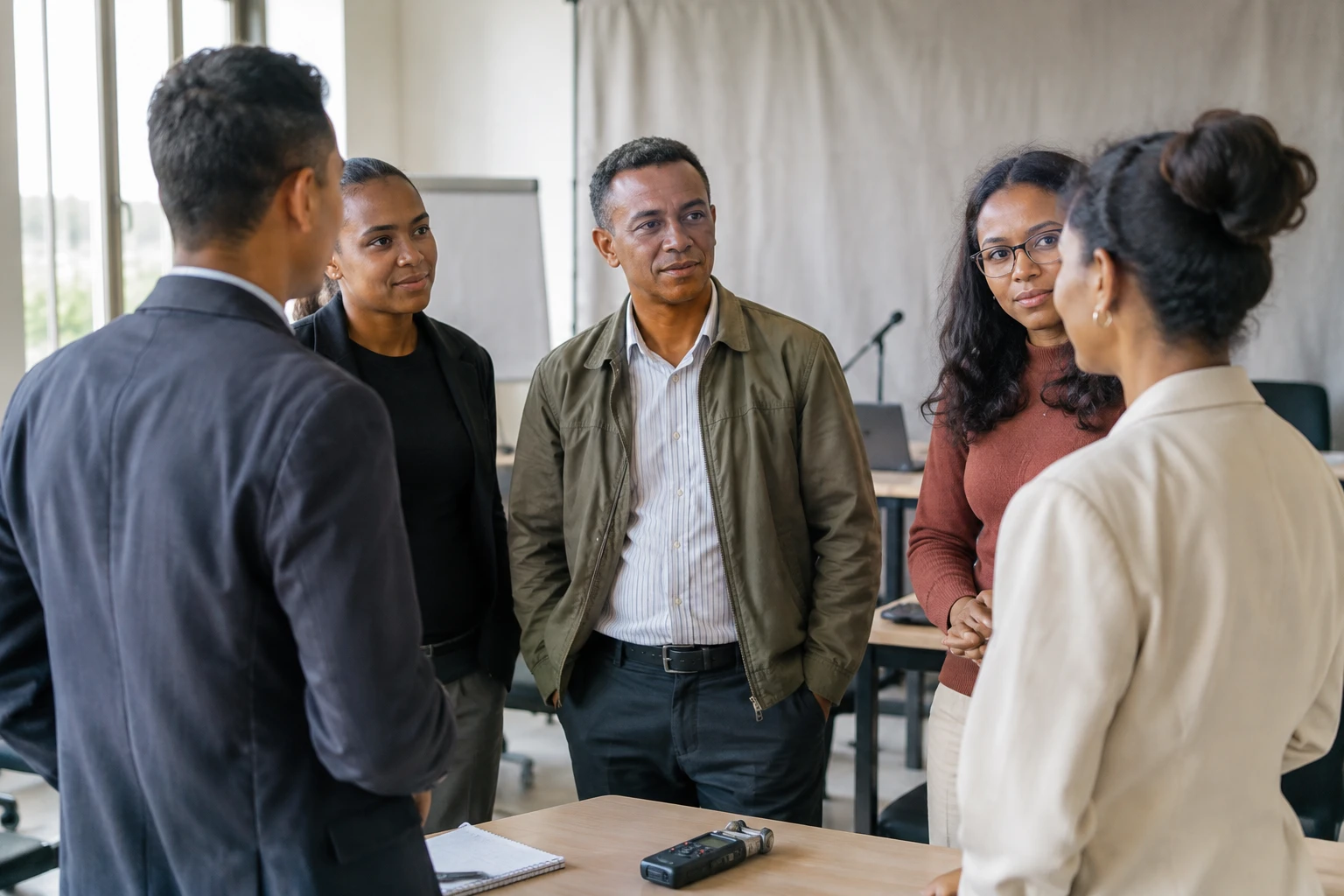
In Antananarivo, two radio productions have focused attention on subjects that the media still cover too little: domestic violence and traditional crafts. Their authors, Nadia Razafimahatratry and Yves Ramarosandratana, will represent Madagascar at a professional training course in Paris in 2027.
Training rooted in Malagasy media
The two professionals were recognised on 2 November 2026 at the Institut français in Antananarivo. They won the 13th edition of the Ghislaine Dupont and Claude Verlon scholarship, organised by Radio France Internationale (RFI) in memory of the two journalists murdered in Kidal, in northern Mali, on 2 November 2013.
This edition took place in Madagascar. For two weeks, ten participants — five journalists and five technicians — attended workshops at the headquarters of Madagascar’s public radio and television office (ORTM), a partner in the training programme. The journalists worked on the theme of “Dialogue and tolerance”. The technicians produced audio reports on Malagasy craftsmanship and trades.
The selection therefore rewards more than two productions. It highlights skills developed within Malagasy media, whether public, community or local. The training and selection bring together several professions essential to producing radio journalism: reporting, writing, sound recording and editing.
Two reports, two seldom-heard realities
Nadia Razafimahatratry, 34, works at the Regional Directorate of Communication and Culture in the Itasy region. Her report, entitled “Behind closed doors: domestic violence in Madagascar”, impressed the jury with its testimonies and writing. It addresses violence often relegated to the private sphere, where silence can make it harder to seek help and obtain support.
The chosen theme raises questions of method as well as representation: how can violence be documented without reducing those affected to their experience or exposing those who speak out? Information published about the selection describes the report’s content but does not detail the measures taken to protect witnesses. It is therefore important not to draw conclusions on this point without listening to the report itself.
Yves Ramarosandratana, 32, a technician at Radio FAFI, was recognised for “Blacksmith, sculptor of metal”. This audio report captures the work of a craftsman in Mangatany, a village west of Antananarivo. The jury noted the quality of the sound recording, mixing and structure. Here, technical work also serves the narrative: the movements and sounds of the workshop offer a glimpse into a trade and its skills.
The two winners will attend a four-week training course in Paris in the first quarter of 2027, funded by RFI. The course is intended to build on the workshops held in Madagascar. It will give both professionals time to hone their skills, without replacing the editorial work they already do at their media outlets.
Media connecting the capital and the regions
The winners’ careers are a reminder that news production is not confined to the capital. Nadia works in Itasy, while Radio FAFI is based in Tsiroanomandidy, in the Bongolava region. Training courses and awards can thus build bridges between regional media and wider professional networks.
This exchange of skills matters in a country where realities beyond Antananarivo can remain less visible in the national media. It also matters to listeners: local radio stations can cover issues close to their daily lives, provided they have the resources, trained professionals and sufficient scope to investigate.
Two other participants were also recognised at the ceremony. Marie Edmondine, a technician at Radio Tsiry, and Diary Ranaivoson, a journalist at Studio Sifaka, received recording equipment from the Friends of Ghislaine Dupont and Claude Verlon association. This material support is a reminder that the quality of a report depends not only on the talent of the teams but also on the tools available to them.
A professional milestone to follow in 2027
The scholarship is named after Ghislaine Dupont and Claude Verlon, RFI journalists killed in Kidal in 2013 while reporting. Since 2014, the programme has linked their memory to the training of media professionals. Its Malagasy edition thus connects a tragic chapter in journalism in the Sahel to professional careers built in the Indian Ocean.
Madagascar is a member of the Southern African Development Community (SADC), a regional organisation bringing together states in Southern Africa, and the Indian Ocean Commission, which promotes cooperation among the region’s island countries. The scholarship is not a programme run by these organisations. Its regional reach instead lies in the exchange of practices and the place it gives Malagasy media in Francophone networks.
The next concrete milestone will be the two winners’ training course, expected in the first quarter of 2027. Following their work and sharing what they learn with their newsrooms will make it possible to assess what the award delivers beyond the ceremony. For Malagasy media, the challenge is to sustain these skills in newsrooms and keep attention on social issues and trades that are often under-represented.
The winners’ names and the broad outlines of their reports have been reported by several Malagasy media outlets and France Médias Monde. Newsmada looks at the two winners and the training course. 2424.mg details their reports and careers. France Médias Monde confirms the announcement and the training planned for 2027.