Algeria
 Libya
 Morocco
 Sudan
 Tunisia
 Benin
 Burkina Faso
 Cabo Verde
 Côte d'Ivoire
 Ghana
 Guinea
 Guinea-Bissau
 Liberia
 Mali
 Mauritania
 Niger
 Nigeria
 Senegal
 Sierra Leone
 The Gambia
 Togo
 Cameroon
 Central African Republic
 Chad
 DR Congo
 Equatorial Guinea
 Gabon
 Republic of the Congo
 São Tomé and Príncipe
 Burundi
 Comoros
 Djibouti
 Eritrea
 Ethiopia
 Kenya
 Madagascar
 Malawi
 Mauritius
 Mozambique
 Rwanda
 Seychelles
 Somalia
 South Sudan
 Tanzania
 Uganda
 Angola
 Botswana
 Eswatini
 Lesotho
 Namibia
 South Africa
 Zambia
 Zimbabwe
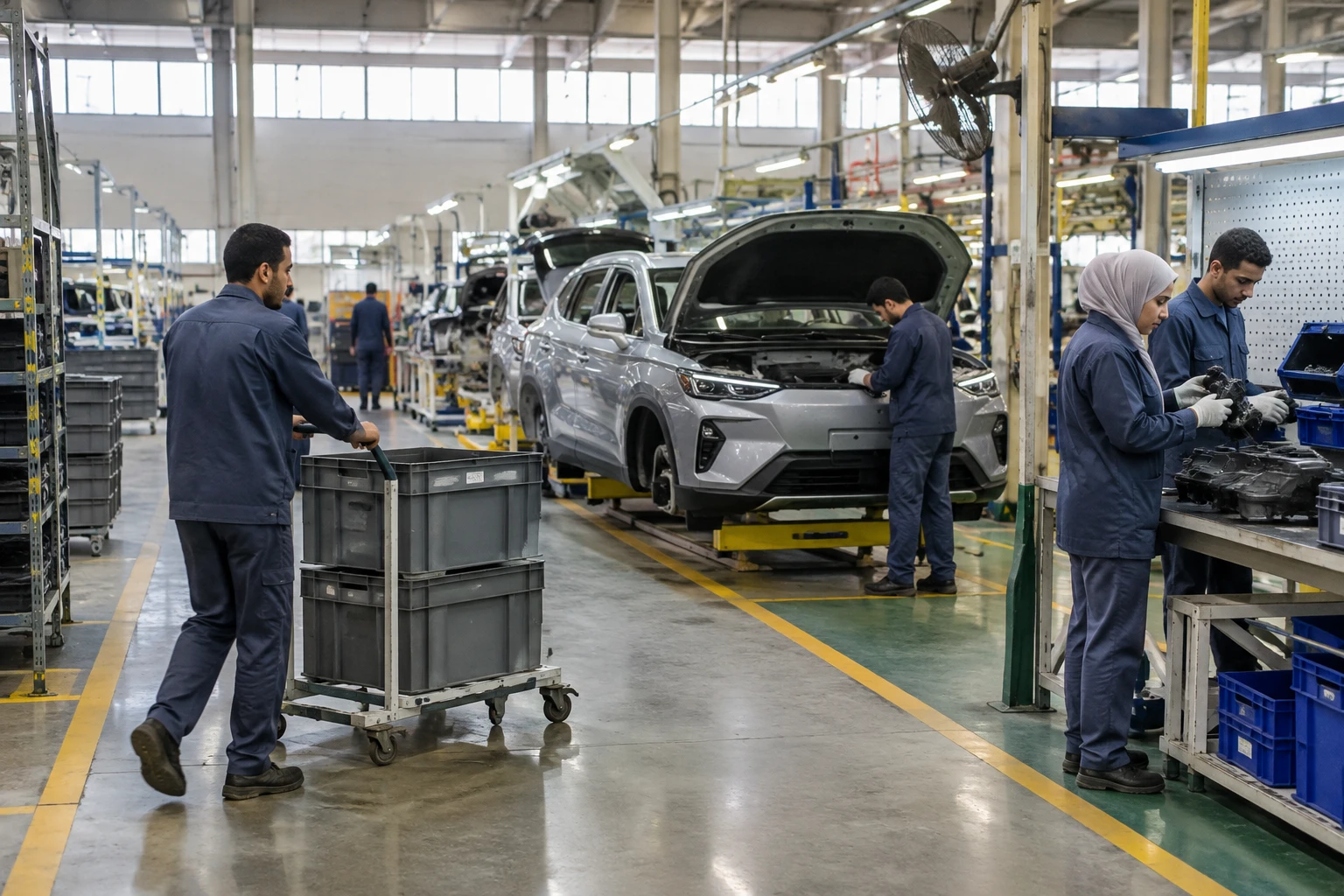
Making an electric car involves more than assembling it. For Egypt, the challenge is to bring more local companies into a production chain dominated by foreign technologies and suppliers. The launch of the MAGE EV marks a concrete step, but its industrial significance will depend on what is actually made in the country.
Industrial revival beyond the car
On 31 October 2026, state-owned El Nasr Automotive Manufacturing Company presented the production in Egypt of the Dongfeng MAGE EV, an electric vehicle from the Chinese brand. The project brings together manufacturer Dongfeng, SN Automotive and Egyptian group Al Safy. Production is taking place at El Nasr’s plants in Helwan, south of Cairo. Egypt’s ministers of industry and electricity attended the announcement, reported by Egyptian Gazette and Egyptian daily Al-Ahram Auto, among others.
The authorities say that up to 45% of the model’s components come from local suppliers. The figure reflects an ambition to increase domestic content, but does not mean that the entire vehicle, or its main technologies, are designed in Egypt. The battery and electric propulsion systems remain decisive elements to examine when assessing the true depth of industrialisation.
The launch is part of the reactivation of El Nasr, a company founded in 1960 that has long faced difficulties. Reviving its facilities is intended to make use of an existing industrial base rather than start from scratch. Published information refers to the modernisation of production lines and a new paint shop. Since the investment amount cited in some communications is not confirmed here by a second independent source, it is not, by itself, enough to assess the site’s capacity for sustainable production.
From local-content targets to Egyptian suppliers
In its first year, the company is targeting 3,000 vehicles, according to objectives communicated around the launch. That volume remains modest compared with national ambitions, but it can serve as a test of component quality, supply reliability, costs and the ability to maintain production. The targets announced are not yet verified industrial results.
The distinction between assembly and manufacturing is central. A car can roll out of a local factory while still relying heavily on imported parts. For the project’s benefits to spread, Egyptian companies must be able to supply, among other things, body parts, seats, wiring and electronic components. This requires regular orders, common standards and investment in skills. The workshops in Helwan can generate activity, but the impact on jobs and suppliers will depend on the share actually produced locally.
This strategy also responds to an economic constraint: imported vehicles and many imported parts expose the sector to currency fluctuations and disruptions to global trade. Local production can reduce some of this dependence, but not eliminate it. Imports of batteries, software and specialised components may continue to weigh on costs and the final price paid by households.
A national programme, regional challenges
The National Automotive Industry Development Programme, known by its English acronym AIDP, provides incentives for manufacturers that invest and increase local value added. The government is targeting domestic production of 100,000 vehicles a year by 2030. This target covers the Egyptian automotive industry as a whole, not electric cars alone. The programme and its objectives are described by the Egyptian Industrial Development Authority and the Egyptian State Information Service.
For the state, the challenge is to turn public support into production, skills and enduring suppliers. For workers and companies in the sector, the question is whether jobs will be sustainable and markets accessible. For buyers, the appeal will depend on price, warranty and the availability of charging points, not only on where the car is assembled. DC fast charging and 800-volt electric architectures have been cited as possible areas of development for the sector. They are not presented as features of the MAGE EV. For this model, published data indicate about 28 minutes to charge from 30% to 80%.
Regionally, Cairo is seeking to strengthen Egypt’s position in African value chains and attract foreign industrial partners. The country is a member of the Common Market for Eastern and Southern Africa (COMESA), an economic co-operation organisation that aims to facilitate trade among its member states. But selling across the continent will require more than local production: competitive prices, compatible standards, charging networks and operational trade agreements will also be needed.
The MAGE EV is therefore both a vehicle and a test of industrial policy. The coming steps will show whether the 45% local-content figure translates into lasting contracts for Egyptian companies, and whether the target of 3,000 units is achieved. Growth in production, the expansion of the supplier base and consumers’ access to charging will determine whether this revival can go beyond the announcement of a new model.