Algeria
 Egypt
 Libya
 Morocco
 Sudan
 Tunisia
 Benin
 Burkina Faso
 Cabo Verde
 Côte d'Ivoire
 Ghana
 Guinea
 Guinea-Bissau
 Liberia
 Mali
 Mauritania
 Niger
 Nigeria
 Senegal
 Sierra Leone
 The Gambia
 Togo
 Cameroon
 Central African Republic
 Chad
 DR Congo
 Equatorial Guinea
 Gabon
 Republic of the Congo
 São Tomé and Príncipe
 Burundi
 Comoros
 Djibouti
 Eritrea
 Ethiopia
 Madagascar
 Malawi
 Mauritius
 Mozambique
 Rwanda
 Seychelles
 Somalia
 South Sudan
 Tanzania
 Uganda
 Angola
 Botswana
 Eswatini
 Lesotho
 Namibia
 South Africa
 Zambia
 Zimbabwe

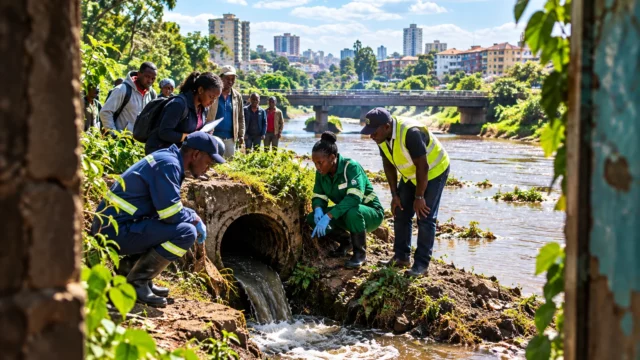
In Kenya, financing a dam is not enough to ensure that a household has water on tap. Water must also be transported, networks maintained and services made accessible in regions where rainfall and water resources are distributed very unevenly.
This challenge lies at the heart of the debate in Nairobi over financing water infrastructure. The Kenyan government wants to attract more private capital while continuing its storage and irrigation projects. The task is to turn major construction schemes into tangible services for households and farmers.
Funding needs must be distinguished from water-access targets
On 1 November 2026, Julius Korir, principal secretary for Water and Sanitation, said the country estimated its needs for water collection and storage infrastructure at 1,600 billion Kenyan shillings, or about $12.3 billion. The national budget would cover only about 20% of this amount, according to reports from Nairobi.
This figure should not be confused with the amount in the National Water and Sanitation Investment Plan, or NAWASIP. Adopted to accelerate access to services by 2030, the programme puts the cost of broader projects at 995 billion shillings: drinking water, sanitation, infrastructure and sector reforms. Kenya’s ministry says 313 billion is envisaged in the form of public-private partnerships. The two figures therefore cover different areas.
The 1,600 billion shilling requirement relates in particular to water collection and storage. NAWASIP also targets networks and sanitation services across all 47 counties. This distinction matters: an additional reservoir alone cannot guarantee reliable supply to neighbourhoods or villages.
Persistent gaps between urban and rural areas
Data from the Kenya National Bureau of Statistics (KNBS) show an increase in access to an improved water source. The national proportion rose from 72% in 2022 to 77% in 2023, a level maintained in 2024. But the average masks a marked gap: 93% in urban areas, compared with 69% in rural areas.
These indicators measure access to an improved source; they do not necessarily mean that water flows continuously into homes, or that it is available nearby for every family. For rural populations, irrigation and storage can support harvests, but their impact will also depend on canals, distribution points and local management. In cities, increasing water supplies will need to be accompanied by networks capable of meeting demand.
The regional context adds to the challenge. The East African Community (EAC), a co-operation organisation bringing together East African countries, highlights major differences in water availability across the region and the effects of droughts, floods and variable rainfall. Kenya’s infrastructure must therefore meet domestic needs while forming part of the sustainable management of shared basins and resources.
Major dams and partnerships: the question of delivery
The government has outlined a programme of 50 large dams, 200 medium-sized structures and more than 1,000 small dams. It is also preparing irrigation projects in the Bura and Galana areas. Public-private partnerships, or PPPs, bring together the state and companies to finance or operate certain projects. They can supplement public resources, but require transparent contracts and a clear allocation of risks and costs.
Two major projects illustrate both the ambition and the delays. At Thwake, in the south-east of the country, the government is aiming to begin filling the reservoir in January 2027. The African Development Bank approved additional funding of €68.39 million in 2026 to support completion of the project. The dam is expected to contribute to water supply, irrigation and electricity generation. These promised benefits will, however, depend on the completion of construction and the equipment needed to transport the water.
At Mwache, in Kwale County, construction of the main dam was more than 90% complete in August 2026, according to the public agency Kenya News Agency. The reported timetable provides for the reservoir to begin filling in October 2027. The project is intended to strengthen supply to the coastal region, particularly for residents of Kwale and Mombasa. Here too, storage is only one stage: treatment and distribution facilities will determine whether users actually gain access.
The government is also discussing a dam in Kiambu County with the Danish agency Danida. It also plans to draw on the future National Infrastructure Fund. These financing avenues still need to be turned into projects that are prepared, costed and backed by safeguards for their social and environmental impact.
Success will be measured by the service delivered
For investors, PPPs can create new opportunities in dams, irrigation and networks. For the state and counties, the challenge will be to keep services affordable and ensure that investment also benefits less profitable areas. Small-scale farmers and rural households will not automatically enjoy the same advantages as large operators or urban centres.
Project monitoring will therefore need to cover more than the sums committed and the construction completed. It will be necessary to measure the water actually distributed, the continuity of service, the cost to households and the availability of water for crops. Protecting basins and consulting affected communities will also influence the sustainability of the infrastructure.
Across the EAC, Kenya’s experience is of interest to countries also facing climate variability and infrastructure needs. But financing models cannot simply be transferred from one country to another: resources, networks and management rules differ. In Kenya, the next steps to watch are the planned filling of Thwake, the Mwache timetable and the publication of concrete arrangements for mobilising private capital.
Ultimately, the gap between the 1,600 billion shillings announced for storage infrastructure and the 995 billion in NAWASIP is a reminder that these are distinct but related plans. Their effectiveness will be judged in Nairobi as well as in rural counties: not by the number of dams promised, but by the regularity and fairness of access to water.