Algeria
 Egypt
 Libya
 Morocco
 Sudan
 Tunisia
 Benin
 Burkina Faso
 Cabo Verde
 Côte d'Ivoire
 Ghana
 Guinea
 Liberia
 Mali
 Mauritania
 Niger
 Nigeria
 Senegal
 Sierra Leone
 The Gambia
 Togo
 Cameroon
 Central African Republic
 Chad
 DR Congo
 Equatorial Guinea
 Gabon
 Republic of the Congo
 São Tomé and Príncipe
 Burundi
 Comoros
 Djibouti
 Eritrea
 Ethiopia
 Kenya
 Madagascar
 Malawi
 Mauritius
 Mozambique
 Rwanda
 Seychelles
 Somalia
 South Sudan
 Tanzania
 Uganda
 Angola
 Botswana
 Eswatini
 Lesotho
 Namibia
 South Africa
 Zambia
 Zimbabwe
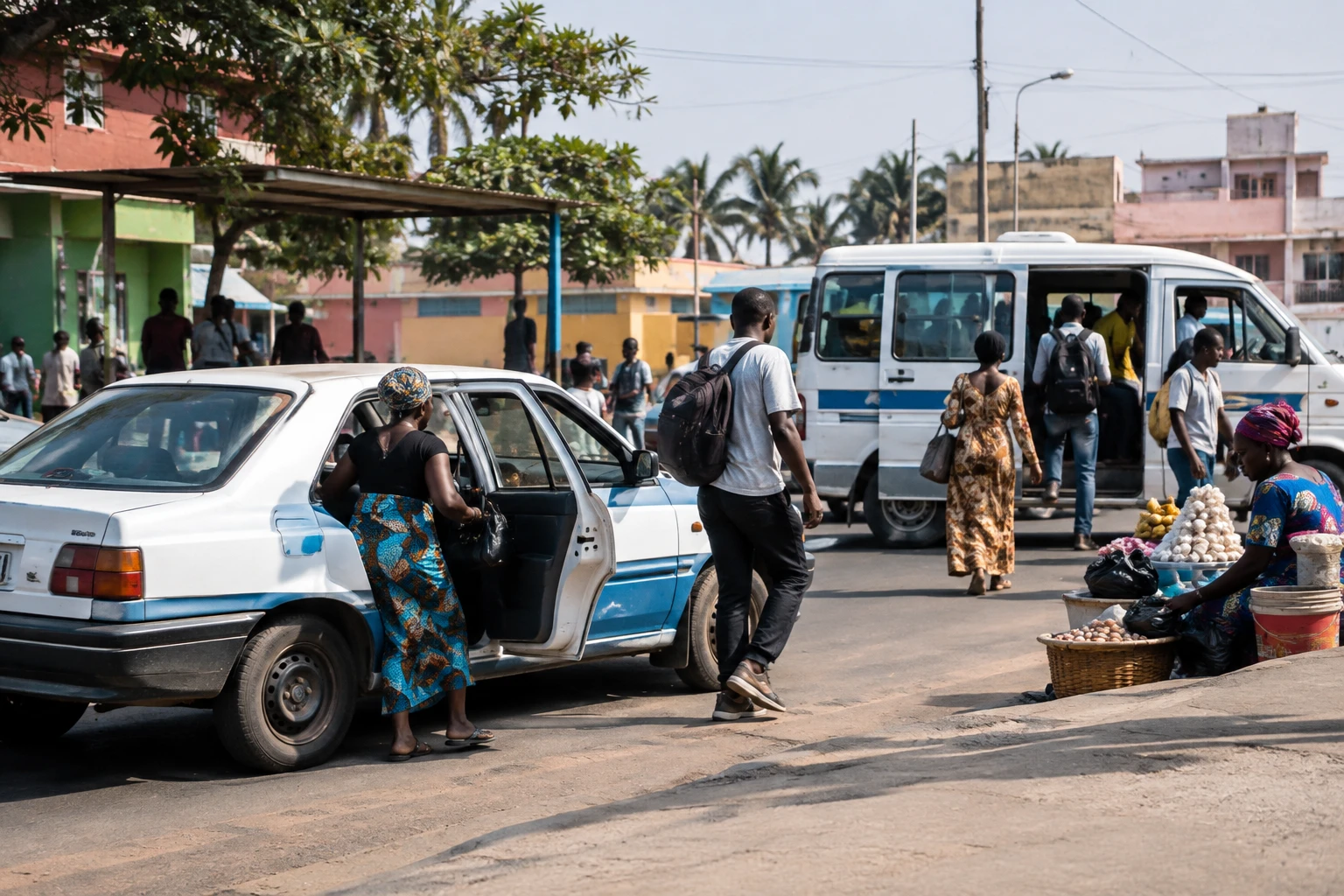
Departures for the Canaries are not always organised on the most visible coastlines. In Guinea-Bissau, two operations around Bissau have brought renewed attention to the role of less closely monitored departure points and the movement of networks across several West African countries.
A route that crosses borders
The Atlantic route to the Canary Islands, Spanish territory off the coast of Africa, has for several years been used by people setting off from or travelling through various West African coastlines. The journey can begin far from the shore: prospective migrants travel to a meeting point before boarding a pirogue, often vulnerable to breakdowns and bad weather.
Guinea-Bissau lies between Senegal and Guinea. Its coastline and the Bijagós archipelago offer several possible departure points, but the use of these locations by trafficking networks must be documented on a case-by-case basis. The International Organization for Migration (IOM) describes an Atlantic route whose departure points and itineraries shift according to surveillance locations and local conditions. In 2025, it recorded 17,788 irregular arrivals in the Canaries from the coasts of West and North Africa, as well as 54 shipwrecks that caused the death or disappearance of 1,214 people. These figures cover the entire route, not Guinea-Bissau alone. IOM data on the Atlantic route in 2025 give an indication of the risks.
In this region, borders do not always correspond to travellers’ routes. Free movement within ECOWAS — the Economic Community of West African States — facilitates regular travel between member countries. But this mobility can also be exploited by smugglers, while checks and national operations sometimes shift departure points without dismantling the networks.
168 people intercepted in two operations
According to information released by the Guinea-Bissau National Guard and reported on 2 November 2026, 168 people were intercepted over three days in Bissau and its surroundings. The total comprises two groups: 143 people spotted near the Bandim fishing quay and another 25 at a house on the northern outskirts of the capital. The AFP report carried by Arab News says the second group was due to travel to an island in the Bijagós before a possible departure for the Canaries.
The second operation, carried out on Saturday 31 October according to the same account, involved a pirogue carrying 143 people. Among them were 141 Senegalese nationals and two Gambians, according to the National Guard. A report by Portuguese news agency Lusa, published about the operation, also gives the figure of 143 people and says they were arrested near Bissau. Lusa’s report on the interception describes an operation launched after a tip-off.
However, the available accounts do not fully agree on the date, precise location and make-up of the group of 25. An EFE dispatch places this interception on 1 November, near the port of Alto Bandim, and gives a different breakdown of nationalities from the one reported by AFP. Both agencies report the aggregate figure of 168, but details about the second group should be attributed rather than presented as definitively established. The EFE dispatch carried by ABC Color reports these differences.
The interceptions do not, in themselves, shed light on the role of each person arrested. The authorities refer to irregular departures and organised networks, but the information made public does not establish whether all the passengers knew the conditions of the journey or who organised each stage. It is also important to distinguish people seeking to leave from intermediaries who may profit from the crossing.
A police response to mobile networks
For the security forces, stopping a departure can prevent a dangerous crossing and open an investigation into the organisers. But an interception in Bissau is not enough to show that a network has been dismantled. Operations must be followed by investigations into recruitment, transport, funding and meeting points, including beyond national borders.
The shifting of departure points is one of the challenges. A Senegalese public broadcaster reported in June 2025 that 60 people had been intercepted in Popenguine, Senegal, including nationals of several neighbouring countries. This incident alone does not prove that Senegalese surveillance prompted the departures observed in Guinea-Bissau. It does, however, illustrate the cross-border nature of the routes and the need for intelligence-sharing between services. RTS’s report on the Popenguine operation highlights the range of nationalities involved.
The consequences are not the same for everyone. People intercepted may find themselves far from their place of departure and dependent on the authorities for what happens next. Families, meanwhile, may have spent resources paying for a journey whose outcome remains uncertain. For coastal communities, the presence of trafficking networks and tighter controls may also affect activities around quays and landing points. The available information, however, does not make it possible to assess the scale of these effects in Bissau or on the islands.
The challenge extends beyond Guinea-Bissau
The situation calls for co-operation between Guinea-Bissau, Senegal and Gambia, the countries cited in recent operations, as well as with other states affected by the Atlantic route. ECOWAS can provide a forum for regional dialogue on mobility and the fight against criminal networks. But the response cannot be limited to arrests: it also requires co-ordinated investigations, the respectful treatment of people intercepted, and verified information about their rights and circumstances.
The question to watch is therefore twofold: will the authorities be able to identify the organisers beyond the departure points themselves, and will tighter controls lead departures to shift to other coastlines? The figures from these operations describe a specific episode. They are neither a comprehensive measure of migration in the region nor proof that departure routes have changed permanently.