Algeria
 Egypt
 Libya
 Morocco
 Sudan
 Tunisia
 Benin
 Burkina Faso
 Cabo Verde
 Côte d'Ivoire
 Ghana
 Guinea
 Guinea-Bissau
 Liberia
 Mali
 Niger
 Nigeria
 Senegal
 Sierra Leone
 The Gambia
 Togo
 Cameroon
 Central African Republic
 Chad
 DR Congo
 Equatorial Guinea
 Gabon
 Republic of the Congo
 São Tomé and Príncipe
 Burundi
 Comoros
 Djibouti
 Eritrea
 Ethiopia
 Kenya
 Madagascar
 Malawi
 Mauritius
 Mozambique
 Rwanda
 Seychelles
 Somalia
 South Sudan
 Tanzania
 Uganda
 Angola
 Botswana
 Eswatini
 Lesotho
 Namibia
 South Africa
 Zambia
 Zimbabwe
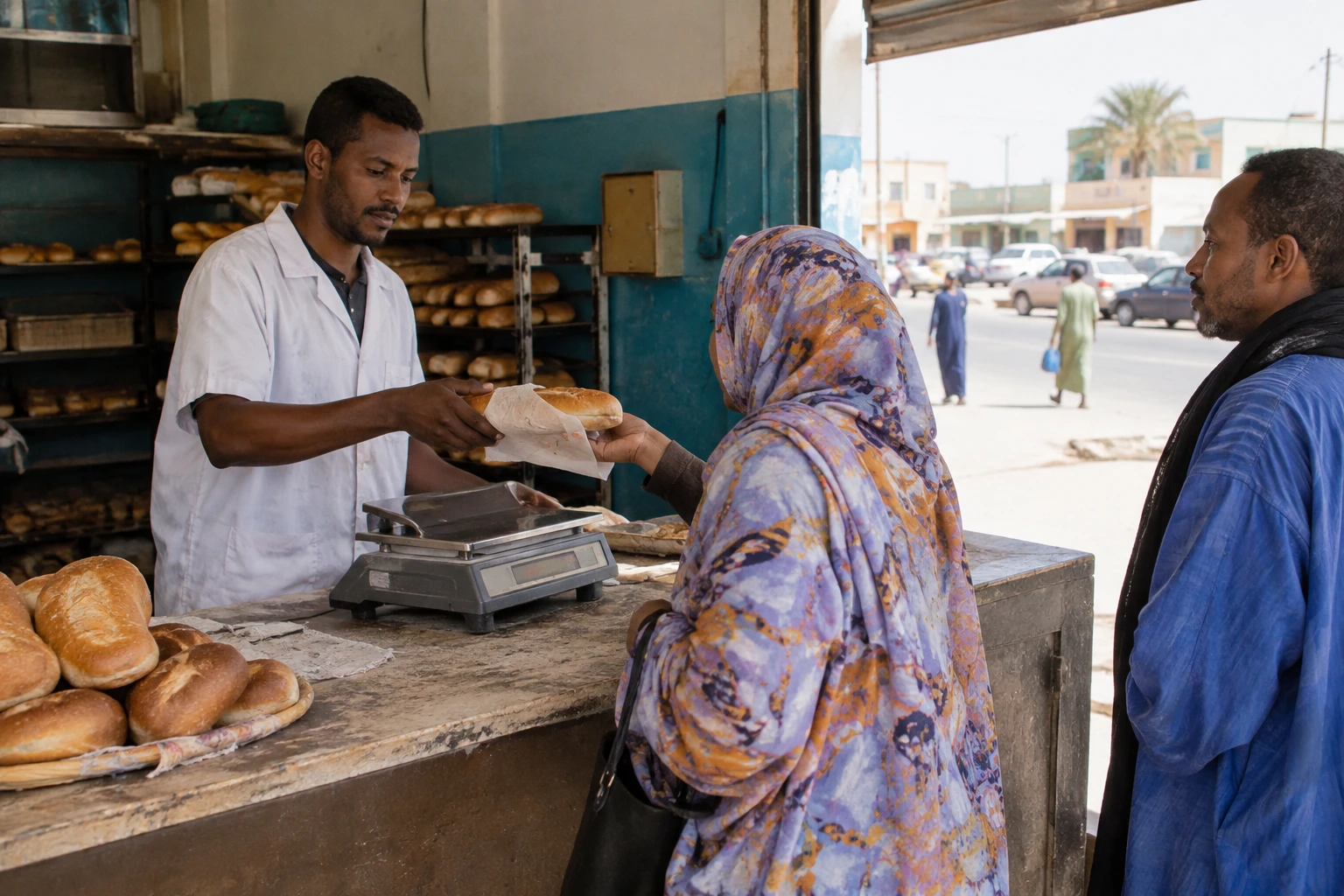
In Nouakchott, the price of bread is determined as much by the weight of each loaf as by trust in the prices displayed. On 1 November 2026, inspections led to the closure of 19 bakeries in the Mauritanian capital. But the authorities have not publicly detailed, for each establishment, the price rises identified or the evidence brought against the traders.
Inspections across Nouakchott’s three regions
The Ministry of Trade and Tourism says the inspections targeted speculation and monopolistic practices, as well as unjustified increases in bread prices. According to its tally, reported by several Mauritanian media outlets, 12 bakeries were closed in Nouakchott-Nord, four in Nouakchott-Sud and three in Nouakchott-Ouest. The ministry says inspections will continue.
The figures are confirmed by Info Plus and Rim Now, two Mauritanian media outlets. However, the official statement, as reported by them, specifies neither the prices found at each bakery nor how long the closures will last. It therefore does not, on its own, make it possible to assess the scale of the alleged offences.
Following discussions between the Ministry of Trade, the Ministry of Mines and Industry, and the Federation of Bakeries, the latter pledged to comply with the prices in force and put an end to the practices denounced by the authorities. That pledge has not closed the debate: industry representatives had previously disputed the interpretation of new bread offerings and maintained that the agreed price was still being applied.
Prices, weight and rules: points that need clarifying
The debate concerns both the amount paid and the product sold. A larger or different loaf cannot be directly compared with a baguette if its weight and composition vary. In 2026, a government circular set national rules for the production and distribution of bread. It provides, among other things, for a minimum weight of 210 grams for hot bread, with a 5% margin of error, and reference prices of 8.5 new ouguiyas wholesale and 10 new ouguiyas retail, according to Madar.
These rules provide a framework for inspectors and consumers. They also make precise information essential: the applicable price, weight, type of bread and any difference between wholesale and retail sales. Without these details, customers can scarcely verify a price increase, while bakers risk having any new offering treated as an offence.
The accounts given by the parties should therefore be distinguished. The ministry presents the closures as penalties for abuses. For its part, the Federation said amid the controversy that some bakeries were offering a different type of bread, without seeking to change the price of the baguette. The available sources do not establish that this explanation applies to each of the 19 bakeries closed on 1 November.
A measure affecting households and small businesses
For households, a change in the price or weight of bread directly affects everyday spending. The impact can be particularly acute when people buy bread daily and in small quantities. Consumers need clear prices and consistent inspections, not just announcements of penalties.
Bakeries, meanwhile, must comply with the rules while covering their production and distribution costs. The ministry has not published, in the information available, data on these costs or on the conditions for reopening the closed establishments. It would therefore be premature to attribute the tensions to a single factor or assess their effect on supplies to the capital.
The Mauritanian Federation of Bakeries and Pastry Shops is a professional organisation established in Nouakchott in 1991 and affiliated with the National Union of Mauritanian Employers, according to the UNPM’s profile. Its role in discussions with the state is central: an agreement on prices will only be lasting if professionals understand the rules and customers can verify them.
A regulatory issue beyond the capital
The decision concerns Nouakchott, but the announced regulatory framework applies across Mauritania. What happens next will therefore depend on how inspections are conducted in other cities and regions, and on whether information is published that allows comparisons of the prices and weights actually being applied.
Mauritania belongs to the Arab Maghreb Union, but this case is primarily a matter of national policy on consumer protection and the regulation of trade. It illustrates a challenge shared by African states: enforcing prices or standards without needlessly jeopardising supplies or leaving consumers alone to contend with opaque prices.
In the short term, three things remain to be monitored: how long the closures last, the conditions for resuming operations and the publication of detailed inspection findings. Clear displays of weight and price, alongside accessible channels for complaints, would make it easier to distinguish a prohibited price increase from a different offering. For Mauritanians, this transparency will show whether the operation tangibly improves access to bread in Nouakchott.