Algeria
 Egypt
 Libya
 Morocco
 Sudan
 Tunisia
 Benin
 Burkina Faso
 Cabo Verde
 Côte d'Ivoire
 Ghana
 Guinea
 Guinea-Bissau
 Liberia
 Mali
 Mauritania
 Niger
 Nigeria
 Senegal
 Sierra Leone
 Togo
 Cameroon
 Central African Republic
 Chad
 DR Congo
 Equatorial Guinea
 Gabon
 Republic of the Congo
 São Tomé and Príncipe
 Burundi
 Comoros
 Djibouti
 Eritrea
 Ethiopia
 Kenya
 Madagascar
 Malawi
 Mauritius
 Mozambique
 Rwanda
 Seychelles
 Somalia
 South Sudan
 Tanzania
 Uganda
 Angola
 Botswana
 Eswatini
 Lesotho
 Namibia
 South Africa
 Zambia
 Zimbabwe

As betting moves to apps and digital payments, tax authorities can no longer rely solely on companies’ declarations. In The Gambia, a new contract is intended to give them more direct access to transactions in the online gambling sector. It remains to be seen how the data will be monitored and protected.
A reform that is part of the state’s digitalisation
In Banjul, the authorities have been seeking for several years to modernise the collection of public revenue. The Gambia has, among other initiatives, rolled out ASYCUDA World, a digital system for managing customs procedures. The tax administration is also testing electronic invoicing, which is intended to make it easier to verify companies’ declared sales. In October 2026, the government launched GovPay, a platform designed to centralise payments for public services and improve their accounting reconciliation.
These tools address the same challenge: better linking economic activity to the amounts declared and paid to the state. They do not all work in the same way, however. GovPay concerns payments owed to government bodies, while the gambling-related project targets transactions in a commercial sector subject to specific tax oversight.
The reform is also part of the 2023-2027 national development plan, which makes domestic revenue mobilisation a public priority. For the Gambian government, more verifiable revenue could help fund public services. But the impact will depend on the quality of the systems and their integration into the administration’s practices.
A trusted intermediary between operators and the administration
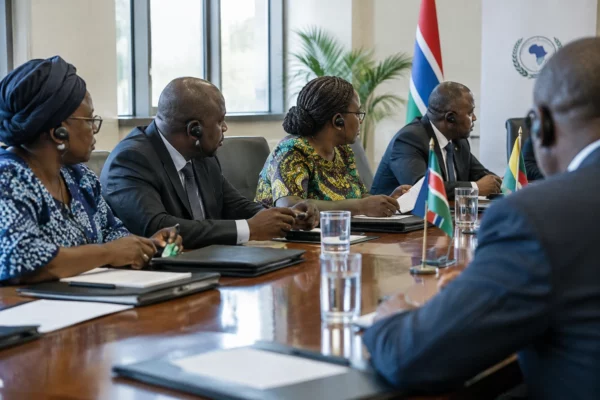
The Gambian Ministry of Finance and the tax administration signed a ten-year contract with InTouch, a Senegalese company specialising in payment solutions, in Banjul on 30 October 2026. The agreement, awarded after an international tender in which three companies reportedly took part, covers the monitoring of financial flows from gambling and betting operators. These details were reported by African Business and iBetAfrica.
The platform is intended to centralise information on transactions and payments, then enable real-time monitoring. Audit and alert functions are designed to help identify discrepancies between amounts received and those declared. InTouch will act as a technical intermediary between gambling companies and the administration. The system is therefore intended to supplement operators’ declarations with transaction data accessible to the authorities.
Finance Minister Seedy K. M. Keita described the agreement as a reform involving several government bodies. However, the published information specifies neither the commissioning date nor the technical arrangements for connecting operators, nor the detailed rules on data access and retention. It also makes no mention of a new tax or a change to the rules governing the payment of winnings.
Tax oversight will also depend on safeguards
For the authorities, the immediate benefit is the ability to compare recorded flows with declared revenue. Greater visibility could make audits easier and strengthen revenue forecasts. It could also reduce reliance on information produced solely by the companies themselves.
For operators, the platform will add another layer of monitoring to existing obligations. Its operation will need to be clear enough for companies to know what data to submit, on what timetable and what procedures to follow in the event of a disagreement. Players, meanwhile, are not directly covered by the announced contract. But the processing of payments raises questions about privacy and security that will need to be clarified before deployment.
Implementation is therefore about more than installing software. Different payment methods will need to be connected, data reliability ensured and staff trained to interpret the information. Discrepancies detected do not automatically prove fraud: they may also result from transmission errors, delays or differences in accounting classification. Verification and appeal procedures will be important to prevent decisions being based solely on automated alerts.
The Gambia has already made progress on several digital projects for the tax administration. In July 2026, the Gambia Revenue Authority announced the launch of an electronic invoicing pilot project. The Gambian media outlet The Point reports that this phase is intended to test the system with companies before a wider rollout. The contract with InTouch extends this shift, but applies it to a specific sector whose payments can pass through several digital channels.
A regional partnership to watch
The contract brings together a Gambian administration and a Senegal-based company. It illustrates the spread of digital solutions between West African countries, rather than exclusive reliance on providers from outside the continent. For InTouch, its presence in The Gambia marks an entry into an English-speaking market, according to information published around the signing.
Regional cooperation does not, however, guarantee interoperability between systems. Tax rules, payment methods and data protection requirements remain defined at national level. Within ECOWAS, the Economic Community of West African States, the growth of digital payments nevertheless makes transaction monitoring a relevant issue beyond The Gambia’s borders.
The contract’s significance will therefore be measured less by its duration than by its tangible results: launch date, number of operators connected, reliability of reconciliations and changes in revenue actually collected. For now, announcements describe the planned functions but do not make it possible to assess their effectiveness. The next step will be to see how the administration reports these results and what safeguards govern the use of the data.