Algeria
 Egypt
 Libya
 Morocco
 Sudan
 Tunisia
 Benin
 Burkina Faso
 Cabo Verde
 Côte d'Ivoire
 Ghana
 Guinea
 Guinea-Bissau
 Liberia
 Mali
 Mauritania
 Niger
 Nigeria
 Senegal
 Sierra Leone
 The Gambia
 Togo
 Cameroon
 Central African Republic
 Chad
 DR Congo
 Equatorial Guinea
 Gabon
 Republic of the Congo
 São Tomé and Príncipe
 Burundi
 Comoros
 Djibouti
 Eritrea
 Ethiopia
 Kenya
 Madagascar
 Malawi
 Mauritius
 Mozambique
 Rwanda
 Seychelles
 South Sudan
 Tanzania
 Uganda
 Angola
 Botswana
 Eswatini
 Lesotho
 Namibia
 South Africa
 Zambia
 Zimbabwe
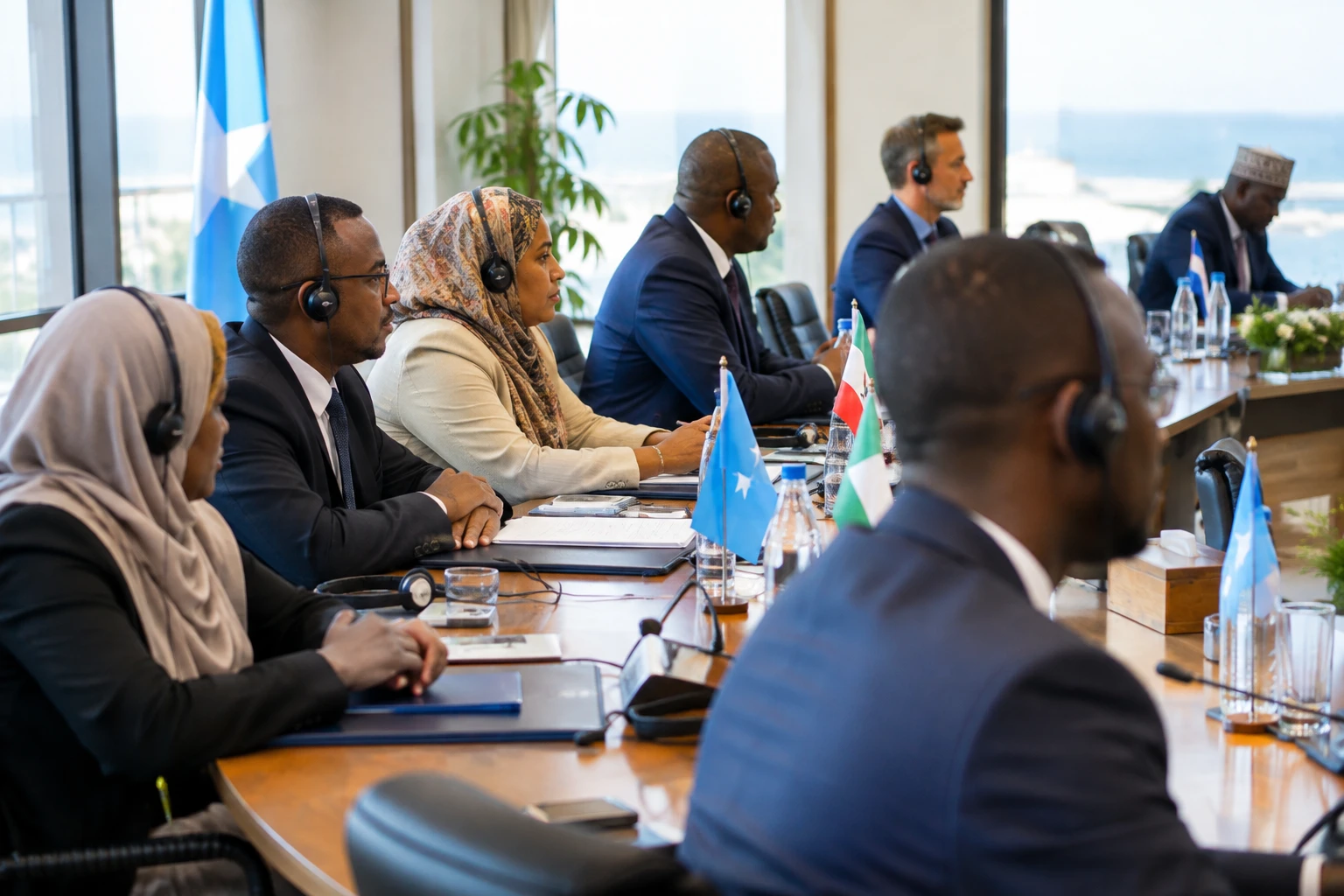
Can an exchange of ambassadors change the status of a territory that most states continue to regard as Somali? In Hargeisa, a ceremony held in late October between Israel and Somaliland gives concrete form to a diplomatic rupture already contested by Mogadishu.
Diplomatic relations take shape
Michael Lotem presented his credentials to Somaliland President Abdirahman Mohamed Abdullahi at the presidential palace in Hargeisa. Israel’s foreign ministry announced the ceremony on Sunday 1 November. The authorities also laid the foundation stone for a future Israeli embassy building, according to reports published in Hargeisa and Mogadishu.
The move follows Israel’s recognition of Somaliland on 26 December 2025. Israel thus became the first UN member state to officially recognise the independence claimed by the territory. It broke away from Somalia in 1991 and has since had its own institutions. Mogadishu, however, considers it an integral part of the Federal Republic of Somalia.
The two sides had already exchanged representatives. Somaliland opened an embassy in Jerusalem in June, following a visit to Israel by its president. Israel’s foreign minister, Gideon Sa’ar, visited Hargeisa in January. Lotem’s accreditation and the embassy project now give the relationship greater continuity. The African news agency APA reported Lotem’s appointment in April.
For Somaliland’s presidency, this step reflects cooperation expected to span several sectors, including trade, infrastructure, security and technology. The territory has sought international recognition for decades, while Israel presents the diplomatic exchange as the implementation of their mutual recognition agreement.
Somali sovereignty at the heart of the dispute
In Mogadishu, the federal government rejects the move. It argues that a foreign state cannot establish diplomatic relations with Somaliland without the consent of the Somali authorities. In April, when the appointment was announced, Somalia’s foreign ministry described the decision as an infringement of the country’s unity and territorial integrity. The late-October ceremony therefore does not resolve the dispute: it makes visible the deepening of a relationship contested by Somalia.
The two governments’ positions rest on distinct realities. Somaliland has administered its territory for more than three decades and asserts its right to conduct foreign relations. Somalia, for its part, points to the international recognition of its borders and the principle of territorial integrity. The disagreement is thus about the territory’s status, but also about whether its authorities have the competence to conduct their own diplomacy.
The issue extends beyond the two capitals. The Intergovernmental Authority on Development, or IGAD — an East African regional organisation — reaffirmed its support for Somalia’s unity and sovereignty on 27 December 2025. It called for dialogue and inclusive political processes to be prioritised. The African Union Commission has also opposed Israel’s recognition and reiterated its support for Somalia’s territorial integrity.
A strategic location, with interests yet to be established
Geography gives this rapprochement particular significance. Somaliland borders the Gulf of Aden, across from Yemen, near the sea routes linking the Indian Ocean to the Red Sea. The Bab el-Mandeb strait, at the Red Sea’s southern entrance, is a major trade passage. Somaliland’s presidency presents this location as an asset for regional co-operation and security.
Somali President Hassan Sheikh Mohamud, for his part, has raised the possibility that Israel is seeking military or naval access to the territory. This claim should remain attributed: the facts announced at the ceremony do not establish that an Israeli naval base exists. Public statements by Israel highlight broader co-operation, particularly in security, defence, trade and technology. They are not enough to confirm a specific military project.
For residents, the effects will depend less on ceremonies than on the agreements that follow. Trade partnerships or infrastructure projects could create economic activity and jobs. Conversely, deeper security co-operation, if it materialised, could further strain relations between Hargeisa and Mogadishu. At this stage, official announcements do not make it possible to assess the impact on communities, or to know which projects will be funded and on what terms.
A test for regional diplomacy
The exchange of ambassadors also puts African institutions in a delicate position. They must take account of Hargeisa’s claim to autonomy and Somalia’s recognised sovereignty, while preventing a diplomatic escalation from complicating regional co-operation. IGAD and the African Union advocate dialogue, but their position does not, by itself, alter the bilateral relationship between Israel and Somaliland.
The next step will be to see whether the announced embassy actually opens and whether the two partners formalise concrete agreements. Mogadishu’s response and the positions taken by IGAD and the African Union will also need to be followed. For East Africa, the stakes are twofold: to preserve stability around an essential sea route and to prevent rivalry over Somaliland’s status from further narrowing the space for negotiation among Somalis.