
 Algeria
 Egypt
 Libya
 Morocco
 Sudan
 Tunisia
 Benin
 Burkina Faso
 Cabo Verde
 Côte d'Ivoire
 Ghana
 Guinea
 Guinea-Bissau
 Liberia
 Mali
 Mauritania
 Niger
 Nigeria
 Senegal
 Sierra Leone
 The Gambia
 Togo
 Cameroon
 Central African Republic
 Chad
 DR Congo
 Equatorial Guinea
 Gabon
 Republic of the Congo
 São Tomé and Príncipe
 Burundi
 Comoros
 Djibouti
 Eritrea
 Ethiopia
 Kenya
 Madagascar
 Malawi
 Mauritius
 Mozambique
 Rwanda
 Seychelles
 Somalia
 South Sudan
 Tanzania
 Uganda
 Angola
 Botswana
 Eswatini
 Lesotho
 Namibia
 Zambia
 Zimbabwe
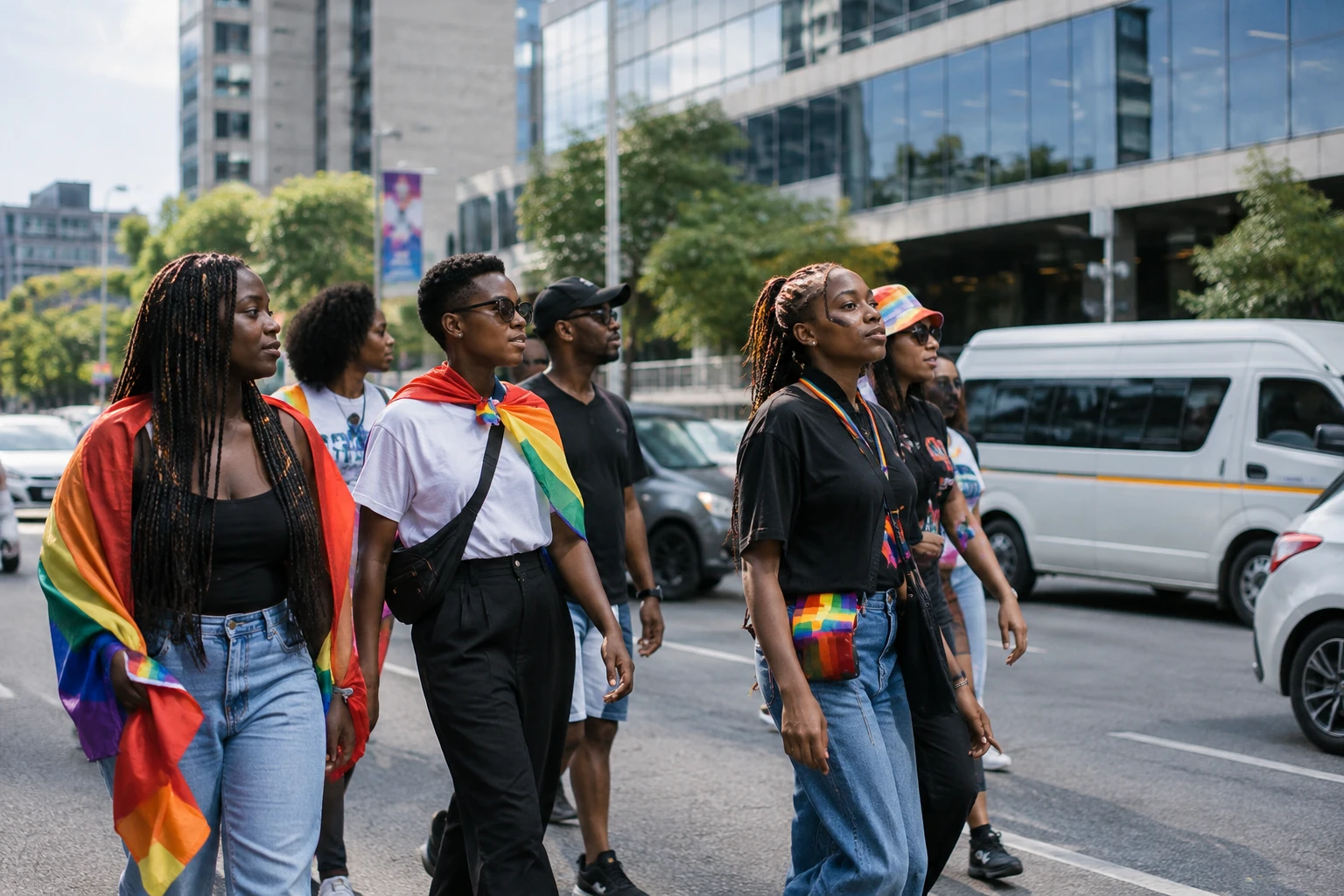
In Sandton, Johannesburg’s business district, Pride is more than a day of celebration. It makes visible a freedom enshrined in South African law, but one that is still experienced unevenly. On 26 October 2024, thousands joined the march marking 35 years of Johannesburg Pride, combining celebration with calls for change.
A history of visibility born before democracy
The first Pride march in Johannesburg dates back to 1990, before apartheid had ended. This history gives the event particular significance: the struggle against discrimination based on sexual orientation forms part of a broader journey towards rights and dignity.
South Africa’s 1996 Constitution prohibits unfair discrimination on grounds including sexual orientation. In 2006, South Africa became the first country on the continent to allow civil marriage for same-sex couples. These legal protections set the country apart in a region where protections and practices vary.
But legislation does not solve everything. LGBTQ+ people continue to face discrimination and violence. Pride thus highlights the possible gap between the rights recognised by institutions and the sense of safety people experience in everyday life.
In Sandton, the celebration also carries a message
On Saturday 26 October, Sandton’s streets filled with rainbow flags, costumes and placards. Attendance estimates published by the media vary: some report hundreds of marchers, others thousands. The exact figure has therefore not been consistently established.
For Patrick Smit-Stachowski, who has attended the marches since the 1990s, support for transgender people was at the heart of his participation that year. He said he wanted to draw attention to what he sees as the erosion of rights in several countries. This concern extends beyond South Africa’s borders, although legal and political frameworks differ from one state to another.
Queer activist Noxolo Maseko described Pride as a rare space in which to celebrate her identity openly. Her remarks also point to a regional dimension: for people living in countries where expressing their identity can expose them to sanctions or violence, public visibility remains a tangible issue.
Strong rights on paper, contrasting realities
In South Africa, constitutional protections give people concerned access to remedies that many other countries do not guarantee. Across the continent, however, laws are not moving in a single direction. Rights groups continue to identify many countries where consensual same-sex relations between adults are criminalised. Situations change as national laws and decisions evolve, so Africa should not be presented as a uniform whole.
This diversity is also found within the country. A large march in the heart of the business district provides a prominent platform and visibility. It does not, on its own, represent the experience of all LGBTQ+ people in South Africa. Community resources, access to services and levels of safety can vary between neighbourhoods, cities and rural areas.
The issue also concerns the place of transgender people, whose experiences and needs are not the same as those of LGBTQ+ people as a whole. By taking part in the march, Smit-Stachowski sought to highlight this reality. Visibility provides symbolic support, but it cannot replace protection from violence or effective access to rights.
An event with resonance across Southern Africa
Johannesburg Pride is part of a regional dynamic, but does not by itself represent the debates across Southern Africa. The Southern African Development Community (SADC), a cooperation organisation for countries in the region, brings together states with different legal frameworks. South Africa’s progress therefore coexists with varied national situations, some of them contested.
Across the continent, the event is a reminder that rights enshrined in a constitution, their enforcement and their social acceptance are three distinct issues. It also highlights the solidarity activists build across borders, while recognising that each society has its own contexts and debates.
The 2024 march thus carried two messages at once: a celebration of long-standing gains and a reminder that effective protection remains a work in progress. For South African authorities, the challenge is not limited to guaranteeing the right to demonstrate. It also concerns institutions’ ability to uphold equality in everyday life, in Johannesburg and across the country’s other regions.



