Algeria
 Egypt
 Libya
 Morocco
 Sudan
 Tunisia
 Benin
 Burkina Faso
 Cabo Verde
 Côte d'Ivoire
 Ghana
 Guinea
 Guinea-Bissau
 Liberia
 Mali
 Mauritania
 Niger
 Nigeria
 Senegal
 Sierra Leone
 The Gambia
 Cameroon
 Central African Republic
 Chad
 DR Congo
 Equatorial Guinea
 Gabon
 Republic of the Congo
 São Tomé and Príncipe
 Burundi
 Comoros
 Djibouti
 Eritrea
 Ethiopia
 Kenya
 Madagascar
 Malawi
 Mauritius
 Mozambique
 Rwanda
 Seychelles
 Somalia
 South Sudan
 Tanzania
 Uganda
 Angola
 Botswana
 Eswatini
 Lesotho
 Namibia
 South Africa
 Zambia
 Zimbabwe
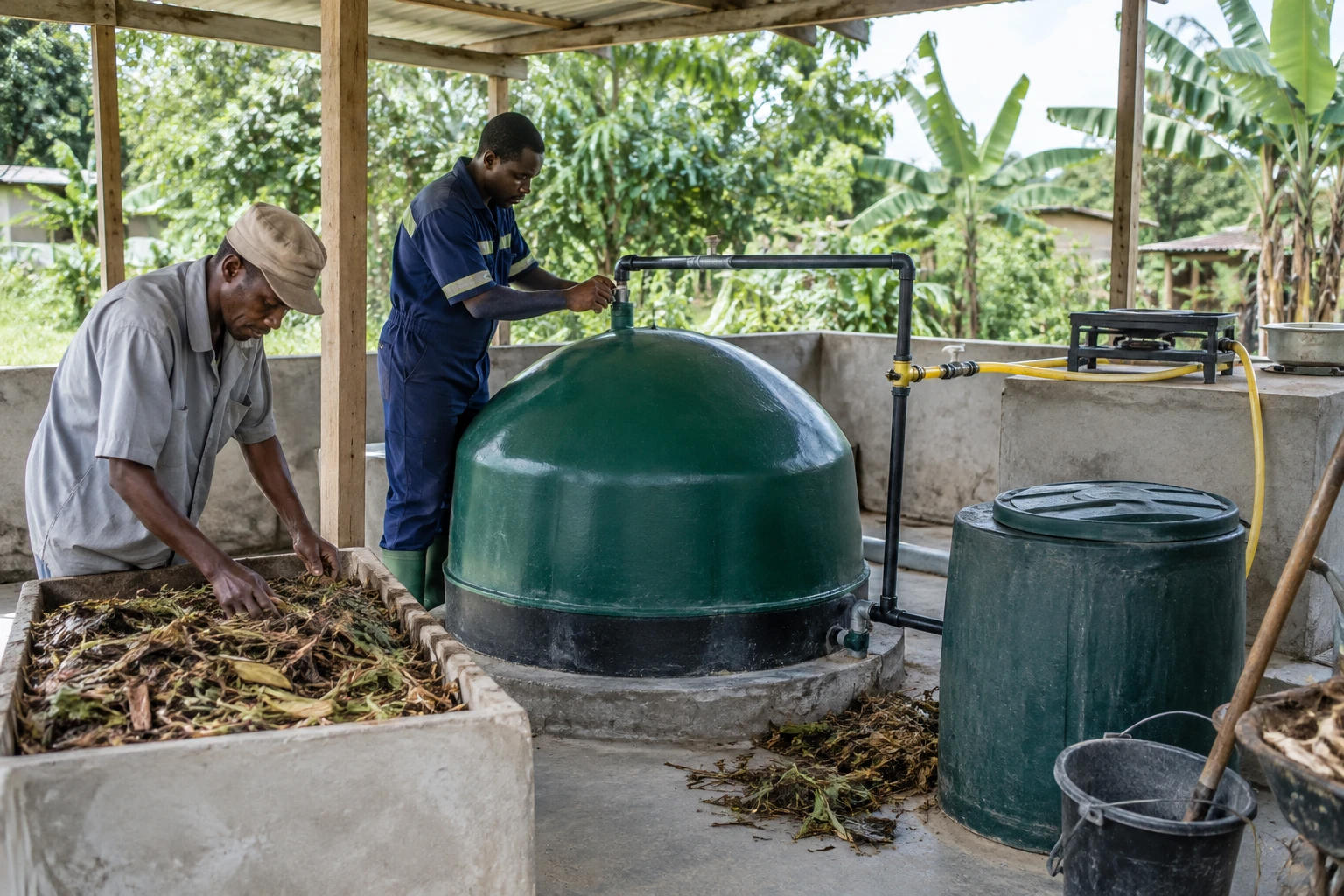
In Togo, turning agricultural residues and household waste into energy and fertiliser could help address two very practical challenges: making better use of organic matter and diversifying cooking options. But the ambition set for 2030 will depend less on the headline target than on the capacity to fund, install and maintain each unit.
A national ambition within a regional effort
In Lomé, representatives of the West and Central African Biodigester Alliance (AB-AOC) met in late October 2026 to discuss its 2026-2030 strategic plan. The intergovernmental organisation brings together eight countries, including Togo, and aims to structure the biodigester market in the sub-region. Its plan calls for 50,000 new installations across the region by 2030. Togo’s target would account for one-tenth of that total. The report on the regional meeting in Lomé confirms that discussions focused on implementing this roadmap.
A biodigester processes organic matter — such as animal manure, crop residues or kitchen scraps — through fermentation in the absence of oxygen. It produces biogas, which can be used for cooking, among other purposes, as well as a by-product called digestate, which can be used as a soil amendment. The result, however, depends on the unit functioning properly and on a regular supply of feedstock.
For Togo, this sector forms part of a broader energy strategy. The country has committed to expanding access to electricity by 2030 and is also focusing on distributed renewable energy and clean cooking solutions. These are systems that can be used locally, outside major networks. The National Energy Compact adopted in September 2025 sets out these priorities, while recognising the expected role of public and private investment.
From 140 installations to a target of 5,000
Togo currently has 140 biodigesters, according to information shared at the AB-AOC meeting in Lomé and reported by Togolese media. More than two-thirds are said to have been installed between 2020 and 2023. Nearly half are reportedly in the Maritime Region and about a quarter in the Savanes Region. These figures indicate that installations remain limited and unevenly distributed; on their own, they do not show how many units are still operational.
The planned programme aims to install 5,000 units in Togo by 2030. This would increase the reported number of biodigesters more than 35-fold in a few years. Alliance chair Malick Gaye said the country had begun developing the technology and that a programme was targeting these 5,000 installations. At this stage, however, funding for the rollout still needs to be secured. The figure is therefore an announced target, not a fully funded installation schedule.
This distinction matters. A national target included in a roadmap guarantees neither the necessary funding nor the sustained operation of the equipment. Governments, local authorities, financial partners and operators will need to clarify who pays for construction, who supports households and producers, and who responds when a biodigester breaks down.
Benefits will depend on everyday use
On farms, biogas can provide a local source of energy, while digestate can return some nutrients to the soil. For households, gas can complement or replace some traditional fuels, provided the unit is suited to their needs and supplied with enough feedstock. The benefits will therefore vary: they will depend on livestock practices, crops, household size and access to technical services.
An initiative launched in Kpalimé in March 2026 illustrates a possible local approach. The EcoFemmes project aims to support 130 rural women in organic farming and biogas production, with funding of more than 52 million CFA francs announced by the International Organisation of La Francophonie. It also includes training in the construction of biodigesters and the production of biofertilisers. The project offers a concrete example of the link between energy and agriculture, but its scale is distinct from that of the national programme. Details of the EcoFemmes project in Kpalimé set out its beneficiaries and funding.
For these solutions to remain useful over time, technicians will need to be trained and available beyond major centres, spare-parts supply organised and affordable maintenance provided. Upfront costs may also deter rural households and small farms, even where future savings are possible. Suitable financing mechanisms and monitoring of equipment that is actually working will therefore be just as important as the number of units built.
A test for regional energy cooperation
The AB-AOC aims to install 50,000 new biodigesters in its member countries by 2030 and develop a regional market. For Togo to contribute to this target, it will need to coordinate national policies with regional stakeholders while adapting equipment to local conditions. Supply chains, construction skills and maintenance models could benefit from this cooperation; results will nevertheless depend on implementation in each country.
The next milestones will be the effective mobilisation of funding, the publication of a Togolese timetable and the monitoring of installations by region. It will also be necessary to distinguish between units that have simply been built and those that are actually supplying gas and fertiliser. Only then can the target of 5,000 translate into a useful service for households and producers, rather than remain a programme figure.