
 Algeria
 Egypt
 Libya
 Morocco
 Sudan
 Tunisia
 Benin
 Burkina Faso
 Cabo Verde
 Côte d'Ivoire
 Ghana
 Guinea
 Guinea-Bissau
 Liberia
 Mali
 Mauritania
 Niger
 Nigeria
 Senegal
 Sierra Leone
 The Gambia
 Togo
 Central African Republic
 Chad
 DR Congo
 Equatorial Guinea
 Gabon
 Republic of the Congo
 São Tomé and Príncipe
 Burundi
 Comoros
 Djibouti
 Eritrea
 Ethiopia
 Kenya
 Madagascar
 Malawi
 Mauritius
 Mozambique
 Rwanda
 Seychelles
 Somalia
 South Sudan
 Tanzania
 Uganda
 Angola
 Botswana
 Eswatini
 Lesotho
 Namibia
 South Africa
 Zambia
 Zimbabwe
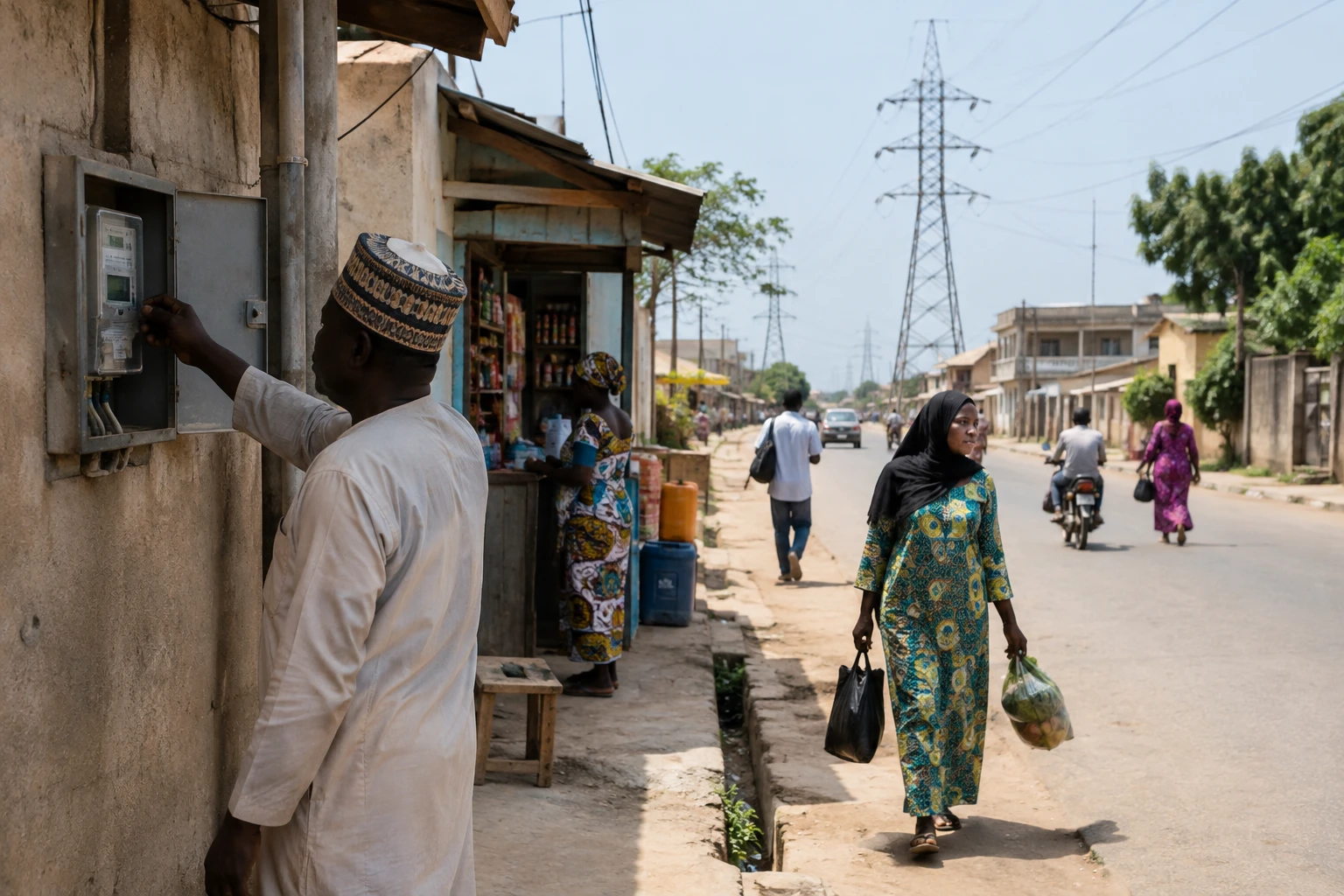
A high-voltage line is more than pylons strung between two borders. For Cameroon and Chad, it must also enable regular electricity exchanges, backed by commercial rules, compatible networks and sufficient financing. The joint project is now progressing in stages, while its timetable and cost remain to be clarified.
A regional project scaled back
The Cameroon–Chad Electricity Grid Interconnection Project (PIRECT) is intended to link the two networks and support energy exchanges in Central Africa. Approved in 2017, it forms part of a broader goal: to improve access to electricity and electrify communities along the corridor. Originally, the programme envisaged around 1,024 kilometres of high-voltage lines across the two countries. The African Development Bank’s presentation of the project also sets out its regional dimension and electrification goals.
Cameroon belongs to the Economic Community of Central African States (ECCAS), which supports regional integration. Chad is also a member. Electricity generated in one country can therefore help supply the other, but only if the lines, substations and commercial agreements work together. The project is thus both bilateral infrastructure and a practical test of regional energy cooperation.
The project’s course has nevertheless changed. In November 2025, Cameroon’s Minister of Water Resources and Energy, Gaston Eloundou Essomba, told MPs that there was a funding shortfall of CFAF 287 billion for the cross-border component: CFAF 150 billion for Cameroon and CFAF 137 billion for Chad. The figure appears in a ministry briefing and was also reported by Sika Finance.
A first phase, but funding is not yet secured
To adapt the project to available resources, the joint technical committee selected the so-called “2-bis” option on 7 August 2025, which envisages implementation in several phases. Cameroon’s ministry confirmed this approach in its briefing on the energy sector. The idea is to start with the equipment needed for an initial commissioning, rather than wait until funding for the entire programme is in place.
Following an assessment mission by the African Development Bank (AfDB) from 12 to 16 October 2026, the Cameroonian project team presented an estimate of €221.3 million, or about CFAF 145.2 billion, for the first phase of the Cameroonian component. It includes 426 kilometres of 225-kilovolt lines, the Garoua II substation and extensions to those at Wouro-Soua and Maroua. The stated aim is to enable 100 megawatts of power to be transmitted to Chad by 2030.
This figure is an estimate for the scaled-down scope. It is not an announcement of new funding approved by the AfDB. Nor does it make it possible to recalculate the 2025 shortfall: one figure is the estimated cost of a reduced phase, while the other is an additional funding need for the cross-border component. The available information does not detail how much has already been covered or how costs are divided among the works.
Some technical details also need clarification. Tender documents published in August covered 419.6 kilometres of lines on the Cameroonian side, 6.4 kilometres less than the estimate presented in October. In addition, the Kousséri substation appeared as a conditional tranche in the tender documents but is not among the substations explicitly mentioned in the new presentation. It remains to be clarified whether it is included in the budget or deferred to a later phase.
The timetable still depends on formal decisions
Procurement procedures have begun, but the contracts do not mean that work can start immediately. Companies have until 18 November 2026 to submit bids for the substations and until 19 November for the lines. Documents from Cameroon’s National Electricity Transmission Company (Sonatrel), the country’s transmission system operator, provide for 34 months of work after contracts are signed.
Meanwhile, the TchadElec implementation unit says formal approval of the restructuring is still required before contracts can be signed. A mission involving the AfDB, Chadian authorities and the consulting engineer, among others, took place in N’Djamena from 19 to 23 October to prepare the restructuring report and update the timetable. The Chadian project unit’s communication says that financing conditions, environmental and social measures, and procurement arrangements were also among the issues examined.
This sequence leaves the commissioning date uncertain. At the end of 2025, the Cameroonian government was considering the end of 2028 for the first phase. The target for transmitting 100 megawatts is now set for 2030. The 34-month period after signature, combined with the approval still awaited, explains why the original end-2027 timetable appears difficult to meet. An analysis by Investir au Cameroun had already highlighted the gap between the contractual deadlines envisaged and that target.
Expected benefits extend beyond the two capitals
For public institutions and state-owned companies, the challenge is to coordinate infrastructure, power-sale contracts and transmission rules. Commercial operations must involve the Cameroon Electricity Company (Socadel), TchadElec and Sonatrel. Without an operational agreement on volumes, tariffs and incident management, a completed line alone cannot guarantee reliable exchanges.
For residents and economic activity, the benefits will also depend on local networks. Transmission lines carry electricity over long distances; they do not automatically guarantee a connection in every municipality they cross. The original project included rural electrification initiatives, but progress on the scaled-down phase will need to be monitored separately. Households, public services and small businesses will therefore not all benefit at the same pace from increased cross-border exchanges.
Across Central Africa, PIRECT highlights a central question: how can unevenly distributed resources and generation capacity be turned into more reliable electricity services, without leaving projects dependent on full funding that is impossible to secure quickly? The next milestone will not simply be the signing of contracts. It will also be necessary to verify approval of the restructuring, the final scope of the works, revised deadlines and the commercial terms for electricity exported to Chad.



